Shop By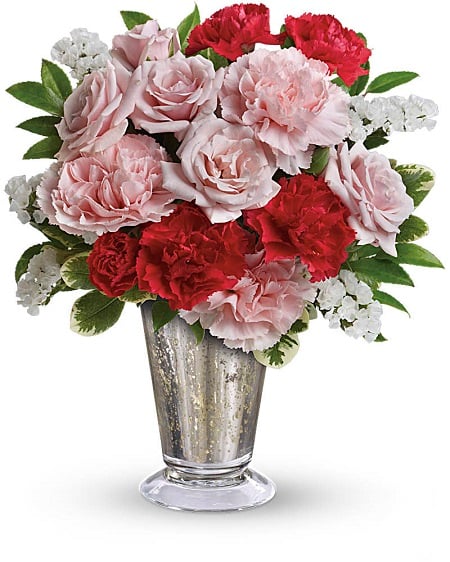
White is what people reach for when somebody is having a terrible time. Tasteful, restrained, respectful, nothing that shouts. In the one study that put flower color against brain activity and heart rate, white was the only color that moved nothing at all. Red and yellow shifted both. And lilies, the other thing people reach for when a situation feels serious, came out worst of every flower tested for tension and anxiety.
Which is a strange way to open an article about flowers and mental health, except that it is the whole problem in one paragraph. Most of us choose on taste and hope the flowers do something. There is now a small pile of research on whether they do, and the answers keep failing to line up with the instincts.
Humans have been at this a long time either way. In a cave in northern Iraq, archaeologists excavating a Neanderthal burial found flower pollen packed into the soil around a body that had been in the ground for sixty thousand years, and the interpretation was immediate and irresistible: somebody put flowers next to their dead. The decades since have been spent picking it apart. Rodents cache seed heads. Solitary bees leave pollen in burrows. What nobody disputes is how fast the story landed, in every language it was translated into, because putting flowers next to grief is something people recognize without being taught it.
Most people do not arrive at an article like this out of curiosity. They arrive because somebody they care about is having a terrible time, they are a long way away or simply out of ideas, and they are trying to work out whether a bouquet is a real thing to do or a way of looking like they did something. If that is roughly where you are: the flowers will not fix it. You already know that. It is also not a reason to skip them, and the rest of this piece is my attempt to work out where the line between those two sits.
I have been in the flower business long enough to be suspicious of stories like the one about the cave. Everyone in this industry has a version of it. We tell them at trade shows and we tell them on our own websites, and they are all moving and none of them prove anything. So when Andrew sent me a stack of research on flowers and mental health and asked me to write something about it, my first thought was that this would turn into another one of those articles. Big claims, thin evidence, a shop button at the bottom.
It did not, and the reason it did not is that the research is more interesting than the marketing. Some of it is weak, and I have ranked it below so you can see which parts. One or two pieces are genuinely strong, and the strong parts are not the parts a florist would choose. Nobody in a marketing meeting picks a study about postoperative painkiller consumption as the headline. That study is the best thing in the file.
I will be honest about the other side of it too. I own a flower company. You should read everything below with that in mind, which is exactly why every claim in here is attached to a named study, why the caveats run longer than most of the sections before them, and why the two findings that most inconvenience us are both in the first screen.
This article discusses general wellbeing research. Nothing in it is medical advice, and nothing in it should be read as treatment for a mental health condition. If you are struggling, or you are worried about someone, a qualified professional is the right first call. Flowers are a good thing to send afterward.
The psychology of receiving flowers, starting in an elevator
The most quoted work in this field is also the easiest to test on a Tuesday.
In 2005 a team led by Jeannette Haviland-Jones ran three experiments that have been getting cited ever since.1 In the first, women were given a fresh bouquet. Every single one produced what psychologists call a Duchenne smile, the kind that engages the muscles around the eyes and is very hard to fake on command. Not most of them. All of them, within seconds. Three days later, the women who had received flowers were still reporting better mood than the women who had not.
The second experiment is the one I keep coming back to. Researchers rode elevators and handed people either a single flower, a pen, or nothing at all. The people given a flower stood closer to strangers, made more eye contact, and started more conversations. The people given a pen behaved like people in an elevator.
That pen is important, and I come back to it in the caveats. The proposed explanation is that flowers prime the circuitry we use for approach and affiliation, with oxytocin and related pathways doing the work, which would explain why the effect showed up in how people treated strangers, not only in how they rated their own mood. Nobody has measured that directly in a flower study, so treat the mechanism as a hypothesis and the behavior as the finding.
The third experiment is the one almost nobody quotes, and it is the most interesting of the set.
Roughly a hundred adults averaging around seventy-three years old received flowers over several weeks. They scored higher on positive mood than controls. Expected. They also scored better on episodic memory, the recall of specific personal events. Nobody expected that one.1 The researchers reported being hugged, kissed and sent thank-you notes, some with photographs of the bouquet attached. None of that is evidence of anything, and all of it is worth knowing anyway.
For anyone sending to a parent or a grandparent, that memory finding is the most practically useful sentence in the entire literature, and it is buried in study three of a paper everyone cites for study one.
Bench since 1988
On the phones since 2018
I take that call most weeks. Somebody rings up and the first thing out of their mouth is an apology for not having a reason. No birthday, nobody sick, nothing happened. They want to know if that is allowed.
It is the easiest call I get. You do not need an occasion. The flowers are the occasion. And the ones who ring back a month later to do it again are almost always the ones who started small, because a small vase does not put the recipient in a position where they have to work out what it means.
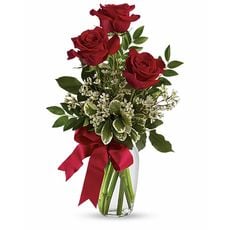
Thinking Of You
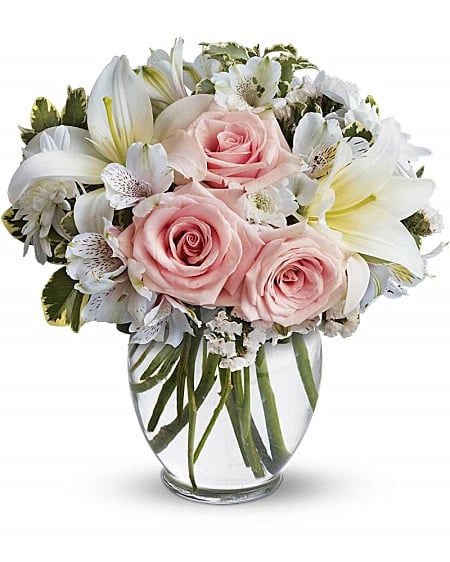
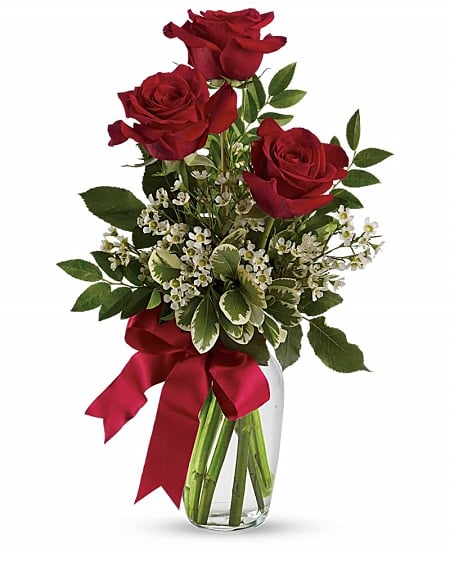
$59.99 · Three roses in a glass vase · 5 to 7 daysThree red roses, a plain cylinder vase, a red ribbon at the neck. The scale is the point. It fits on a bedside table or a desk without anyone needing to find a second pair of hands, and it is small enough that nobody feels like a declaration has been made. Red says care. It does not say love, and at this size that distinction is the whole product. If someone wants to test what the elevator study found without committing to a full bouquet, this is where I point them.
Send this one Or see the rest of the just because range.How flowers reach the brain: sight, scent, and touch
Three senses, three different roads, and one of them skips the queue.
Most sensory information takes a detour through the thalamus before it reaches the parts of the brain that handle emotion. Smell does not. Odor molecules hit the olfactory bulb and the signal goes more or less directly to the amygdala and hippocampus, the structures that deal in feeling and memory. As the Harvard neuroscientist Venkatesh Murthy has put it, odors take a direct route to the limbic system.
Joan puts the same thing less formally. Freesia is the one she watches for on the phones: somebody describes an arrangement they want copied, cannot name a single flower in it, and then says it smelled like their grandmother's hallway. The scent is the only part they retained and it is the part they are actually ordering.
That shortcut is why a scent can drop you into a specific afternoon from twenty years ago before you have consciously identified what you are smelling. The same shortcut is probably why scent research on flowers produces stranger results than color research. In one Japanese study, twenty-six men were exposed to plum blossom fragrance while researchers recorded brain activity and mood.2 Their sympathetic nervous activity went up, not down. Heart rate rose. And yet on the mood questionnaires they reported feeling more energetic and less depressed. Relaxation was not what the scent produced. Alertness was.
The same flower reaches your brain by three different roads
The teal path is the short one. Scent skips the thalamic relay that sight and touch pass through, which is why a fragrance can reach the emotional and memory structures before you have identified what you are smelling.
The touch route gets the least attention and may be the most useful, because it is the only one the recipient controls. Across this literature, the studies reporting the largest effects are consistently the ones where people are doing something with plants instead of looking at them. Arranging. Trimming. Repotting. Changing water. Gardening.
That pattern shows up in the horticultural therapy reviews and it shows up in the arranging trials, and it changes what a thoughtful gift looks like. A bouquet that arrives finished asks nothing of the recipient. A bouquet with a few stems too many, or a plant that needs a drink on Thursday, hands them a small repeated task at a time when small repeated tasks are exactly what a person can manage. Nobody has run the trial that would prove that specific point, and I am flagging it as a reasonable inference and not a result.
Can flower color reduce stress? Sometimes, and not white
The one study here that changes what a florist would actually recommend.
In 2021 Xie and colleagues showed fifty adults arrangements in three colors: yellow, red, and white.4 While the participants looked, the researchers recorded brain activity and heart rate variability, one of the cleaner physiological readouts of whether the calming branch of your nervous system is engaged.
Red and yellow raised prefrontal alpha activity, associated with relaxation, and raised the parasympathetic component of heart rate variability. Participants also rated themselves as more relaxed and more cheerful. White, in the same setup, came out neutral.
I want to be careful here, because this is one lab study with a three minute exposure per color and a culturally specific sample, and color meaning travels badly between cultures. None of that makes it a rule. What it does is put a small, testable finding underneath something florists have said for decades without evidence, which is that white is a register, not a lift. White is what we build for services and for calm. If somebody wants their kitchen counter to change the temperature of their morning, white is not the color doing that job.
40,000 arrangements
Sympathy specialist
Callers ask me for something cheerful and then describe an all-white arrangement, and I do not argue with them. I ask where it is going to sit. Once somebody says the kitchen counter, they usually get there on their own.
Here is the part the color research does not cover, and I would not know it from a lab. A yellow cushion mum holds its color for close to two weeks. A red rose in a west-facing window fades to a dusky pink inside two afternoons. So the color that reads brightest on delivery day is not always the color still doing the job on Thursday. If it needs to last the week, that decision gets made at the wholesale market, not in the vase.
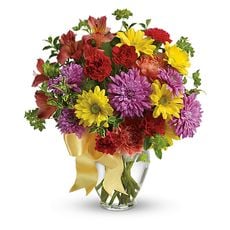
Mixed Color Bouquet
$59.99 · Ginger jar vase · 10 to 14 daysYellow cushion mums, deep purple pompons, red mini carnations, alstroemeria threaded through. No rose in this build and no lily, and both absences are deliberate. Those two stems are the most complaint-prone at this price: roses brown at the edges first, lilies drop pollen and carry heavy scent. What is left are three of the longest-lasting commercial stems available, and that is why this one still earns its counter space on day ten.
Send this one Or browse everything in yellow.A separate 2020 study had people view stressful images and then look at a photograph of flowers. Blood pressure and cortisol came down relative to a control condition, and imaging showed reduced activity in the right amygdala and hippocampus region.3 Note the detail that undercuts the sales pitch: those were photographs, not flowers in a vase.
Do flowers help patients heal faster? The ward evidence
Two trials measured things that cannot be talked up: medication use and length of stay.
Everything above this point measures mood, or a proxy for mood. Questionnaires, brain waves, self-reported relaxation. All of it is real and all of it is soft. Then you get to the hospital studies, and the outcome variables change character entirely.
Park and colleagues ran a randomized controlled trial with ninety patients recovering from abdominal surgery.7 Half the rooms had foliage and flowering plants in them. Half did not. Patients in the planted rooms used fewer painkillers, had lower blood pressure and heart rate, and reported significantly less pain, anxiety and fatigue.
Khan and colleagues did something similar at ward scale with 270 surgical patients across two wards, one with indoor plants and flower arrangements and one without.8 Shorter stays. Lower analgesic use. Lower pain scores. More positive reported emotion.
Neither study is airtight. You cannot blind a patient to whether there is a plant in the room, and Khan's ward assignment was not randomized, so systematic differences between the two wards are a live possibility. But painkiller consumption is recorded by a nurse in a chart, not reported by a participant who knows what the researcher is hoping for. That is a meaningfully harder outcome than a mood questionnaire, and it is why these two sit at the top of the pile.
Not all of this evidence is the same weight
Nine studies, ranked by how hard the outcome is to talk yourself into. Bar length reflects design strength: randomization, sample size, and whether the thing measured was objective or self-reported.
There is a second finding that belongs in this section even though it came out of a lab and not a ward, because it decides what actually goes in the box.
Wu and colleagues had thirty adults arrange five different flower types while recording brain activity and heart rate variability.6 Stocks and carnations produced the highest attention scores. Lilies produced the lowest attention and the highest tension and anxiety of anything tested. The study had no control group and the analysis was exploratory, so read it as a signal and not a verdict. It happens to be the same verdict every hospital florist in America reached independently, decades earlier, from the returns.
A rule sits inside the hospital findings that never makes it into the research and matters enormously to whoever is placing the order. A lot of wards will not accept flowers at all.
Hospital coordination
The call I hate is the one where the flowers made it to the building and then sat at a nurses' station because the floor does not take them. Oncology, transplant and intensive care are the ones we run into most often, and the rule varies hospital by hospital, and there is no national policy, so I cannot tell you from here what your floor does.
What we changed is that we now ask on hospital orders whether the ward has been checked, and we ask for a room number and a patient name as recorded at admission, not a nickname. Two questions. They catch most of it before the van leaves.
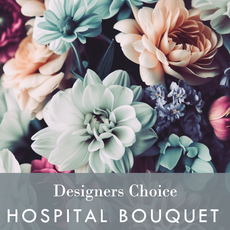
Designers Choice Hospital Bouquet
$51.99 · Hand-tied, built to a brief · 4 to 5 days in ward airThe word hospital on this one is a build specification, not a label. No lilies of any kind, the rule Wu's data landed on, and the rule the returns landed on decades earlier. Nothing heavy on fragrance. Modest enough in scale to sit on a rolling tray table without tipping. The honest part is the vase life: hospital air is dry and the lighting is unkind, so call it four or five days in the room. Most of the value lands afterward anyway, on a kitchen counter, once the patient is home.
Send this one Or compare the full hospital range, and the get well options for a home recovery.Flowers at a desk, and flowers in grief
Two settings the research treats very differently, and one of them it barely treats at all.
The desk
The workplace evidence is the quietest part of this file and possibly the most immediately usable. Healthcare workers given access to a plant-filled recharge room, a small space built with greenery and natural imagery, reported stress down by around 59% after a single session.9 Self-reported, single session, no long-term follow-up. Still, 59% is not a rounding error, and the room was a fixture. Nobody delivered it on a Tuesday.
The research file this article was built from carries an illustrative account of an office worker in his forties under sustained stress who started keeping a pot of violets and a vase of cut flowers on his desk. Within days he described himself as calmer and more focused, and put it like this: just looking at those blossoms makes me breathe deeper, I actually feel my shoulders relax. One anonymized person, and it proves nothing on its own. Also, almost word for word, what people say on the phone when they call to reorder for their own desk instead of somebody else's.
The commercial version of this is unglamorous. A standing weekly or fortnightly delivery to an office is the only format in this whole article that reproduces what the recharge room study actually tested, a permanent green fixture, not an event. If a fixture is the job, corporate arrangements are the right shelf, and the long-life build below is the right recipe.
The grief
Here is the honest position, and it is not the one you would expect from a florist. There is almost no controlled research on flowers in bereavement. None of the nine studies here tested it. What exists is anthropological, historical, and about sixty thousand years old if the Shanidar pollen holds up. Everything else is craft knowledge.
Which means this section rests on Joan and not on a citation. I would sooner label that clearly than dress it up.
Sympathy specialist
Greensboro, 1988 to 2018
A woman walks in and cannot finish her sentence, you do not ask what the occasion is. You already know. Thirty years of funeral weeks, twenty or thirty sprays between Monday and Friday, and every one of them mattered to somebody who was barely holding it together.
The thing I learned that no study is going to tell you is about timing. The week of the service, that house is full of flowers. Everybody sends at once. Then it stops, and the quiet that comes after is worse than the week itself. So when somebody rings me and they missed the funeral and they feel terrible about it, I steer them away from apologizing and toward week three. That delivery lands in an empty room. It does more work than anything that arrived on the day.
And for the family, white and green for the casket, something warmer for the house. Nobody wants the kitchen to look like the chapel.
The practical split Joan is describing runs across two shelves: sympathy and funeral arrangements for the service itself, and sympathy plants for the week-three delivery, which is the one that arrives when the house has gone quiet.
What lasts past a week, and what quietly fades
The research separates a gesture from an environment, and only one of them keeps working.
Haviland-Jones noticed something in her own data that flower companies do not put on billboards: repeated flower gifts produced slightly smaller smiles than the first one. Psychologists call this hedonic adaptation and it applies to almost every pleasant thing. The first bouquet is the biggest bouquet, emotionally speaking, and every one after it competes with a memory.
Nobody has run the study that would settle this. Whether repeated deliveries build any durable resilience over months is listed as an open question in the literature, not as a finding. Any florist who tells you a subscription is clinically supported is describing a business model, not a result.
What the research does support for duration is different in kind. The recommendations that come out of this literature for ongoing benefit are about environment, not events: indoor plants, desk greenery, window boxes, access to green space. Every one of those is a fixture. None of them is a delivery.
There is a wrinkle in the adaptation finding that the studies do not capture, and I only noticed it because it happened in my own house. Somebody sent my wife three stems in a small glass vase years ago, for no reason at all, and I spent about a week quietly annoyed that I had not thought of it first. What I remember is not the flowers. It is her photographing them on the counter within about ten minutes and sending the picture to the person who sent them.
That gap between delivery and photograph turns out to be the most reliable signal in this business. Fast photo, they landed. Slow photo, something is off. No photo at all is the one that makes senders anxious, and nine times out of ten it means the recipient was at work, not that the flowers were disappointing.
That delivery lands in an empty room. It does more work than anything that arrived on the day.Joan · NCCPF certified florist
Bench 1988 to 2018
When someone wants the lift to keep going instead of fading out after a week, I steer them to a dish garden. A cut arrangement at this price is beautiful for about three days and finished inside eight. A dish garden is still sitting on a windowsill months later.
I have had people separate the plants out a year on and end up with three or four houseplants that outlasted the reason they were sent in the first place. That is not a floristry achievement, it is just what a dieffenbachia does. But it is the honest answer for anyone asking what keeps working after day one.
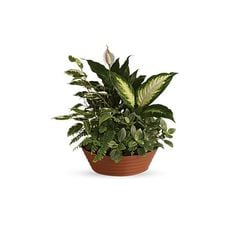
Serenity Now
$61.99 · Live dish garden · Months, not daysDieffenbachia, a peace lily, a calathea and a fittonia in a shallow pan. The fittonia will be the first to go and the calathea will brown at the tips in dry winter air, and neither of those is a build fault: the fussy plants buy visual texture, the two hardy anchors carry the years. It also gives the recipient something to do on a Thursday, and that is the part of the research most gifts ignore. One caution that keeps it out of pick three's job: some wards restrict live soil plants more tightly than cut flowers, so this is a home, office or discharge gift, not a ward gift.
Send this one Or browse the rest of the plants.What the evidence does not show about depression
The section I would skip if I were only trying to sell you something.
Go back to the pen. The reason researchers handed out pens is that they were trying to rule out the possibility that people simply respond well to being given things. The pen result is what makes the flower result interesting, and it is also the clearest reminder of how much of this work involves isolating one variable inside a situation that is full of them.
Because consider what a bouquet actually is. It is a flower, and it is also a person deciding to spend money on you, and a stranger bringing it to the door, and a card with your name written on it. The studies can separate some of that. They cannot separate all of it, and neither can anyone reading this.
One study got closer than the rest, and it is the reason I keep it in the file despite the sample size.
Yang and colleagues ran a crossover trial where the same participants arranged real flowers and artificial flowers.5 Same activity, same hands, same duration. The only variable removed was whether the flowers were alive. Real flowers suppressed sympathetic nervous activity more than artificial ones, with a reported effect size of Cohen's d around 0.66, a medium effect. Anxiety, depression and tension scores all fell further with real stems. Fifteen students, no blinding, and the closest thing this literature has to a sham control.
This is a partial answer to the placebo objection, not a complete one. Everyone in the room knew which flowers were fake. But it does mean the effect survives when you strip out the gift, the sender, the delivery and the surprise, and leave only the biological difference between a living stem and a plastic one.
| The claim you will see | What the evidence actually supports | Verdict |
|---|---|---|
| Flowers reduce stress | Several studies show lower cortisol, lower blood pressure and higher parasympathetic activity after flower exposure, mostly over short windows in lab settings. | Supported |
| Flowers help patients heal faster | Two controlled hospital studies found lower analgesic use and shorter stays. Neither could blind participants, and one did not randomize. | Supported |
| Real flowers beat fake ones | One small crossover trial found a medium effect favoring real stems on stress and mood measures. Fifteen participants, so treat it as promising and not settled. | Partly |
| Flowers treat depression | Reviews report positive mood outcomes from horticultural activity in depressed populations. No trial has tested flowers as a treatment against or alongside standard care. | Not shown |
| Regular deliveries build resilience | Explicitly listed as an open question. The one relevant observation points the other way, since repeat gifts produced smaller reactions than the first. | Not shown |
| Flowers help with grief | No controlled trial has tested it. The support is anthropological and craft knowledge. A different kind of claim, and worth naming as one. | Untested |
Three more limitations run through nearly all of it, and the third is the one that should bother you most. Samples are small, and heavy on students and volunteers who signed up for a flower study, and that is not a neutral population. Blinding is close to impossible, because a person always knows there is a bouquet in front of them. And journals publish findings more readily than non-findings, so the honest expectation is that the real effect is smaller than the published record makes it look. If a study ran and found nothing, you would probably never hear about it, and neither would we.
Twenty-one years of it, and the field is still small
How to choose flowers for someone who is struggling
What thirty years on a bench adds to nine studies.
The research says the effect is real, modest, and short. Joan's contribution is the part the researchers were not measuring: what happens to the physical object between the delivery van and day nine.
Who is it going to? Pick one, and the evidence picks the format.
The elevator finding: a small unexpected flower changed behavior with no occasion attached. Red and yellow moved the physiological measures where white did not.
Thinking Of You, $59.99
Small enough that nobody has to work out what it means. Step up to a longer-life mixed build if it needs to hold a desk all week.
The strongest evidence in the field. Two ward studies found lower painkiller use and shorter stays. Separately, lilies scored worst of any flower type on tension.
Hospital Bouquet, $51.99
Call the ward first. Oncology, transplant and intensive care often decline fresh flowers, and some decline live plants more strictly still.
Nothing controlled. No trial has tested flowers in bereavement, so this one rests on craft knowledge and thirty years of funeral weeks, not on a citation.
Serenity Now, $61.99
And send it in week three, not week one. For the service itself, the sympathy range is the right shelf.
The most underquoted result here. Adults averaging seventy-three who received flowers over several weeks improved on episodic memory as well as on mood.
Mixed Color Bouquet, $59.99
Repeat exposure was the design in that study, so vase life is the variable that matters. Ten to fourteen days beats a prettier six.
What to actually write on the card
This is where people stall, and it is the part of the gift that outlasts everything else. Recipients read the card twice, once fast to see who, once slowly to see what. Then it goes in a drawer and the flowers go in the bin. Joan has watched people rewrite four words for twenty minutes at the counter. Short is not lazy. Short is correct.
Thinking of you. No reply needed.
Those last three words do more work than the first four. They remove the obligation to perform gratitude, which is exactly the burden a depressed person does not need adding to their day.
Hope you are on the mend. Not expecting a call.
Hospital cards get read aloud by whoever is visiting. Assume an audience and keep it easy to hear in a room with other people in it.
There are no right words. Thinking of you and your family.
Joan's line, given at the counter for thirty years to people who were frozen. Naming the fact that language fails is more comforting than any attempt to make it succeed. Avoid anything beginning with at least.
Still thinking about you. I know the house has gone quiet.
Pairs with the week-three delivery. Do not apologize for your absence in the card. It hands the grieving person the job of reassuring you.
No occasion. Just thought of you.
Say the quiet part. Unexplained flowers make some people nervous that they have forgotten something, and one honest line removes the whole problem.
Handwriting beats typing where it is offered, and a florist writing it out beats a printed slip. If you get stuck, read it aloud once. Anything you would not say out loud to that person, do not send in writing to a room they cannot leave.
Which format for which job, based on what each study actually measured
Three stems, small vase
Matches the single-flower finding. Small enough that nobody has to work out what it means.
Long-life mixed color
Red and yellow moved the physiological measures. Mums and carnations keep them there past day ten.
Hospital-built bouquet
Where the hard evidence sits. No lilies, no heavy scent, tray-table scale, and check the ward first.
Live dish garden
The only format answering a question measured in months, and the only one that asks something of the recipient.
Same delivery fee on all four at $16.95 flat. Same-day cutoff is 1PM on weekdays and 10AM on Saturdays.
Questions people actually ask us about this
Do flowers actually help with anxiety, or is that marketing?
Both things are true at once. Several studies show reduced anxiety scores and lower physiological stress markers after flower exposure, and the hospital trials found lower reported anxiety in planted rooms. What none of it shows is an effect on clinical anxiety as a diagnosed condition, because that trial has not been run. Treat it as a small, real, short-lived lift. Not a treatment.
Can flowers help with depression?
Reviews of horticultural therapy report positive mood and quality-of-life outcomes in people with depression, and the strongest results in those reviews come from active gardening and arranging, not from receiving a bouquet. No trial has tested flowers as an adjunct to standard treatment. If someone you love is depressed, flowers are a kind thing to send and not a course of action.
Are real flowers actually better than artificial ones?
One crossover trial had the same people arrange both and found real flowers suppressed sympathetic nervous activity more, with a medium effect size of around 0.66, plus larger drops in anxiety and tension. Fifteen participants and no blinding, so it is not settled. No other study in this field strips all of that away and still finds a difference.
Which flowers should I avoid sending to a hospital?
Lilies, first and last. They came out worst on attention and tension in the one study that compared flower types, they drop pollen, and heavy fragrance in a small room is the most common reason a bouquet gets moved to the nurses' station. Stocks and carnations scored best in the same study. Beyond the stems, check the ward: oncology, transplant and intensive care frequently decline fresh flowers entirely.
Is one flower really enough, or should I send a bouquet?
The research does not answer this. Dose and frequency are listed as open questions, and the elevator study used a single bloom because it was testing whether the gesture needed to be large, not because one stem is optimal. Our answer is a merchandising answer, not a scientific one: small for a first attempt with no occasion, fuller when it needs to hold a room for a week.
Why do florists keep recommending plants over flowers for sympathy?
Because the timing of grief does not match the vase life of a rose. Cut flowers arrive in the week of the service, when the house is already full of them. A living plant is still there in week six, when almost everyone else has stopped calling. That is a floristry observation from decades of taking those orders. Not a research finding, and we would sooner label it accurately.
Wrote our About Us page
I know what you are thinking, because I thought it too when I started reading this file. Of course the flower company found research saying flowers are good.
Fair. And before the honest summary, the practical bit nobody puts on an article like this: after you order, you are in a gap. You cannot see the arrangement, you will not get a photo from us, and the recipient may not call for two days. That silence is not a signal. If you want to know it landed, call us on 800-946-5457 and we will check with the florist. If it arrived wrong, same number, and we would rather hear it on the day than a week later when nothing can be done.
So here is the honest summary from someone with an obvious interest. The effect is real, it is small, and it is measured in days, not months. The best evidence in the whole field is about hospital painkillers, which is not a sentence anyone in marketing would have chosen. The section on grief, which is the category we sell the most of, is the one section with no controlled evidence behind it at all, and I have said so. We are seven people spread across three countries and a network of florists who make us look good, and we would rather tell you the modest true version than the impressive one.
Flowers that are still working on Thursday
Everything above says the effect is real and short. The practical response is not a bigger arrangement, it is a build that lasts long enough for the exposure to repeat. A florist in or near your recipient makes it fresh that morning from what came in at market.
And for what it is worth, the flowers are never the part that lasts. Every study here measured a week at most. The card ends up in a drawer, and people find it years later.
See same-day flowersOrder before 1PM on a weekday and it is there this afternoon. Saturday cutoff 10AM. Flat $16.95 delivery. Questions on a hospital order, call 800-946-5457 or email [email protected].