Shop By
A woman called me last spring wanting to know what she had done wrong. Her roses had lasted four days. Her sister had bought the same color rose the same week and was still looking at them nearly two weeks later. She had trimmed the stems. The water got changed every other day. Everything the little packet told her to do, she had done.
She had not done anything wrong. She had a different rose, and for years that was the one answer I could never quite prove to anybody on the phone.
I have been doing this since 1988. Bench by nineteen, thirty years in Piedmont North Carolina, a shop of my own in Greensboro, and somewhere north of forty thousand arrangements behind me. Most of what goes in a beginner's guide I could write with my eyes shut. Cut the stems. Strip the leaves. Keep them away from the fruit bowl. I have said all three of those things a thousand times.
What I had never done, until Andrew put a stack of research in front of me this year, was sit down and read why any of it works. Thirty years teaches you what happens. The why is a separate education and nobody hands it to you. Some of what I read confirmed exactly what my hands already knew. One thing in there I have been telling people for three decades, and I could not find a single study backing it up. I have left that in rather than quietly dropping it, because a beginner's guide that only tells you what sounds good is not helping anybody learn to arrange flowers.
One thing before we start, because it shapes everything after it. Almost nobody arranges flowers because they needed a centerpiece. They do it because they want to make something with their hands for somebody, sometimes themselves, and they would like it not to look like they tried and failed. That is the actual job on the table. The chemistry below is only how you get there.
I get two sorts of people asking me about this, so let me sort you before we go any further, the way I would on the phone. Most of you are going to arrange flowers yourselves, and the whole thing is written for you. Some of you are working out what to buy before you spend money on somebody else. If that is you, section 05 on why arrangements look flat, section 06 on color, and the list of what actually lasts are the three worth your time. You can skip the chemistry unless you want it.
Before this went up, every research claim in it was traced back to the study it came from. Two things florists repeat constantly did not survive that check and have been cut rather than smoothed over. You will find both of them named below, in the sections where I would otherwise have repeated them. The twenty-two sources at the foot of the page are all linked, so you can go and read any of them without taking my word for it.
What actually kills a cut stem
The failure happens in open air, seconds after the cut, long before the flowers reach anyone's kitchen counter.
Almost everybody who calls me about dead flowers arrives with the same theory, and it is a perfectly reasonable one. They think the flowers got thirsty. I have talked to people who topped the vase up every single morning, who could not have been more diligent about it, and who still watched the whole bunch give out by Thursday. The water was rarely the problem. The problem was decided in the first two seconds after the stem was cut, usually before they ever laid eyes on it.
A plant still in the ground moves water upward without spending any energy on it. Water evaporates out of the leaves, that evaporation pulls a negative pressure down the internal plumbing, and more water follows it up. The plumbing is a bundle of narrow tubes called xylem vessels. Think of a drinking straw with the suction already applied.
Cut the stem in open air and that suction does exactly what suction does. It pulls in air. A bubble seizes the vessel at the cut face and the water column stops there. The technical word for it is an embolism, which is the same word they use for a blocked artery, and it is doing much the same job. Researchers using cryo-scanning electron microscopy, which is a way of freezing a stem solid and then photographing its cross section, have imaged the air pockets sitting inside cut chrysanthemum stems where the water should be.1 It is not a figure of speech. There is a bubble in the pipe.
The bubble does not clear on its own once the stem is back in water either. Dissolving a trapped bubble out of a narrow tube is slow diffusion, and the vessel stays partly blocked while it happens.2
Air entry at the cut surface, not dehydration, is the first thing that goes wrong with a cut flower. This is why the single most useful thing a beginner can do is cut the stem with the cut end underwater, or re-cut it and get it straight back into water within a second or two.12
That one mechanism sits underneath three rules I was taught as things you simply do, decades before anyone explained them to me.
Cut underwater, or re-cut and move fast. Nothing gets sucked in if there is no air at the cut face. I have kept a bucket of water on the bench for this my entire career. I never had the reason to give the new starters. Now I do.
Strip every leaf below the waterline. A submerged leaf rots. The rot breeds bacteria, the bacteria build a slimy film across the cut surface, and the film blocks water uptake as effectively as the air bubble did. This is why a proper flower food contains a bactericide and why sugar on its own underperforms it. Sugar feeds the stem. It also feeds everything else in the vase.
Sear the sappy ones. Euphorbias, poppies, some lilies. They seal themselves shut with a latex plug within seconds of being cut, because that is a defense response, not a florist's inconvenience. A few seconds of heat on the cut end reopens the road. That old trick turns out to have real plant defense biology behind it.
The angle of the cut, and what to do instead
Here is the part I have to be straight about, because a guide that only tells you the flattering things is not worth your time.
Cut at 45 degrees. Every florist says it. I have said it. You will find it on the little card in the packet and in every beginner article on the internet, stated with total confidence by people who have never questioned where it came from. I went looking for the trial that established it. Somebody must have taken a hundred stems, cut a third of them flat, a third at 30 degrees, a third at 45, and counted the days.
I could not find it. Neither could the people who helped me search. There is a large body of postharvest research on what extends vase life, and the cut angle is not really in it.
I want to sit on that rather than skate past it, because it is not a neutral finding for me. I taught that rule. New starters, apprentices, anybody who came through a shop I was running, and every caller over thirty years who asked me why their flowers had died on them. All of them got the angle, delivered with total confidence, by somebody who had never once gone and looked. The woman who taught it to me had not looked either, and neither had whoever taught her. Nobody was lying to anybody. We were just passing it along.
I have told people the angle matters more times than I can count. I still cannot show you the study.Joan · NCCPF Certified Florist
So I am going to keep telling you to angle the cut, and I am going to stop telling you the angle is the magic. Here is my own read on why the habit survived. A stem cut dead flat can sit flush on the floor of a vase and seal itself against the glass. Angle it and it cannot. The habit solves a real problem. Just a different one from the problem everybody thinks it solves.
| The rule | What people say it does | What is actually going on | Verdict |
|---|---|---|---|
| Cut at 45 degrees | More surface area for drinking | Stops the stem sealing flat against the vase floor. Surface area is not the constraint. | Do it anyway |
| Cut underwater | Keeps the flower hydrated | Stops an air bubble entering the xylem at the moment of the cut. Directly imaged in research. | Holds up |
| Strip leaves below the water | Looks tidier | Prevents the bacterial film that physically blocks the cut surface. | Holds up |
| Keep it away from fruit | Old wives' tale | Ripening fruit releases ethylene, a hormone that triggers programmed cell death in petals. | Holds up |
| Ice cold water on day one | Fresher, more careful | Backwards for the first fill. Room temperature water enters the vascular system more readily. | Backwards |
Now, the thing that does move the needle, and it is not close.
Postharvest trials across 38 different Hybrid Tea rose varieties found vase life running from 4.5 days to 18.8 days, all at the same temperature, before anyone touched a single care variable.4 Not the water. Not the food. Not the trimming. Genetics. Five of those varieties shrugged off direct ethylene exposure entirely. Twenty seven of them lost between 0.8 and 8.4 days from it, which at the top end is nearly half their life.
The woman on the phone last spring had not made a mistake. She had a rose that was never going to give her more than four or five days. I told her that, and I could hear her put the whole thing down. Worth knowing early, before you decide you are bad at this. Sometimes it is just the rose.
Four levers. Only three of them have been measured.
Days of vase life at stake, by what you change. Rose data measured at 70 degrees Fahrenheit across 38 Hybrid Tea varieties.
- Teal. Variety, measured across 38 Hybrid Tea roses at one fixed temperature. The biggest single lever, and the one you have least control over.
- Pink. Ethylene exposure, measured on the same 38 varieties. This is the lever a fruit bowl on the same table pulls for you.
- Sand. Vase solution, measured on cut chrysanthemums. Sugar plus acid plus a bactericide, three separate jobs.
- Missing. The 45 degree cut. Nothing to plot, because we could find no published trial that has tested it.
Sources 3 and 4 at the foot of the page. Rose and chrysanthemum data come from separate studies and are shown on a shared day scale for comparison, not as a single experiment.
What is actually in a packet of flower food
Three ingredients doing three unrelated jobs. Miss one and you undo the other two.
Sugar. The fuel.
A cut stem can no longer photosynthesize enough to feed itself. Sugar is the carbohydrate it would have made. On its own it also feeds the bacteria.
Acid. The uptake.
Vinegar or citric acid lowers the water pH, which improves how readily the stem draws water up. Cheap, and it does real work.
Bleach. The bouncer.
A drop of household bleach is the bactericide. It stops the film forming across the cut face. This is the part people leave out, and it is the part that makes the sugar worth adding.
A controlled trial on cut chrysanthemums reached 19.8 days on a sugar and vinegar mix. Source 3. Bleach quantity is not a place to improvise: a few drops per quart, never a splash.
Ethylene is the hormone doing the actual killing, and it comes at your flowers from three directions at once. The flowers make it themselves as they age. Ripening fruit makes it. So does anything burning, from a gas heater to a cigarette. It triggers senescence, which is the plant equivalent of programmed cell death, and the damage happens at concentrations far below one part per million.5 Silence the genes that produce it in a carnation and the petals stay whiter for longer.6
Every time I have told a caller to move the vase off the counter with the bananas on it, I was giving them real endocrine biology and calling it an old wives' tale.
Which brings me to the question I get asked most about imported flowers
Some version of this lands on the phone most weeks. If these flew in from South America, are they not already half spent by the time they reach me? Fair question, and the answer is in the same chemistry.
At grower and wholesale level, stems get pre-treated with compounds that physically block the ethylene receptor sites in the flower tissue, silver thiosulfate or a gas called 1-methylcyclopropene, so the hormone arrives and finds the door locked. The protective effect holds longer when the stems are kept cold the whole way. On the microbial side the industry has been moving toward finer antimicrobials, silver nanoparticles among them, to suppress the same biofilm at the cut face using a smaller dose. None of it changes the mechanism from section 01. It attacks the same two problems earlier and more precisely, before anybody's kitchen scissors get involved.
That treatment happens long before a stem ever sees a retail cooler. A large part of why one imported flower arrives with a full week in it and another arrives spent comes down to whether that step happened. Which makes the honest answer to the question a slightly unsatisfying one. It depends entirely on whether everybody in the chain did their job.
Built the partner network, 2009 onward
I am the one who put the research pile in front of Joan. Twenty-two papers, not one of which I could have written a word of, handed to a florist by an Australian who wanted her to go and check her own trade. Most of it held. Two things did not, and both are named on this page.
On that chain Joan just described, here is exactly where we sit in it. We are an order gatherer. No warehouse, no cooler, no van. Your order goes to a florist in or near your recipient's town and they build it that morning out of what they bought at wholesale that week. The pre-treatment and the cold happened upstream of them, and upstream of us. What we control is which florist gets the order, and what happens when something goes wrong. Fifteen thousand florists and not one cooler of our own. That is a smaller claim than most flower websites make. It is also the true one.
The spiral, and the order you do it in
The reason a hand tied bouquet stands up on a table by itself is mechanical, not decorative.
Every article about arranging flowers that mentions the golden ratio makes it sound like florists are standing at the bench with a calculator working out 1.618 before they cut anything. Nobody does that. I have worked in five shops across thirty years and I have never once seen it.
What is happening has a proper name. Phyllotaxis. It governs how a plant packs leaves, petals and seeds around a growing tip. Each new cell settles into the largest gap the previous ones left, those gaps sit at a consistent angle of roughly 137.5 degrees, and the result is a spiral packing pattern that lands close to the Fibonacci numbers. One, one, two, three, five, eight, thirteen. Which is why a trillium reliably gives you three petals and a daisy head often gives you 34 or 55 florets. It is a growth algorithm, running while the plant is still in the ground.
I sat nine courses and three hands-on workshops for my certification and I never heard that word once. Thirty years of building spirals with my hands and the name for what my hands were copying arrived this year, from a paper, at my kitchen table.
When you build a bouquet by crossing the stems diagonally and rotating the bunch in your hand instead of dropping them straight down, you are copying the structural logic of how that plant grew. So much for the aesthetic half. The mechanical half is better. Spiral crossed stems brace against each other through friction and form a self supporting lattice, which distributes the weight evenly enough that the bouquet stands upright on a table with no vase at all.
I used to tell new starters to spiral it properly or it would flop. True enough. The reason it is true is an engineering byproduct of a rule most people think is purely aesthetic.
Why a spiral bind stands up and a straight bunch does not
Same nine stems, same hand, two different results. The difference is whether the stems touch each other on the way past.
Rotate the bunch a quarter turn in your hand every two or three stems, and lay each new stem across the front at the same angle. That is the whole technique.
The order you actually do it in
Everything above this is why. Here is the what, in sequence, because a guide that never gets around to telling you what to do first is not much of a guide. Seven steps. Maybe twenty minutes the first time you try it, ten once your hands know the shape. Twenty minutes in which nobody wants anything from you and the only decision in the world is where the next stem goes. I have known people take this up for that alone and never much care what the finished thing looked like.
Fill the bucket first
Strip everything below the tie point
Cut, and get it wet
Leave them alone for an hour
Build in your hand, not in the vase
Tie exactly where your hand is
Cut the ends level, all at once
The step that matters most is step four, and it is the one that looks like you are not doing anything.
Bought a flower shop in 2006 knowing nothing about flowers
Reading this section made me laugh. When Andrew and I bought that shop in 2006 I thought arranging flowers meant sticking a bunch of stems in a vase until it looked full. That was the entire technique. We had zero flower experience, a shop that still looked like it did in 1979, and a baby due in seven months (you can probably guess which of those three I was actually lying awake about).
We found Kelly, who actually knew what she was doing, and we quietly scaled the flowers down and the gift side up. Mostly soaps, of all things. So when Joan starts talking about Fibonacci spirals I want every beginner to know the goal is not to become Joan on day one. The goal is to know that filling it up until it looks nice is not the technique, even if it was mine for about three years. Nobody complained either, which probably tells you more about Kingscliff in 2007 than it does about me.
Three numbers instead of a calculator
The proportions I was taught as just how you do it, and what they are actually copying.
Proportion never arrives as an abstract question. It arrives as a vase. Somebody calls because they have a tall glass cylinder their mother left them, everything they put in it looks wrong, and they want to know which flowers to buy to fix it. Nine times out of ten the vase is the problem and the flowers are innocent. The three numbers below are how you work out which one you are dealing with before you spend anything.
Build the flowers to roughly one and a half times the height of the container, so the vase carries about a third of the visual weight and the flowers carry two thirds. Shorter and it reads squat. Taller and it topples in your eye before it topples on the table.
Put your biggest bloom off center, about a third in. Dead center parks the eye and the arrangement stops moving. Off center pulls the eye through it, which is the same reason a plant that grew in the ground never looks symmetrical.
Three focal blooms, five textural stems, eight fillers. I was taught this as a rule with no reason attached. You are looking at the Fibonacci count, the same series the plant used to place its own petals, which is why the result reads as grown rather than stacked.
Now the caveat, and it is a real one, because the golden ratio gets sold much harder than the evidence supports. The claim that people have a universal built in craving for 1.618 specifically has been tested since the 1800s and it does not hold up well. A review of that whole tradition found no preference for the golden section under controlled conditions, and found that how you phrase the question changes which proportion people say they prefer.11
A 2024 study split the difference usefully. Measuring reaction time rather than stated opinion, researchers did find a real automatic positive response to golden ratio patterns. Ask the same people directly and their conscious ratings did not line up with it, and in a money splitting task the overwhelming majority went for an even split rather than anything golden.12
What that tells me, after a thousand spiralled bouquets, is that the three numbers work but not because your recipient is unconsciously measuring for phi. They work because phyllotaxis shows up constantly in nature, so an arrangement built on it reads as grown instead of assembled. I would rather teach a beginner the real mechanism than the tidy myth.
Worth knowing that the entire Western instinct here is contested from another direction too. Japanese ikebana starts from fukinsei, a principle that treats asymmetry and imperfection as the source of beauty rather than a departure from it. The traditional structure is three off-center points called shin, soe and tai, arranged as an uneven triangle rather than a rounded dome, and the empty space between them is treated as a compositional element carrying equal weight to the flowers. The reasoning is Zen and it is worth sitting with: a perfectly symmetrical arrangement is finished, and a finished thing gives the eye nothing left to do. An unresolved one keeps you looking. A Western bouquet is built to fill a shape. An ikebana arrangement is built around what it deliberately leaves out. If that idea appeals, we have a longer piece on ikebana.
Why a bunch of one flower looks flat
The most common complaint I hear from people who arrange at home, and it is almost never the flowers.
Somebody buys good stems, does everything right, and the finished thing still looks like flowers in a vase rather than an arrangement. They call assuming they bought badly. They almost never did.
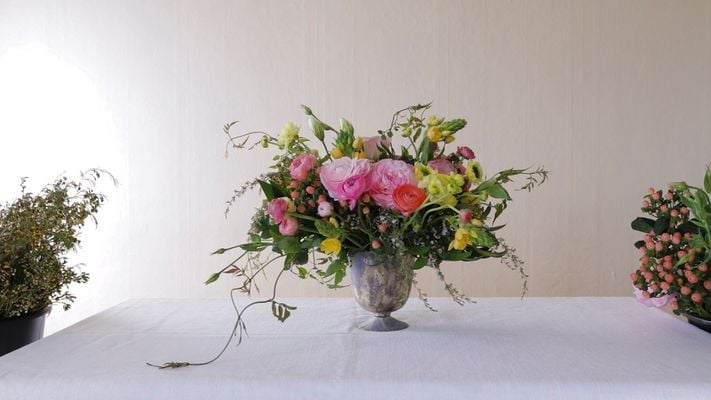
A trained florist builds asymmetrically on purpose. One high side, one draping low side, nothing mirrored. Perfect symmetry reads to the eye as static and manufactured, while controlled imbalance mimics the genuinely irregular way a plant actually grows, and reads as alive. Ikebana arrives at the same conclusion from the opposite philosophical direction, which I find reassuring rather than confusing.
Underneath that there is a layering rule, and it is the part almost no beginner guide bothers to explain. A professional arrangement is built in four distinct tiers.
Four tiers, and what happens when you skip them
Same vase, same freshness, same money. The difference is how many depths the eye has to travel through.
- Teal, line flowers. Delphinium, foxglove, snapdragon. Tall and vertical. They set the height and the back edge of the arrangement.
- Pink, focal blooms. The big ones. Three of them, placed off center, never in a row.
- Sand, secondary and textural. Medium heads that fill the middle depth and stop the focals floating.
- Gray, filler. Small and low, around the rim. The tier everybody leaves out, and the one that makes the whole thing sit down properly.
Those four tiers create depth cues, and the eye reads depth cues as three dimensional space. Take them away and you get a wall of one color at one distance. Which is the real reason a single-tier bunch of one flower type so often disappoints somebody who paid good money for it. The problem is a missing depth cue, and no amount of fresher flowers will fix it.
It is not a freshness problem. It is a missing depth cue problem.Joan · NCCPF Certified Florist
Two more techniques do the same work at the level of individual stems, and both are worth knowing because most people treat them as fussy finishing touches when they are actually structural.
Reflexing is folding the outer petals of a rose back on themselves, gently, so the bloom opens wider than it naturally would at that stage. It exposes more petal surface and creates shadow underneath, which is how one rose starts reading as three. Florists do this to garden roses constantly and almost nobody outside the trade knows it is happening.
Mirroring means repeating one focal element on the back of the arrangement. Not the whole design, just one echo. Without it an arrangement has a front and a hollow, and the recipient discovers the hollow the first time they walk around the table. With it, the thing reads properly from every angle. This is the single biggest difference between a bunch built to be photographed and a bunch built to be lived with.
If you are building for your own kitchen, flat is fine. You will fix it next time and nobody is watching. If it is going to somebody else on a day that counts, the four tiers and the mirroring are the part worth handing to a bench that does it forty times a week. That is not me selling you something. It is me telling you where the difficulty actually sits.
Color, scent, and what the charts get wrong
Red means love, yellow means friendship. I have repeated some version of that over the counter plenty of times because it is fast and roughly true. Just thin.
Something worth knowing before any of the theory: color is the first thing the person at the other end registers, ahead of size, ahead of which flowers they actually are. The ones who call back happy lead with color almost every time. The pinks were gorgeous. It was all white and really elegant. In thirty-eight years nobody has once called me to praise the construction.
The physiological work is more specific and more useful. In a controlled study, people shown red and yellow flowers for three minutes at a time showed significantly higher alpha brainwave activity, which is the marker of a relaxed state, and higher parasympathetic nervous activity, which is the body's rest and digest mode, compared with white flowers.7 Yellow came out strongest. Red second.
Two findings from the wider color research changed how I talk to callers about this. The first is that saturation and brightness matter at least as much as which hue you picked.8 A vivid pale yellow can hit harder than a dull red. That single fact undoes the premise of the simple hue based color charts most beginner guides are built on, including a couple I have handed people myself.
Warm colors dominate a mixed arrangement out of proportion to how much of it they occupy. Orange kept its lift even when half the composition was swapped for blue, while the calm of a blue arrangement collapsed once just a quarter of it went orange. The relationship is not symmetrical in reverse.9
Which is the practical version of something I already knew from the bench without the vocabulary. Put three orange gerberas in a soft blue and white sympathy arrangement and you have not made a blue arrangement with an accent. You have made an orange arrangement. If you want calm, the orange has to come out entirely, not come down.
So what do you actually do with that
Pulling apart a chart is easy. Replacing it is the harder job, so here is the version I use on the phone. Three groups, not twelve meanings.
Warm and saturated, for celebrating something specific. Oranges, golds, strong greens. A promotion, a graduation, news that just landed. This is the group people under-reach for, because they hear "flowers" and think soft. When the occasion has a date and an achievement attached to it, be confident with the color.
The wide soft band, for everything relational. Pinks, lavenders, teals, warm creams. This is the group that covers most of what I actually send in a week: the thank-you, the thinking-of-you, the get-well, the new baby. The band has far more range than sending something pink gives it credit for, and a mixed palette does its best work in here.
Muted and pale, for grief. Whites, creams, soft greens, nothing saturated. The reason is mechanical rather than traditional: saturation is what drives emotional intensity, and intensity is the last thing you want to add to a room that is already holding as much as it can. Which is also why sympathy arrangements converged on those colors long before anybody measured why.
Three groups. The whole chart, and it will get you further than a page of hue meanings. Most people sending flowers are not feeling one clean emotion anyway. Gratitude with a thread of guilt in it. Relief tangled up with grief. A mixed palette for a mixed feeling is not a beginner's mistake. Half the time it is the most honest thing on the table.
The sense nobody writes about
There is a second channel doing work here and almost no beginner guide mentions it.
Rose fragrance is not one compound. The smell is a ratio between chemical families, and research quantifying the volatile compounds in rose scent found that the quality people recognize as rosiness comes mainly from a group called the ionones, working with another group called oxylipins. Overall pleasantness depends on the balance holding across all of them, and certain other compounds actively drag the whole thing down.13 What that means at a bucket is worth knowing before you spend money: two roses can look identical, same color, same head size, same stage of opening, and one of them smells right while the other smells faintly of not much. That was decided in a breeding program years earlier and no photograph on any website will ever show it to you.
Scent also takes a shorter route into the brain than anything else you can put in a room. The olfactory bulb sits close enough to the amygdala and the hippocampus that the signal barely has to travel, which is why a smell drops you into a memory faster than a picture can. Researchers running EEG on gardenia volatiles measured increased alpha wave power and decreased beta power, which is the stress and alertness marker, and attributed the effect largely to the linalool in the flower's profile. Heart rate variability moved in the same direction but did not reach statistical significance, so I am not going to claim it did.14
I used to watch people walk past a bucket of lisianthus at the wholesale market at five in the morning and just breathe out. Shoulders drop, on the way to somewhere else, usually without noticing they had done it. For thirty years I assumed that was me being a flower person and seeing what I wanted to see. Turns out it is linalool doing to anybody's nervous system exactly what linalool does.
The green brick nobody defends anymore
Nobody has ever called me to ask about microplastics. What they ask is whether they need the green brick at all, and whether the whole arrangement will collapse without it. No, and no. The longer answer is worth having anyway, because the reason the trade has been quietly moving off the stuff runs through the sink and through the bench in about equal measure.
Floral foam, the green brick sold as Oasis, is a phenol formaldehyde plastic. For most of my career it was simply what you built into. Nobody in any shop I worked in questioned it, and the wastewater went down the sink at the end of the day the same way the coffee grounds did.
An RMIT University study published at the end of 2019 was the first research to test its environmental impact directly. The aquatic invertebrates tested all ingested the foam microplastics, and the leachate from the foam proved more toxic to those organisms than leachate from other families of plastic.10 The manufacturer disputed how well the test conditions mapped to real world exposure. Independent researchers pushed back that survival is not the same as being unaffected.
The argument over how far the RMIT findings generalize to real waterways is genuinely unsettled and is worth reading both sides of. What is not in dispute is the material itself: it is a plastic, it is single use, and the alternatives now work.10
There is a second half to this that gets less attention than the ocean, and it is the half that concerns anyone standing at a bench. The material carries carbon black and trace formaldehyde, both flagged by the IARC and the EPA for carcinogenic potential under prolonged occupational exposure.1516 Cutting a brick releases dust. Soaking one puts your hands in the solution. In thirty years across five shops I never once saw anybody wear gloves for it, myself included, and it never occurred to any of us to ask. Not a scandal. Just a thing the trade did not know and now does.
The good news for a beginner is that the replacements are cheaper than the thing they replace. Crumpled chicken wire dropped into the vase. A kenzan, which is the spiked metal pin holder that ikebana has used for centuries and which will outlive you. Both are reusable indefinitely, both cost less over a year than a box of bricks, and once you understand the spiral support mechanism from section 03, both are honestly easier to build in than jamming stems into foam and hoping.
Why doing it badly still works
The part a beginner's guide usually skips, and the part I would keep if I could only keep one.
By now you have a procedure, a proportion rule, a color shortlist and a fair idea of what kills flowers. None of that touches the thing most people actually notice first, which is that doing this feels good even when the result is nothing much to look at.
Flow is the psychological state where a task's difficulty sits close to your current ability. Hard enough to hold your whole attention, not so hard it tips into anxiety, not so easy it tips into boredom.17 Craft activities that use the hands are a reliable route into it. An international survey of over three and a half thousand knitters found a significant relationship between how often people knitted and how calm and happy they felt.18
Here is the counter-intuitive part, and it is the reason this section exists. Flow depends on the match between challenge and ability, not on the absolute level of the ability. A total beginner cutting stems, working out proportions and fumbling a first spiral bind is operating right at the edge of what they can currently do, which is precisely the condition the research says produces the state. I am on autopilot. There is a real argument that a first timer gets more out of arranging flowers than I do on a Tuesday.
And there is a tactile layer nobody puts in a beginner's guide. Stripping thorns, feeling where a stem wants to bend before it snaps, judging the weight of a bloom in your palm before you have looked at it properly. I could tell whether a rose was going to open before I could see it, just from how the bud sat between my fingers. That is not a gift. Thirty years of four thirty alarms, standing on concrete, hands in cold water bucket after bucket. Your hands start building the same vocabulary from the first stem you touch.
On being a total beginner
This is the most important bit in the whole thing for a beginner, and I say that as someone who loves the chemistry parts (I went back and read the one about why roses smell nice twice). The reason I did not arrange flowers myself for years was not a lack of interest. It was the fear of doing it wrong.
What Joan has flagged here, that the benefit depends on being at the edge of your ability rather than already being good, would have completely changed how I approached my first attempt. I was not supposed to be good. I was supposed to be right where I was.
Why the gesture works at all
There is a version of this article's ending where I tell you flowers are meaningful and leave it there. I would rather tell you what I actually found, including the part where the nicest story in the whole field appears to be wrong.
You have probably heard that Neanderthals buried their dead with flowers. The story comes from Shanidar Cave in northern Iraq, where pollen clumps were found around a burial in the 1960s and read as deliberately placed blooms. Florists have repeated it for fifty years, and I have repeated it myself. The team currently excavating that site published a reassessment of the pollen in 2023 and concluded that at least some of those clumps were put there by nesting solitary bees.19 The flowers, as flowers, do not really survive. What has got stronger over the same period is the burial itself: articulated remains, a cut feature in the sediment, a stone placed on purpose, in a spot used repeatedly.20 So the honest version is smaller and, I think, better. We cannot show that they brought flowers. We can show that they carried their dead to one particular place and put them down with care. The impulse is documented. The bouquet is not.
What does hold up sits in an odder corner of the literature. Evolutionary biologists modelling courtship found that the stable solution is a gift that is expensive for the giver and intrinsically worthless to the receiver, because a costly gift proves intent while a worthless one filters out anybody who would have taken a valuable gift regardless of who was offering it.21 Flowers are the example everybody reaches for when explaining that model, and once you have seen it you cannot unsee it on the sales floor.
My own reading, and I want to be clear that this is a florist extending a courtship model rather than a finding you can cite: everything that looks like a design flaw in a bouquet is doing the work. It costs more than its materials. Somebody had to give up an afternoon to it. There is no re-gifting a bouquet, no reselling it, no putting it away for later. And it starts dying the day it arrives, which means it can only ever be about the moment it was sent.
People ask me all the time why they should spend money on something that dies. That is the answer. The dying is not the flaw in the gift. It is the part that makes it mean anything.
Which brings up the part people actually freeze over, and it is never the flowers. It is the card. Nobody remembers which stems were in the bunch a year later. Everybody remembers what the card said, and I have watched sympathy cards come back out of a drawer a decade after the arrangement went in the bin. New parents read them out loud to each other at two in the morning. The card outlives everything else in the box.
So keep it short. Shorter than feels adequate, because adequate is not the goal. Thinking of you today does more work than a paragraph. From a distance on a birthday, wish I was there is the entire message and it is honest. For sympathy, there are no right words is not a failure to find them, it is the truest thing that fits on a card that size. Do not apologize for sending flowers and do not explain them. The gesture already said all of that on the way in.
Which is also why the smallest version works. In the most replicated study in this whole area, handing a stranger a single flower produced more smiling, closer physical proximity and more conversation than handing them a pen, with no occasion, no relationship and no warning.22 One flower. In an elevator. To somebody who had no idea it was coming. If you have been putting off sending something because you are not sure the gesture is big enough, that study has been quietly telling people for twenty years that size was never the variable.
One last thing, and it is the one I end up saying most often on the phone. If you send something and hear nothing back by that evening, nothing has gone wrong. The photo comes when it comes. People forget, they are asleep, they are in a hospital bed on medication, they are handling something you cannot see from where you are. Silence at the other end tells you nothing about the flowers. The gesture has already done its work in that room whether anyone has managed to tell you yet or not.
The seven rules, graded by how much they actually matter
The last one on that list is the one I would want you to actually remember. Your first bunch does not need to look like it came out of my cooler. It needs to be the thing your hands were doing while your brain finally got a break from everything else.
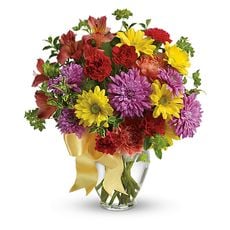
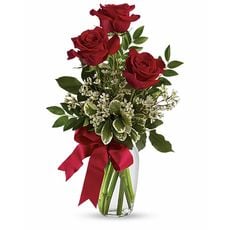
Four I would put in a beginner's hands
Not the prettiest four in the catalog. The four that reward what you have just read, whether you are keeping them or sending them.
What actually lasts, from my own bench
Typical days in a room around 70 degrees, clean water, food in it, out of the sun. No study behind this one. Thirty years of watching the same stems behave the same way is a different kind of evidence, and I would rather say so plainly than dress it up.
Nothing on the bottom half of that list is a bad flower. A sweet pea gives you three days and the best smell in the shop, and I would still send them. Know what you bought before you feel let down by it. Note where the florist rose sits: that is an average across a range the research puts at 4.5 to 18.8 days, which is why the variety on the sleeve is worth reading.
There is a second reason to read that list, and it has nothing to do with getting your money's worth. Put three stem types with different lifespans in the same jar and the arrangement rebuilds itself every day. The gerberas go first. The roses open properly around day five, which is when most people think they are past it. The chrysanthemums are still holding the shape after everything else has gone.
The best compliment that has ever come back to me through a caller was that her mother said the flowers looked different every morning. That was three lifespans in one vase, put there on purpose by somebody who already knew what the middle of the week was going to look like. Nothing lucky about it.
Handles it when an order goes wrong
Joan picks them. I am the one who deals with them when they go wrong, which is a part of this job nobody puts on a website.
So here is what happens after you order. It goes to a florist near your recipient and they build it that morning. If what shows up does not look like what you paid for, send us a photo the same day. I call that florist and ask what happened before the day is out. It nearly always comes down to a substitution somebody made without checking with you first. Fixable if we hear about it that afternoon. Close to unfixable if we hear about it in a review three weeks later.
The questions I actually get asked
So should I still cut the stems at 45 degrees?
Yes, but for a different reason than you were told. Angle it so the cut face cannot seal itself flat against the bottom of the vase. Use a sharp knife or florist snips rather than kitchen scissors, because scissors crush the vessels closed as they cut, which is a real and separate problem from the angle question. If all you own is scissors, open them wide and use one blade like a knife.
Can I just use sugar instead of the little packet?
Sugar alone will underperform the packet, and can do worse than plain water. Sugar feeds the stem, but it also feeds the bacteria building the film across the cut surface, so without a bactericide you are running the clog faster. If you are mixing your own, you need all three parts: sugar, an acid such as white vinegar, and a few drops of household bleach per quart. A splash of bleach rather than a few drops will scorch the stems.
Why did my roses last four days when the same bunch lasted a friend two weeks?
Almost certainly a different variety, not a different mistake. Across 38 Hybrid Tea varieties tested at one fixed temperature, vase life ran from 4.5 days to 18.8 days before anyone touched the care. Ethylene sensitivity varies just as widely: five of those varieties were unaffected by direct exposure, and others lost close to half their life to it. If a particular rose keeps disappointing you, note the variety name on the sleeve and ask for something else next time.
Mine looks flat and boring even though I bought good flowers. What am I doing wrong?
Almost always one of two things. Either everything is at the same height, or everything is the same flower. Section 05 has the fix. The quickest single improvement for a beginner is to add a filler tier around the rim, low and small, and cut three stems noticeably shorter than the rest so the arrangement has a front edge. Two minutes of work, and it changes the whole read.
Do the old tricks work? Aspirin, a penny, lemonade in the water?
They are all crude attempts at one of the three real jobs. Aspirin and lemon juice are acids, lemonade is sugar plus acid, and a copper penny is a very weak antimicrobial that stopped working properly when US pennies moved to zinc plating in 1982. None of them is a bad instinct. All of them are worse than the packet, because the packet does all three jobs at a dose somebody actually calibrated.
How many stems do I need for a first arrangement?
Fewer than you think. If you want a shape to aim for rather than a number, three focal blooms plus five textural stems plus eight fillers gives you a full hand tied bouquet, and you can halve every one of those for a small jar on a kitchen table. If you are sending rather than making, the elevator study in section 08 is the honest answer: one flower changed how a stranger behaved with no occasion attached to it at all.
Do I need floral foam to arrange at home?
No, and I would not start there. Crumpled chicken wire in the neck of the vase or a kenzan pin holder both do the job, cost less over a year, and are reusable more or less forever. Foam also holds a fixed water volume that you cannot see, which is the practical reason home arrangements built in foam tend to dry out without warning.
Flowers with the clock barely started
Everything above is about the days you can add at your end. The days you cannot add are the ones already spent before the bunch reaches you. A florist in or near your recipient's town builds it that morning from what they bought at wholesale, which is the whole reason the clock starts later.
Browse bouquets$16.95 flat rate delivery anywhere we cover. Order before 1PM on a weekday, or 10AM Saturday, and it goes out same day. Questions about a variety before you order, call 800-946-5457 and ask for me.