Shop By




That gap between garden expectations and rooftop reality is measurable, and it starts with the numbers most planting guides skip. A rooftop bed usually runs two to six inches of engineered substrate sitting on a membrane that was never built to hold a puddle, gets no afternoon shade unless a taller structure happens to throw one, and sees wind that behaves nothing like wind at ground level. The result is a strange kind of climate: baked and starved of water most of the year, then hit by gusts strong enough to shred a plant that would shrug off the same wind six feet lower down, in a backyard bed. A six-inch clay pot on a sheltered patio and an exposed rooftop parapet are not the same test, even for the same "drought tolerant" tag on the same nursery label, and that mismatch is where most green roof plantings quietly fail in their first season.
The environmental case for putting flowers up there anyway is real and worth restating, because it's easy to lose under the aesthetics. A vegetated roof slows stormwater that would otherwise hit the drain system all at once, it takes some of the heat load off the building underneath it, and in a city with almost no ground-level planting space, it is sometimes the only patch of soil a bee or a monarch is going to find between one block and the next. That upside disappears fast with the wrong plant list. It shows up with a short list of tough, low, deep-rooted-relative-to-their-height species that were bred by exposed hillsides and coastal cliffs long before anyone put them on a roof.
I know what you're probably thinking at this point: just tell me the five plants that work. Fair enough, they're coming. But the shortlist means nothing without the reasoning behind it, because the same five plants will fail on a windy Chicago high-rise and thrive on a sheltered Brooklyn walk-up, and no plant list can tell you which situation you're in. This guide goes further than "here are five plants that work." It covers the substrate depth and wind mechanics that decide whether a flower survives its first August up there, a shortlist of the species that hold, how to weave in native options for wherever the roof happens to be, what the planting does for pollinators in a city that has precious little else to offer them, and where the cut-flower trade and the rooftop-garden world quietly overlap. Joan, who has spent thirty years on the bench with cut stems rather than living roots, weighs in on that last part specifically. She knows which of these plants also turn up in a vase, and which ones never will, and why.
The Elevated Environment, By the Numbers
Extensive green roofs, the lightweight, low-maintenance type most buildings retrofit rather than the deep intensive systems built for full walkable parks, typically run two to six inches of substrate. Intensive systems can carry twelve inches or more, sometimes several feet where a real tree is involved, but that depth comes with a serious structural cost. A saturated extensive system weighs somewhere in the range of fifteen to fifty pounds per square foot depending on the substrate blend and drainage layer. An intensive system with real soil depth can climb past one hundred fifty pounds per square foot once it's wet through. That difference is not a design preference. It is a structural engineering conversation that has to happen before a single plant goes in, because most existing roofs were never framed to carry the extra load.
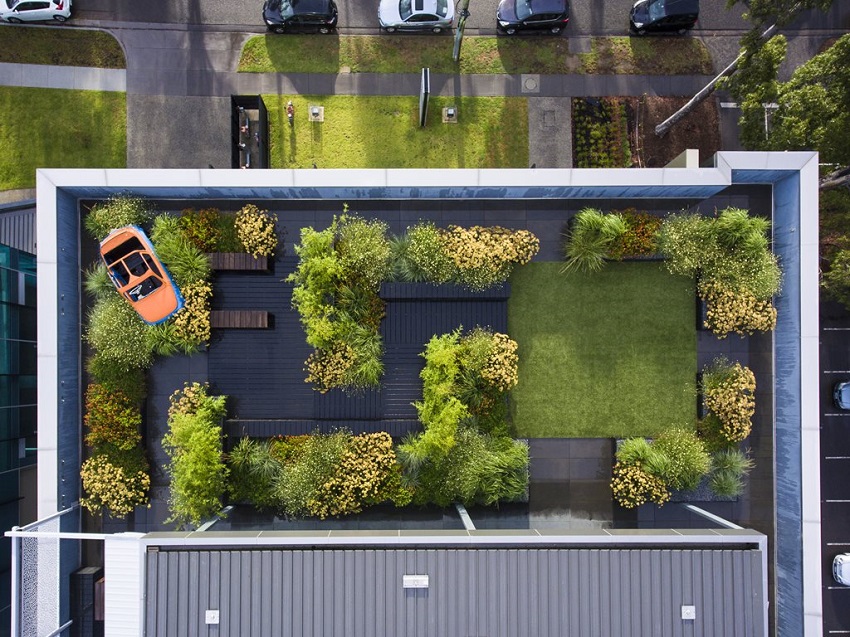
Wind is the part people underestimate most. Industry design guidelines in Europe (the FLL guidelines, which most U.S. green roof standards are adapted from) account for the fact that wind doesn't just blow harder at height, it accelerates sharply at parapets and roof edges, where air gets squeezed and speeds up the same way it does around a building corner at street level. A flower bed six feet in from the edge can sit in comparatively calm air while the same bed pushed against the parapet gets hit by gusts strong enough to shred broad leaves and snap upright stems. That's why the toughest, lowest-growing species belong at the perimeter and anything with height or a delicate bloom structure gets tucked toward the interior.
The payoff for getting the substrate and the wind exposure right is measurable. Depending on substrate depth and rainfall intensity, a well-built extensive green roof can retain somewhere between fifty and ninety percent of the rain that falls on it before any of it reaches a stormwater drain, which matters enormously in cities where old combined sewer systems overflow into waterways during heavy storms. That's not a marketing number. It's the plain engineering reason cities like New York and Chicago started offering incentives for green roofs in the first place.
I want to be straight about my lane before I say anything else. I don't know the first thing about waterproof membranes or how much weight a roof deck can carry, that's not my world and I'm not going to pretend otherwise. What I do know is the difference between a living root and a cut stem. A flower in a vase starts dying the moment it's cut, and thirty years on the bench taught me that the whole job is managing that decline, choosing water, temperature, and stem cuts to slow something that can't be stopped. A flower on a green roof is doing the opposite. It's trying to establish a root system in six inches of gritty substrate and keep itself alive on rainfall alone. Those were two completely different jobs every time I worked with them, and a plant that's brilliant at one can be useless at the other.
A six-inch substrate bed and a garden bed are not the same climate wearing different clothes. One of them is closer to a coastal bluff.Dennis, Lily's Florist USA
What a Rooftop Flower Actually Has to Survive
Four things decide whether a flower makes it through its first summer on a roof, and they compound on each other rather than acting independently.
Drought tolerance, the real kind
Not "can skip a week of watering." Extensive green roofs are usually watered heavily for the first six to twelve weeks after a spring planting to get roots established, then largely left to rainfall through the dry stretch of July and August. That means a plant needs the ability to store water in its own tissue (succulents do this in leaves and stems) or send roots wide rather than deep to catch whatever moisture is in that shallow substrate layer before it evaporates. Species bred for cliff faces, alpine scree, or coastal dunes tend to have this built in already, because that's the environment that shaped them.
Wind resistance at the growth-habit level
Height is the enemy. A plant that grows tall and upright presents a sail to the wind and a long lever arm at the base, which is exactly the combination that snaps stems or uproots shallow-anchored plants. Mat-forming, cushion-forming, or low-clumping habits survive because there's simply less plant for the wind to grab. This is also why a flower that performs beautifully in a sheltered backyard bed can fail completely six feet from a parapet.
Shallow, efficient roots
A plant with a deep taproot, the kind that would happily punch three feet down into open ground, has nowhere to go in a six-inch substrate bed. It hits the drainage layer and the waterproofing membrane and stops, then struggles in every dry spell after that. Fibrous, shallow, wide-spreading root systems are the ones built for this. It's a very different requirement from most cut-flower breeding, where root architecture barely matters because the whole point is what happens above the soil line.
Genuinely low maintenance
Rooftop access is a real constraint. Nobody is running up four flights with a watering can every evening, and most facilities crews visit on a schedule measured in weeks, not days. A flower that needs regular deadheading, feeding, or pest monitoring to stay alive is setting the planting up to fail the moment budget or staffing gets tight, which it usually does within a year or two of installation.
The Rooftop Shortlist
Five species that consistently clear all four bars above, drawn from what green roof horticulturists specify rather than what looks good in a catalog photo.
Sedum
Sedum spp., particularly S. album and S. spuriumThe default workhorse of extensive green roofs almost everywhere. Stores water in thick, fleshy leaves, spreads in a low mat that shrugs off wind, and roots in the top two inches of substrate without complaint. Blooms in dense clusters of small star-shaped flowers, usually late summer into fall, on top of foliage that stays interesting year-round.
Ornamental Allium
Allium senescens and related perennial typesThe taller option on this list, and the one that needs the most thought about placement. Clumping, grass-like foliage with round purple-pink flower heads on wiry stems. Shrugs off drought well once established but wants slightly more root depth than sedum, and does best set back from the parapet where wind is less brutal.
Chives
Allium schoenoprasumA shorter, tougher cousin of ornamental allium that doubles as an herb. Forms tight low clumps, tolerates the shallow substrate well, and throws round lavender-pink flower heads that pollinators visit hard. One of the few plants on this list that gives a rooftop planting a practical harvest, not just a display.
Lavender
Lavandula angustifoliaWoody, wind-tolerant, and drought-hardy once mature, which makes it a strong pick for wind exposure. The catch is root depth. Lavender wants better drainage and slightly more substrate than true succulents, so it tends to do best in the deeper pockets of an extensive system or in a lightweight raised bed within an intensive one, not the shallowest two-inch zones.
Ice Plant
Delosperma spp.A succulent groundcover that rivals sedum for pure toughness, with the added benefit of daisy-like flowers in bright pinks, oranges, and purples that open in full sun and close at night. Sprawls low and wide, roots shallow, and tolerates reflected heat off a roof surface better than almost anything else on this list.
Rooftop Flower Shortlist, Rated
How each species copes with the three conditions that decide survival on an extensive green roof. Longer bar means better suited.
Here's where I can add something specific, because this is squarely my world. Lavender and ornamental allium turned up in my bench work regularly over the years, cut for bouquets, dried arrangements, and a fair number of weddings. They behave like cut flowers because their stems are built for it, upright, structural, with a vascular system that keeps drinking water after the cut. Sedum and ice plant almost never made it into a vase in thirty years, and it's not because they're unattractive. Succulents don't wilt the way other cut flowers do, but they also barely rehydrate through a cut stem, so a sedum head in water just sat there looking roughly the same for a week and then quietly started to go soft from the base. Different physiology entirely. Chives held for three or four days if you caught the flower heads before they fully opened, but I can't remember anyone specifically asking for them. That's the honest split. Some of what thrives up on a roof has nothing to offer a florist, and that's fine. It's not supposed to.
Bringing in Native Species
The shortlist above works almost anywhere, which is exactly why it shouldn't be the whole plan. A roof planted entirely in the same handful of imported, catalog-standard sedums looks the same in Portland, Phoenix, and Pittsburgh, and it misses the biggest opportunity a green roof has: functioning as habitat for the specific insects and birds that evolved alongside the plants native to that region.
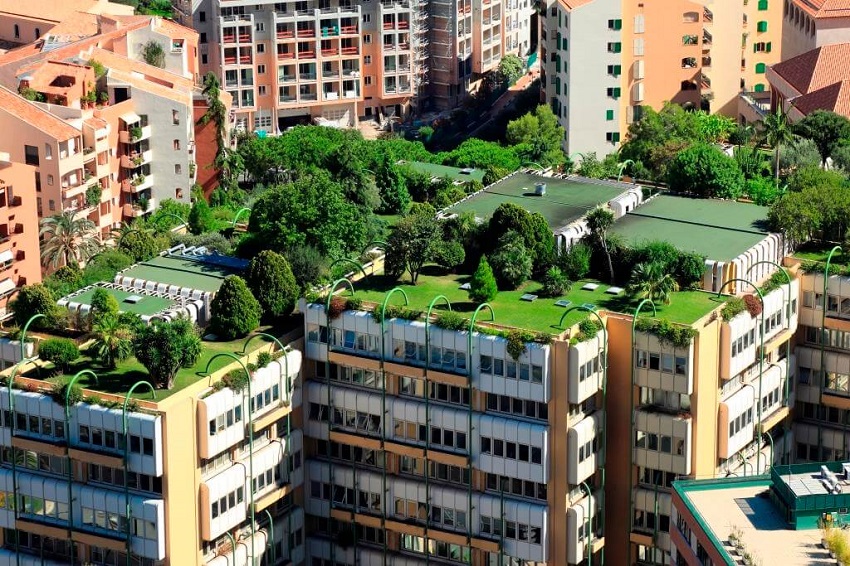
The good news is that most regions have a native equivalent to the workhorse species above, sometimes several. The Northeast and Mid-Atlantic have native stonecrops like Sedum ternatum and tough little bunchgrasses such as poverty oatgrass that handle thin, dry soil naturally. The Southeast and Piedmont, Joan's part of the country, have native asters and coreopsis that take heat and thin soil in stride once established, plus native sedums of their own in rockier terrain. The desert Southwest has native ice-plant relatives in the purslane family that fill the same low, succulent, drought-proof niche without importing a South African species. A rooftop planted with even twenty to thirty percent regional natives worked in alongside the reliable non-natives gets meaningfully closer to functioning like real habitat, not just a green-colored surface.
The tradeoff shows up in performance, and it's worth being direct about it. Native species selected specifically for extreme, thin-soil conditions (a rocky outcrop, a coastal bluff, a barren) tend to be reliable rooftop performers. Native species from richer woodland or meadow soil often are not, because a green roof's substrate has almost nothing in common with the ground they evolved in. Match the native plant's original habitat to the roof's real conditions: a rocky outcrop or coastal bluff, not the woods behind it. That's the working rule, and it holds regardless of which region a roof happens to be in.
What This Does for Pollinators, and When
In a dense city, a green roof can be one of very few unbroken patches of flowering plant material between the ground and the sky, which counts for more than it sounds. Urban ecologists have documented bees, butterflies, and other pollinators using green roofs as stepping-stone habitat, small waypoints that let a population move between larger green spaces it otherwise couldn't reach across blocks of pavement and glass. A rooftop planted for one dramatic bloom period in June and then mostly finished for the rest of the year does less of that work than one planted for a long, staggered bloom season.
This is where the five-species shortlist complements itself well, because their bloom windows barely overlap.
Rooftop Bloom Calendar
Typical bloom windows for the shortlist above, staggered across the growing season so something is usually flowering for pollinators.
Planted together, the five species hand off from May through October, roughly six months of continuous forage for anything flying past at rooftop height.
That handoff is the design principle at work: choose bloom windows so the gaps between them close, and plants that look good together tend to follow on their own.
Where the Technology Has Moved
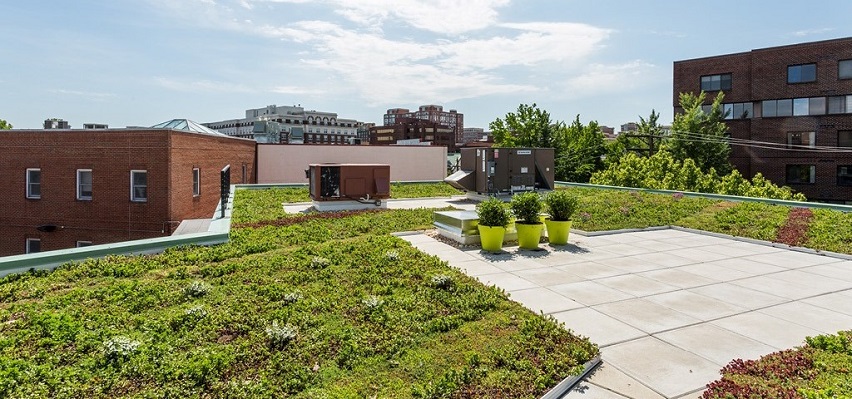
The biggest shift in green roof construction over the last decade has been the substrate itself. Early green roofs often used something close to real topsoil, which is heavy, compacts over time, and holds too much water for the drainage layer to clear in a downpour. Modern engineered substrates blend expanded shale, expanded clay, or pumice with a small percentage of organic matter, which cuts the saturated weight dramatically while still holding enough moisture and nutrients for shallow-rooted plants to establish. That single change is a large part of why extensive green roofs became structurally feasible on far more buildings than they used to be.
Irrigation has moved the same direction: away from constant coverage and toward smart, minimal intervention. Drip lines paired with soil moisture sensors now let a system water only when substrate moisture drops below a set threshold, rather than running on a fixed timer regardless of recent rainfall. For a plant list built around drought tolerance in the first place, that kind of irrigation is really just a safety net for the establishment period, not a long-term crutch.
None of this happens well without the two disciplines that used to barely speak to each other collaborating from day one. A structural engineer has to sign off on load capacity before a horticulturist gets to choose a single plant, and a horticulturist has to flag microclimate and wind exposure issues before a landscape architect finalizes the layout. The green roofs that fail within a few years are, more often than not, the ones where a beautiful planting plan got handed to a structural team after the fact instead of built alongside it. I'll admit that's a frustrating way to learn a lesson, watching a good plant list die because two teams never sat down together early enough, but it's the honest reason so many first attempts at a green roof don't make it to year three.
A Couple of Roofs Worth Knowing About
Brooklyn Grange, spread across rooftops in Long Island City and the Brooklyn Navy Yard, is probably the best-known large-scale rooftop growing operation in the country, farming several acres across its sites and hosting events, workshops, and a working apiary above the street. It's intensive rather than extensive in parts, with deeper soil than a typical retrofit roof, but the underlying lesson holds either way: once the structural and drainage questions are solved properly, a roof can support a genuinely productive planting, not just a decorative one.
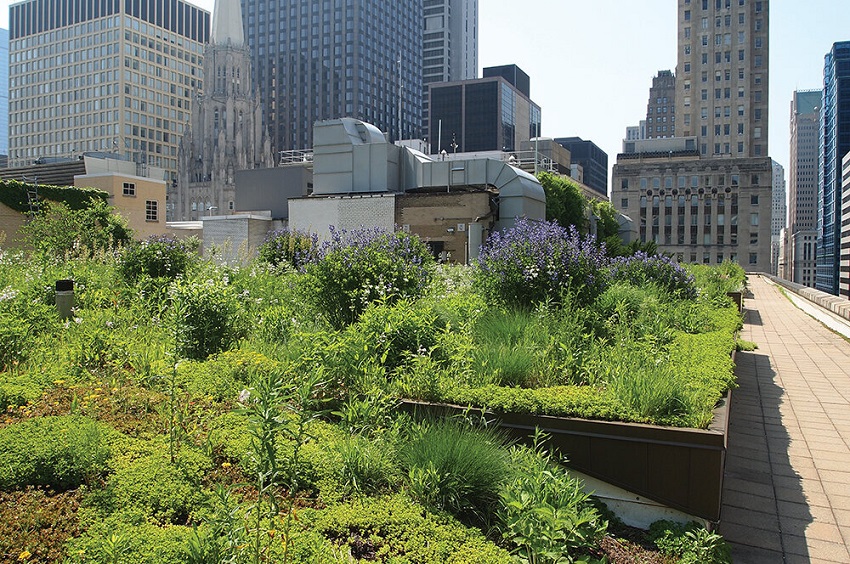
Tokyo has taken a different path with the same underlying idea. A number of office towers there have added rooftop green space that blends compact Japanese garden traditions, bonsai and clipped shrubs among them, with the same tough sedum groundcovers used everywhere else, because sedum solves the same weight and drought problem regardless of the design language sitting on top of it. The aesthetic differs completely from a New York rooftop farm. The substrate and structural math underneath it does not.
Further Reading
A few more places to go if rooftop and small-space growing has your attention, plus one on how flowers move once they leave the ground.
If the roof planting is done and you're after something for the deck itself, a table, or a housewarming gift for whoever just finished the build, our potted plants collection covers low-maintenance options that handle a slow ride up without wilting. For everything else, our florists build it fresh the day it ships.
Browse Potted PlantsLily's Florist USA works with 15,000+ partner florists across the country.
Same-day delivery when you order before 1PM weekdays or 10AM Saturdays.
Questions? Call 800-946-5457 or email [email protected].
About the Contributors
This guide was written by Dennis, with floristry guidance from Joan and an operational note from Andrew. Read our full story.