Shop By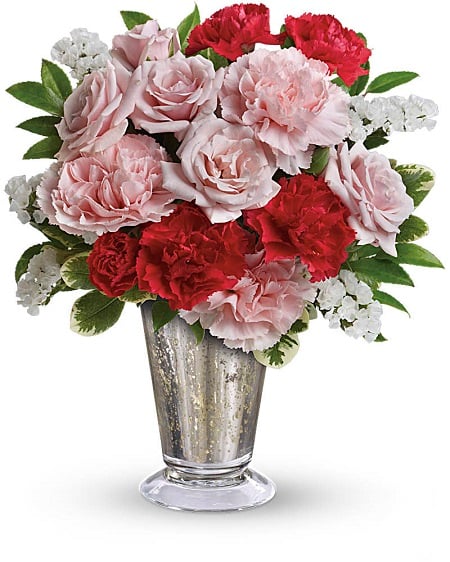


Flower Delivery Thomasville NC, Past the Big Chair
Everybody knows Thomasville by the thirty-foot chair at Main Street and Highway 109, up since 1951 and on the florist's route most days. What decides whether your flowers arrive is duller than that. Half these addresses are not streets in town, they are county roads where the number is on a post at the road and the house is up a gravel run, and from three states away you cannot check any of it. So the florist asks for a cross street before the van leaves. Every time.
Flowers from under $60 with $16.95 flat delivery. Same-day cutoff is 1PM weekdays and 10AM Saturdays. Call 800-946-5457 if you want to talk it through.
Florist Guidance
Sending into a service, a care campus or a hospital bed, and what holds up in each
Joan, NCCPF Certified Florist · 30 years on the bench · 40,000+ arrangements · about our team
Most people who land on this page are sorting one of three things from a long way off. A service. A room on a care campus. A hospital bed. None of it is checkable from where you are sitting, and the person you would normally ask is usually the person you are sending to. So here is what I would tell you on the phone, in the order it comes up.
Southern funerals are where I spent most of my career, and the flower load at a service in this part of the state runs heavier than almost anywhere in the country. Family takes the casket spray. Friends, coworkers, the church circle, the neighbors, they all send standing sprays and baskets until the room fills, and that garden effect is deliberate. One question sorts most of the calls I take: are you family, or a friend. Family gets walked toward the casket spray conversation. Everybody else toward a standing spray on an easel.
Thomasville is not one tradition, though. Close to one in five people here is Black and about one in six is Hispanic, and from what callers tell me those services want different flowers than a quiet Methodist funeral does. A homegoing is a celebration and the flowers are supposed to say so: purples and golds, custom shapes, hearts and crosses and lettering, visitation running across more than one day, and sometimes a separate car in the procession carrying nothing but the tributes. For a Catholic Hispanic family the velorio is the flower event, so the delivery wants to be at the funeral home the evening before, ahead of the vigil. Not the morning of the Mass. I ask about the tone and the timing before I recommend anything, because getting either one wrong is the kind of mistake nobody tells you about afterward.
For anything headed to Novant Health Thomasville Medical Center, two things decide whether the flowers reach the room. The first is the name. US hospitals keep a directory of admitted patients and a patient can opt out of it at admission, so the florist needs the full legal name as it was registered. Margaret Elizabeth Thompson, not Mom. If reception says they have nobody by that name, in my experience that often means the directory, not the ward, and a call to the patient sorts it out. Get that detail wrong and your flowers wait in a holding area two floors below somebody who never learns they arrived. The second is size and format. Bedside tables in a 146-bed hospital are not generous, an arrangement wants to run about one and a half times the height of its container, and it needs to arrive already sitting in water. A bunch wrapped in paper means somebody on the ward has to find a vase, cut the stems and fill it, and that rarely happens fast.
Skip lilies. The pollen travels on staff clothing from room to room, which is why most systems I deal with name them specifically. If somebody has their heart set on the look, pollen-free Asiatic varieties exist with sterile anthers and no scent, and a florist can order to that. The ward matters as much as the flower. This hospital runs an outpatient cancer center, and a day infusion visit is not the same call as an inpatient oncology admission, so I ask which one before I answer. And for what it is worth, the evidence is on the side of sending. A randomized trial of ninety surgical patients found the ones with flowers in the room needed fewer painkillers and rated their pain and their anxiety lower, and ninety-three percent said they would choose the same room again. Nobody sends flowers because of a trial. It is still a decent answer to anyone who calls them a waste.
Piedmont Crossing, Pine Ridge, Magnolia Gardens. Three care campuses inside the city limits is a lot for a town of twenty-seven thousand where fifteen percent of people are past sixty-five, and the calls I take for them are different again. Around a third of skilled nursing residents share a room, so a large arrangement claims half a bedside table and becomes the staff's problem by Thursday. Small, stable, sitting in its own water. In memory care, non-toxic stems only and no glass, because residents sometimes try to eat the flowers or drink the vase water. Send stems the resident recognizes, roses and daisies and carnations, not something built to photograph. I stood on concrete for thirty years making arrangements for rooms like those, and the ones that worked were never the showiest.
Now the part everybody asks last and worries about first. Central North Carolina is humid enough in summer that petals stay hydrated longer than they would in Phoenix, and the warmth speeds up everything else regardless. Respiration roughly doubles for every 18 degrees Fahrenheit a room climbs, so a gerbera that runs ten days in a house held in the low sixties gives you five or six on a screened porch in July. Which is why I steer people toward chrysanthemums and carnations. Chrysanthemums get a bad name from people who think they look cheap. Those people have never watched a good florist build with spider mums. A disbud chrysanthemum holds two weeks in a seventy-degree living room and standard carnations do close to the same. Hydrangea is the one I talk callers out of most weeks, because no commercial stem gives up faster in a warm room, sometimes inside a few hours. And the number worth caring about is not the vase-life figure on a chart. It is whether she is still shifting them off the table to eat dinner in week two.
Carnations come with one warning attached. A carnation is about as ethylene-sensitive as a cut flower gets, and ethylene comes off ripening fruit. Set the vase on the kitchen counter next to a bowl of bananas and the petals curl in on themselves inside a day, which the recipient reads as bad flowers. The fruit bowl finishes more arrangements around here than the heat does and nobody thinks about it. Dining table, not kitchen counter. Chrysanthemums do not care either way, which is another reason they get the nod. Same goes for the ceiling vent. Central air runs in this county from May through September, it is very good at temperature and very poor at humidity, and the air directly under a vent sits near thirty-five percent. Move the vase out of that draft and you buy days.
The flowers did not grow here. North Carolina does very little commercial cut flower growing, some specialty stems and native wildflowers and that is close to the whole list. So most of what gets built for a Thomasville address grew at altitude in Colombia or Ecuador, flew into Miami, and came up the Southeast pipeline by refrigerated truck within a day or two of clearing customs. Every hour on that road is an hour of stored energy the stem has already spent. It costs roughly a day of vase life against what an Atlanta florist pulls off the same shipment, and a good florist closes most of that gap by recutting on arrival and rehydrating in conditioned water held between thirty-three and thirty-eight degrees. What no florist can do is make a sweet pea survive the leg. Which is the real reason the mixed bunch built near here leans on the stems that travel.
People rarely ask this one out loud. On a hundred-dollar order the platform takes its commission, delivery and materials come out, and the florist is building with somewhere around fifty dollars of flowers. So the sweet spot on this site is not the top of the range. Between sixty and eighty dollars, most of what you pay turns into stems. Above that you are largely paying for size, and size is the thing a photograph exaggerates. Spend more when the arrangement has to carry a whole room. Spend under sixty and the florist is working with very little.
And if you want one answer and no reading: a mixed arrangement of chrysanthemums and carnations, in its own water, sixty to eighty dollars, sent to the house instead of the ward. It lands right more often than anything else I could tell you from here.
Same-day cutoff
1PM weekdays, 10AM Saturdays
Or call 800-946-5457
Our NC office, Mon-Fri
What people send here, and how to get it right
Three things dominate what comes through Thomasville: a service, a care-campus room, and a hospital bed. Those are the orders where getting the format wrong actually costs you something, so they get the space below. If yours is simpler than that, get well flowers and the birthday range are two clicks away and neither needs a briefing.
What to send when the service is in Thomasville
Funeral home or the family's house. Two different gestures, and the answer changes what you order, not just where the van goes. J.C. Green and Sons has been on West Main since 1895 and S.E. Thomas is over on Highland, and both are used to taking flowers ahead of a viewing. Holly Hill Memorial Park on West Holly Hill Road is the other half of it, fifty landscaped acres with paved walkways, running since 1947 on a perpetual care trust. Some Thomasville families are buried out at the Jamestown park instead, so confirm which one before you order.
Then get one more thing from the family: which section. Holly Hill sells upright headstones, larger monuments, ledger stones, lawn crypts, community and outdoor mausoleums and columbarium niches, and the sections carry names, not numbers. Garden of Memory. Gentle Meadow. Woodland. That answer changes the arrangement, and Joan will tell you why faster than I can. If the service is at a chapel or a church first, sympathy flowers for the service want to be there an hour or two ahead, not on the hour.
Joan, NCCPF Certified Florist
Most people calling for a funeral do not know the difference between a casket spray and a standing spray, and they should not have to. The spray lies on the closed part of the lid, anchored with adhesive clay or clips, and that one is usually immediate family. A spray that slides during a viewing is the worst thing that can happen in that room, which is why it gets anchored, and why an open casket moves it down to the foot end so it is not across the viewing. A standing spray goes on a wire easel, five or six feet at the apex, and that is friends and coworkers and the wider circle. Now the section. On a monument or a ledger stone you have a stone surround to seat a vase against. On a flat bronze marker or an open lawn section you have nothing, and a tall vase on level turf goes over the first time the mower comes through. Wreaths and sprays lie flat and stay where they were left. On color I hold to whites and creams and soft green unless the family has asked for something, because those tones do not compete with what is already in the room. Sometimes a family wants their father's yellow roses. Then you honor that.
Pick the destination
Same grief, five different orders
The format is decided by where the flowers physically end up, not by how much you spend. Tap where yours is going.
It reads from across a full room, which is the job. Give the funeral home an hour or two of head start, not the service time itself, and name the venue in the delivery notes so the director knows which room it belongs in. Immediate family sending the primary tribute wants the casket spray instead.
A flat bronze marker or an open lawn section gives a vase nothing to seat against, so anything tall tips the first time the ground gets mown or the wind gets up. A flat-backed sheaf or a wreath sits on the surface and stays put. Confirm the section with the family before you order, because a monument or a ledger stone changes this answer completely.
A niche is a small opening with a shelf, and standard sprays do not fit into one. They get moved, usually to the floor. Ask for something built tight and low, and tell the florist it is going to a niche or a crypt front, not a plot, because that is a different build from the ground up.
The house order usually lands a day or two after the service, once the visitors have gone and the quiet starts. Nobody in that house is trimming stems and hunting for a vase. Send it already in water. This is the one that gets remembered longer than the service flowers do.
Not family, and the service has already happened. A dish garden or a plant to the house says something a bunch of cut stems cannot, because it is still on the kitchen counter in six weeks when everything else has been thrown out. Two weeks after the funeral is the window most people miss.
Her room is smaller than her house was
Somebody moved onto a campus this year and you have not been down to see the room yet. You have a phone number, a building name, and a rough idea of a bedside table. Most of these orders start there. Piedmont Crossing runs sixty-one acres of cottages and apartments through to skilled nursing, Pine Ridge is a hundred and fifty-four beds on Piney Wood Road, and Magnolia Gardens is over on Blair Street. All three take flowers at reception and staff carry them in from there, which means the arrangement has to survive a desk and a hallway before it ever reaches her.
The honest version: a monthly miss you order does more work in a place like that than one enormous delivery at Christmas. And plants outlast the visit by months, which matters if you are three states away and cannot get back until spring.
The call I take most often for those campuses opens with an apology about the budget. Somebody has been sending the biggest arrangement they can afford every few months, out of guilt, and it has not been landing. The question that unlocks it is whether the resident has a roommate, because about a third of them do. The big ones get shifted to a windowsill and then to the nurses' station, because there is nowhere to put them. Drop the size, put it in a low container that holds its own water, and set it to go monthly instead. What happens next is the part I did not expect the first few times. The resident starts telling the staff which week the flowers are due.
Order by 1PM on a weekday and it goes out today. Saturday the clock stops at 10AM.
Sympathy and funeral flowersSending flowers to a hospital room you have never seen?
The medical center on Old Lexington Road is one of the shorter runs in the florist's day, which is the easy part. The hard part is that you are ordering blind. You do not know the ward, you may not know the room, and you have no idea whether the flowers will still be there tomorrow. So here is the mechanical answer. The florist hands them to the front desk, because delivery drivers do not walk clinical floors at US hospitals. A volunteer or a staff member carries them up from there. Front desk to bedside runs anywhere from half an hour to most of a morning depending on the ward and the day. Put the patient's full legal name in the delivery notes and hospital flowers will find them.
One local detail worth knowing: this hospital runs a certified Baby Friendly maternity center with a Baby Café on site, so a decent share of what goes in there is a congratulation rather than a get-well. Maternity stays in this country can be finished inside two days, so new baby flowers either land the first morning or they are better off going to the house.
Half the hospital calls I take end with the flowers going somewhere else. If it is a day procedure, or the discharge is tomorrow, send them to the house. The room version means an arrangement waiting at a front desk while the patient is being wheeled down for imaging, and then a family member carrying it out to the car on the same afternoon they are carrying everything else. The house version arrives to somebody who has time to look at it. When it genuinely is a longer stay, small and low-scent will be fine on a general ward. The wards where it will not be fine are the ones where I ask people to call first, and I have never once regretted asking.
Save this
Where flowers get through, and where they get turned around
What Joan tells callers, and what our partner florists run into at reception. This is the general US pattern, not one facility's rulebook.
In a hospital
On a care campus
Anywhere clinical
The restrictions are about immunocompromised patients, not about flowers being dirty. The CDC's own position is that hospital flowers are no more contaminated than the ones on a restaurant table. Policies still move around by facility, by ward and by patient, and one call to the ward settles it in about ninety seconds.
Still not sure what to send?
Plenty of what comes through here does not fit any of the three above. A neighbor has been unwell for months and nobody has named it. Somebody is going through a rough stretch and you heard about it secondhand. Joan goes one particular direction with those.
The Dish Garden is where I send the callers who cannot pick a lane. A peace lily in the middle, parlor palm behind it, ivy and philodendron trailing over the rim of a white ceramic bowl. And yes, I have just spent this page telling you to skip lilies at a hospital. A peace lily is a Spathiphyllum, a different genus altogether, no airborne pollen and no scent, so those two pieces of advice are not fighting each other. Five or six plants sharing one set of conditions, so it wants a bright spot out of the path of a heating vent and very little else. The ivy usually goes first and I tell people to expect it. What survives is the reason it works in this town: a room on a care campus where nobody has time for water changes, and a house two weeks after a funeral when the cut flowers have gone in the bin. If it is headed for a hospital ward, send cut stems instead, because the soil is what gets it turned away at reception. Order the dish garden for a house or a care room and you have made the right call.
How to order flowers to Thomasville
Our NC office, Monday to Friday.
1PM weekdays, 10AM Saturdays. Sunday delivery for Mother's Day only.
Saturday is the tight one. A viewing on a Saturday afternoon needs the order in by 10AM, not by lunch.
$16.95 flat to any Thomasville address.
The florist near town often works the same corridor as the High Point shops, so this is a known run, not a favor.
Same-day is a route, not a taxi. Think of a school bus run: your order joins a loop the florist has already planned by geography, which is why the cutoff exists and why an address out past the city limits gets slotted differently from one on Randolph Street. Flowers cannot be left in a mailbox, and out there the number on the road is often the only number there is.
So give the delivery notes a cross street or a driveway description and a phone number for the recipient, and a florist close to the area calls ahead instead of guessing at a gate. For a campus, name the building. For a service, name the funeral home or the section at the cemetery. Those two lines do more for a delivery here than anything else you can type.
Order before 1PM and it goes out on this afternoon's run.
At the Counter
Spray number twenty-seven, and the thing I learned to watch for
I ran a shop in Greensboro in the early 2000s, about fifteen miles from where you are reading this, and the funeral program was the steadiest line in the business. A heavy week was twenty or thirty sprays between Monday and Friday. What that volume teaches you is not artistry. It is that spray number twenty-seven on a Friday afternoon is somebody's mother, and the family walking into that room has no idea it is number twenty-seven. You do not get to phone that one in.
The tell I learned to watch for was the clay. A casket spray has to be anchored to the lid with adhesive clay or clips, and a spray that slides during a viewing is the worst thing that can happen in that room. The shops that had actually stood in a chapel anchored them properly and built to the lid they were given. The shops that had not made beautiful sprays that moved. I still ask which venue when a caller names a service, because a florist who knows the room builds for the room.
Joan, NCCPF Certified Florist. Burlington 1988, the Research Triangle through the nineties, a Greensboro shop in the early 2000s, on our phones since 2018.
After you order
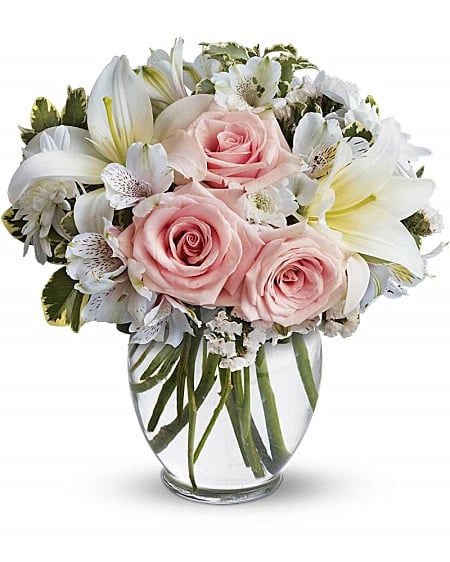
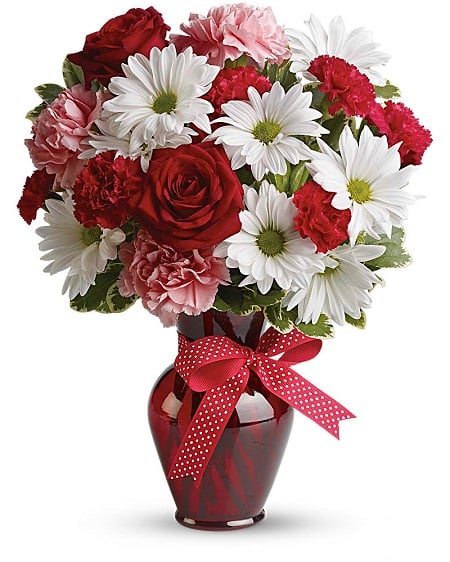
Here is the part nobody explains, so I will. Your order comes into our office, we match it to a partner florist in or near Thomasville, and they build it that morning from what they bought at market. Nothing sits in a warehouse and nothing gets boxed and shipped across three states. Which raises the thing you are probably already wondering about, having just scrolled past the photos. The photo is usually the premium size. If the stems in it did not come in strong that morning, the florist substitutes to match the color and the value, not the picture. So what arrives may not be the image. What arrives is built from whatever was genuinely good that morning, and that is the trade you are making. I would rather say it here than let you discover it on a doorstep.
There is no tracking bar counting down either. There is a desk in a small office in North Carolina, a phone, and one of seven people to answer it. If something needs to change after you have ordered, the address, the card, the day, call 800-946-5457 or email [email protected]. I will be honest about the limit: once the van has left the shop we are chasing a driver, and that is a phone call rather than a click. Earlier is easier. And if the recipient has not messaged you by evening, that usually means the flowers are on a hallway table and she is on the phone to her sister. It is almost never bad news.
From Bonnie, who picks up when something is wrong
The mistakes I have made most are addresses. A unit number typed into the wrong field, and the driver ends up at the right campus with no idea which building. That one is on me every time, and the fix was not trying harder. Now the address gets read back on every order that comes through the phone before the ticket closes. And if you want a Saturday, call before 10AM, because after that I am booking you for Monday and I would rather say so now than at four in the afternoon. Same number, same person picking up.
Between Joan on the guidance, Bonnie on the desk, and a florist who has driven these roads before, there is not much left for you to manage. Which is the point of paying somebody.
Browse other categories
Or browse by occasion
We also deliver nearby