Shop By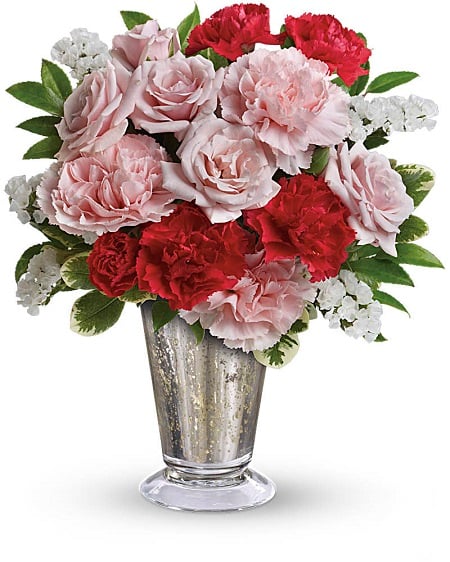
If you only have 30 seconds
- Bees are close to red-blind. Most red flowers didn't evolve to attract bees at all. They evolved to catch the attention of birds, and to stay invisible to a pollinator that mostly just steals nectar.
- There is no single "red pigment." Three unrelated chemical families, anthocyanins, carotenoids, and betalains, each independently arrived at red, and none of them fade or hold color the same way in a vase.
- Shade changes the message. A clean, bright red rose reads as straightforward romantic love. Deep crimson, closer to wine than fire-engine red, has historically carried a heavier reading, closer to grief than romance.
- Red is not universally romantic. In large parts of East Asia, white is the color of mourning and red is reserved for weddings and celebration, the near-opposite of the American convention.
- Red fades faster than any other common bouquet color in direct sun, a real chemical vulnerability, not a quality complaint.
- Valentine's Day compresses a huge share of a year's red flower demand into about ten days. Industry estimates put yearly rose production for the holiday above 250 million stems, most of them red, which is why prices spike and your order likely landed in Florida within the last couple of days.
- Not every viral "ancient meaning" is actually ancient. The red spider lily's reputation for having over a thousand folk names is real and centuries old. A lot of what circulates about it online is modern anime and pop culture layered on top, not a straight line back to antiquity.
You're standing in front of a bucket of red flowers, trying to work out if they say the right thing. Or scrolling past a photo of them on a screen, same question. Rose. Carnation. Something in between. Red feels like the safe, obvious choice right up until you have to pick one, and then it stops feeling safe at all.
I know what you are probably thinking. It is a flower. How complicated can red be? Fair question. The answer turns out to be more complicated than the color swatch at the flower counter lets on. Botanists still argue about why red exists in nature in the first place. Victorians built an entire coded alphabet out of it. And in more than one country, the exact bouquet that says "I love you" through one of our 15,000 partner florists says something closer to "congratulations" at a memorial service.
This guide pulls all of it into one place, the biology, the folklore, and the buying advice, checked against real floristry practice by Joan, who has been on the phones at Lily's Florist USA since 2018 after thirty years on the bench in North Carolina before that. I wrote it. Andrew added the one number that matters most if you are ordering red roses in the second week of February.
None of it is complicated once someone walks you through it. That is the whole point of this page.
In this guide
Why Are Flowers Red, Really?
Ask a botanist why so many flowers are red and you get an answer that sounds backwards at first. It might be because bees can barely see them.
Bees see a narrow slice of the light spectrum, weighted toward ultraviolet, blue, and green. They are missing the receptor most animals use to register long wavelengths, which means pure red reads to a bee closer to a flat, low-contrast smear than to the vivid color we see. A red poppy against green leaves barely registers to bee vision. A red hibiscus practically vanishes.
Birds see the opposite way. Hummingbirds and other nectar-feeding birds have strong long-wavelength vision, so red stands out to them sharply against green foliage, the same way it does to us. Researchers studying hummingbird-pollinated plants in the eastern United States found more than half of them are red or orange, a huge overrepresentation given how rare pure red is across flowers generally. The leading explanation, the bee-avoidance hypothesis, argues plants evolved toward red partly to filter out an inefficient visitor. Bees often just steal nectar without moving much pollen between plants. Birds carry it much further per visit. Red became the color that quietly excludes one pollinator while still catching the eye of the one that actually does the job.
I don't think about photoreceptors on the phone. What I think about is that red fades faster than anything else in the cooler, and I've watched it happen on a hundred delivery photos. I love giving people red. It's the one color everyone already knows how to read without a card explaining it. It's also the first color I have to warn them about, because it's also the first color that goes.
None of that explains where red comes from at a chemical level, and here the plant kingdom gets stranger. There is no single "red pigment." Three unrelated chemical families independently arrived at red, in different plants, for different biochemical reasons.
Anthocyanins are the most common, water-soluble pigments in the petal's cell sap, the same family behind red apple skin and purple blueberries. Their shade shifts with the acidity inside the cell, more acidic toward red, more alkaline toward blue and purple, part of why one red rose can read a slightly different shade than the next. Carotenoids work differently, fat-soluble pigments in structures called plastids, the same family behind orange carrots and yellow daffodils, concentrated dark enough in some flowers to read red rather than orange. Many red tulips and dahlias lean on carotenoids. Betalains are the outlier, occurring in only one plant order, and a species makes betalains or anthocyanins, never both, ever. Bougainvillea and the deep red of a beet root both run on betalains.
The practical consequence for anyone buying red flowers: "red" is not one stable chemical. Three different systems are behind it, and each responds to heat, light, and time differently.
Red didn't evolve to be noticed by everything. It evolved to be noticed by exactly the right thing, and ignored by almost everyone else.Dennis, on why red flowers exist at all
What Red Flowers Actually Mean
Red rose equals romantic love is the one piece of floriography that never needed decoding, and it predates the Victorians who get most of the credit. Greek and Roman mythology already tied the rose to Aphrodite and Venus, and Roman writers scattered rose petals at weddings the way modern florists use confetti. What the Victorians actually did, once a British ambassador's wife brought home her own version of a Turkish gift-giving custom, was formalize hundreds of these associations into published dictionaries anyone could buy.
Shade did real work inside that system. A clean, saturated red rose meant straightforward romantic love, no hedging required. Deep crimson, closer to wine than fire-engine red, carried a heavier reading, closer to mourning and to love that had already cost something. Victorian dictionaries kept the two separate instead of treating them as shades of one message.
| Flower | Victorian Meaning | Where It Diverges Today |
|---|---|---|
| Red Rose | Passionate, unwavering romantic love | Still the default. Nothing has replaced it in over 150 years. |
| Red Tulip | A declaration of love | Still reads romantic, just rarer and less loaded than a rose. |
| Red Carnation | "My heart aches for you" | Often mistaken for simple romance. It is longing, not joy. |
| Red Chrysanthemum | Cheerfulness, "you're a wonderful friend" | Reads friendly in the U.S. Reads funeral in France and Italy. |
I don't need the chemistry to tell you what I've watched happen on delivery photos for years. A red rose sitting in a window that gets afternoon sun turns dusty pink within about thirty-six hours. Doesn't matter if it's June in Raleigh or February anywhere warm enough to get direct sun through glass. The lighter colors in the same bouquet will hold fine for another week. Red goes first, every time. If I'm on the phone with someone sending red anywhere south-facing, I tell them straight: hallway table, not the windowsill. It's a fifteen-second fix once you know it's coming, more on that near the end of this guide.
That gap, between "I love you" and "I'm thinking about you," is where a lot of real orders land. Not every red bouquet is a declaration. Plenty of senders want red specifically because it reads warm without reading romantic.
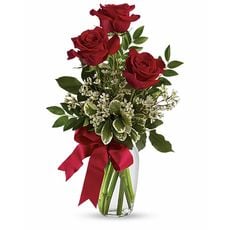
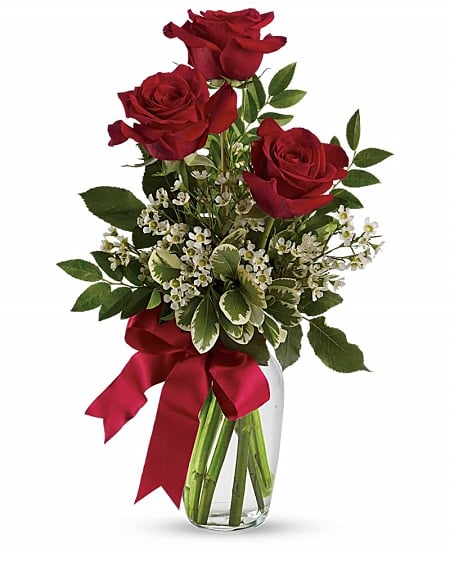
Three red roses in a small glass cylinder, a light dressing of baby's breath, a red ribbon at the neck of the vase. Joan doesn't sell this one as a romantic gesture. It's the coworker whose mother just had surgery, the friend halfway through a rough divorce, someone on your mind who you want to know it without a card that oversells the moment. The three stems are picked deliberately at different opening stages, so the bouquet keeps changing over its first few days instead of peaking and dropping all at once. The exact rose variety flexes a little by what the florist has in the cooler that morning. The three-rose count and the staggered bloom are the constant, not the specific stem.
Timing changes the read, too. Early in a relationship, red roses can feel like a bold, slightly nerve-wracking declaration, a gift that says something before the relationship has officially said it. Ten years in, the same rose can read as the comfortable default, sweet, but sometimes coasting on habit rather than a choice someone actually considered. Neither read is wrong. It's worth knowing which one you're sending before you hit order.
Red and the Body
Strip away the folklore and red still does something measurable to people looking at it. Red consistently raises heart rate and draws the eye faster than cooler colors, part of why it shows up on stop signs and clearance tags as much as Valentine's cards. In some traditions of Hindu and Buddhist thought, red ties to the root chakra, physical vitality and survival instinct, not romance specifically, a different read from the Western shorthand and worth knowing if the recipient holds that framework.
Red Around the World: Weddings, Funerals, and What the Color Actually Signals
Red carries close to the opposite emotional charge across large parts of Asia from what it carries in the American market, and the reversal runs in exactly the direction you would not expect.
In Chinese culture, red is the color of luck, celebration, and new beginnings. Brides traditionally wear red rather than white, money gifts come in red envelopes, and New Year decorations lean almost entirely red and gold. White, by contrast, is the traditional mourning color, worn by grieving families in Chinese and Vietnamese tradition alike. In Buddhist funeral tradition more broadly, red goes from merely wrong to a specific, hard avoid, a single red stem in an otherwise appropriate white arrangement reads as celebrating the death rather than mourning it. Send an all-red arrangement to a grieving family with roots in any of these traditions, without more context, and the color itself can register as closer to celebratory than sympathetic, the reverse of what an American sender means to say.
India runs a parallel pattern. Sindoor, the red powder worn in the hair parting by married Hindu women, marks marital status and is applied during the wedding ceremony itself, and red bridal saris are standard across much of the country. Red's tie to auspiciousness and marital devotion runs deep enough that red flowers at a Hindu wedding read as entirely appropriate, arguably more traditional than white.
None of this means an American sender needs a passport to get it right. It means the safest move, when you know the recipient's background and the occasion is sympathy and not celebration, is to ask instead of assuming red is the automatically safe, universal choice it reads as coast to coast in our own network.
Getting a birthday bouquet wrong is forgettable. Getting flowers wrong for a grieving family, especially one whose customs you don't share, feels like there's no room for a second try.
My default for sympathy work is white and cream, always has been. But I've had callers who specifically want red because the family is Chinese, and red is the respectful choice for them, not white. I learned that from a single caller years ago who corrected an assumption I'd been carrying since my Greensboro years. I don't argue with it now. I ask what the family wants and build toward that. The flower doesn't carry one fixed meaning. The family does.
There's a narrower version of the same idea inside Western floriography. Victorian dictionaries drew a line between bright, romantic red and deep crimson, closer to wine than fire-engine red, read as heavier, closer to grief than romance. A single dark crimson rose can sit appropriately at a Western funeral in a way a dozen bright red roses never would.
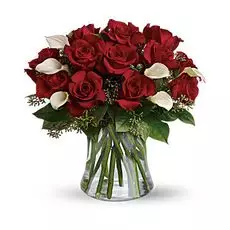
Twelve red roses built for exactly this narrower reading, love and loss in the same arrangement rather than one crowding out the other. Not marketed as a sympathy product, and it shouldn't replace an all-white funeral tribute where a family expects one. It fits the gap Victorian floriography already understood, red as grief that still carries love inside it, better suited to a home in the week after a loss than to the service itself. If the occasion calls for the service itself rather than a home delivery, our sympathy and funeral flowers are built for that setting instead.
Two more red things worth a sentence each. A red dragonfly shows up in Japanese folklore around the autumn equinox as a symbol of courage and returning souls, the same season the red spider lily blooms. A red butterfly carries a lighter, more Western reading, transformation and joy. Neither is a flower. Both keep turning up in the same searches, which tells you people are pattern-matching red itself, not red flowers specifically.
What It Means to Dream About Red Flowers
Dream interpretation is not a science, and no two dream dictionaries agree completely, but a few readings show up consistently enough to be worth naming. Popular interpretation ties dreaming of red flowers to intense emotion rising to the surface, passion, anger, or desire depending on the rest of the dream. A red flower in full bloom tends to read as passion or vitality. A wilting one tends to read as a fading relationship or a fear of losing something intensely felt. Take it as folk psychology, not clinical fact. The pattern survives because red is already loaded with meaning while you're awake.
A Field Guide to Red Flowers
Ten of the most-searched red flowers, each decoded on its own instead of flattened into one generic "red flowers mean love" answer.
Red Rose
The default, for good reason. Modern commercial varieties sold in the U.S., Freedom and Explorer among them, are bred for head size, consistent color, and vase life rather than fragrance, which is why a florist-bought red rose rarely smells like much. Sepals folded past ninety degrees from the bud is the visual cue that a stem has stored enough sugar to finish opening rather than sitting closed until it drops.
Red Carnation
Dismissed as filler, mostly unearned. A standard carnation holds fourteen days in a vase or longer, roughly double a rose's honest lifespan, at a fraction of the cost. Victorian floriography read red carnation as "my heart aches for you," distinct from the rose's straightforward romance. It's a longing, not a declaration. Joan's line on it: "I can't remember the last complaint about a carnation's vase life. Can't say that about roses."
Red Chrysanthemum
Splits harder by geography than any flower here. In the U.S. and across much of Asia it reads as cheerfulness and long life, the imperial flower of Japan, printed on the country's passport. Cross into France, Italy, Belgium, or Spain, and the same flower reads almost exclusively as a funeral tribute tied to All Saints' Day cemetery visits. Geography overrides color in those countries, red or not. Joan's rule for it: "If the recipient has family in France or Italy, I steer people somewhere else. We've got hundreds of alternatives. Not worth the risk over one flower."
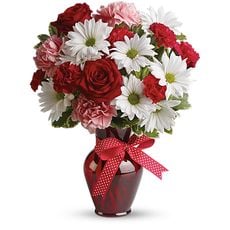
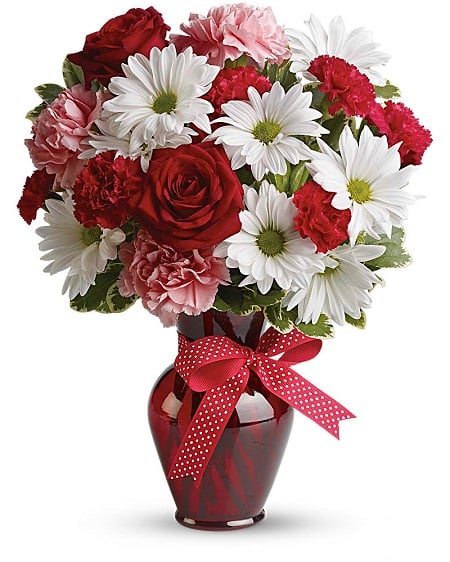
Layered floriography, not a single-flower statement. Red roses for passionate love, white daisy chrysanthemums for the cheerful reading, hot pink carnations for admiration instead of red carnation's aching longing, all in the same red pressed-glass vase. Joan's read: "Nobody buying this is decoding the floriography. They're buying it because it looks like effort without looking like a proposal. The layered meaning is just true whether the sender knows it or not."
Red Rhododendron
One of the more dramatic reversals in Victorian floriography: "beware." The plant is genuinely toxic, and Victorians built that fact directly into its symbolic meaning, a warning dressed as a bouquet. Modern gardeners mostly ignore the caution and grow it for spring color, but the old reading survives as florist trivia.
Bleeding Heart
Lamprocapnos spectabilis earns its name honestly. Each blossom forms a heart with a single drop-like petal hanging beneath it, close enough to a broken heart that no dictionary needed to invent a meaning. It reads as compassion, unrequited love, and in some traditions a token exchanged before a long separation.
Red Orchid
Rarer in nature than the cut-flower market suggests. Most commercial "red" orchids are deeply saturated magenta or wine-toned hybrids, since pure fire-engine red barely exists naturally in the orchid family. The symbolism leans exotic passion and strength, tied to orchids' broader reputation for rarity.
Red Anemone
Greek mythology ties the anemone, the windflower, to the death of Adonis, Aphrodite's lover, with red anemones said to have sprung from his blood. That origin gives it more weight than most red flowers: anticipation and forsaken love, not straightforward romance.
Red Lily & Red Spider Lily
True red lilies carry passion and pride, a bolder read than the purity tied to white lilies. The red spider lily, Lycoris radiata, is a different plant entirely, part of the amaryllis family, and carries the heaviest folklore load here. It blooms leafless in late summer across Japan, China, and Korea, has over a thousand folk names, most tied to death and cemetery planting, and shows up constantly in anime and manga as shorthand for tragic, unrequited love. Centuries-old tradition and modern pop culture both circulate online. They are just not the same layer.
Red Iris
Iris generally symbolizes wisdom, hope, and valor, named for the Greek messenger goddess of the rainbow. True red iris is a genuine rarity, since the natural species run overwhelmingly purple, blue, yellow, and white, making it more of a hybridizer's showpiece than a florist's standard stock item.
Red Salvia
The red spike you've seen in a hundred municipal flower beds without knowing its name. A garden and bedding plant more than a cut flower, bred for season-long color, not vase performance, and in American folk garden tradition it carries a simple meaning: devotion that keeps showing up.
Beyond the ten here, red shows up reliably across the American perennial garden: poinsettia at Christmas, red tulips and peonies in spring, dahlias, zinnias, and gladiolus through summer, camellias and amaryllis in cooler months. Red's high contrast against green foliage, the same trait that draws hummingbirds, is why gardeners lean on it for a bed that needs to read from a distance.
Found the one you're after? Browse the full red flowers collection.
Sending Red Flowers Today: Valentine's Day and What Actually Works
Nowhere does red flower demand concentrate harder than the ten days around February 14th. Understanding why explains both the price spike and the specific flowers that show up in your order that week.
Close to 90% of the cut flowers imported into this country move through one building, Miami International Airport, which is why your February order probably cleared customs in Florida within the last couple of days, not weeks ago. Valentine's week alone accounts for a huge share of a year's red rose demand, industry estimates put yearly production above 250 million stems for the holiday, roughly three in four of them red, which is the actual reason the price never matches June.
Americans spend more than $2 billion on cut flowers in that single window, most of it compressed into about ten days. That kind of demand spike is why florists start reordering stock daily instead of weekly, and why a red rose order placed on February 10th and one placed on February 13th can ship from two different wholesale lots entirely.
Victorian floriography ran on quantity as much as species. A single red rose meant love at first sight, a simple, unadorned declaration. A dozen meant something closer to complete devotion, the number itself doing communicative work independent of anything else in the bouquet.
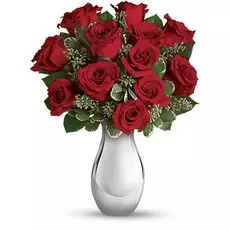
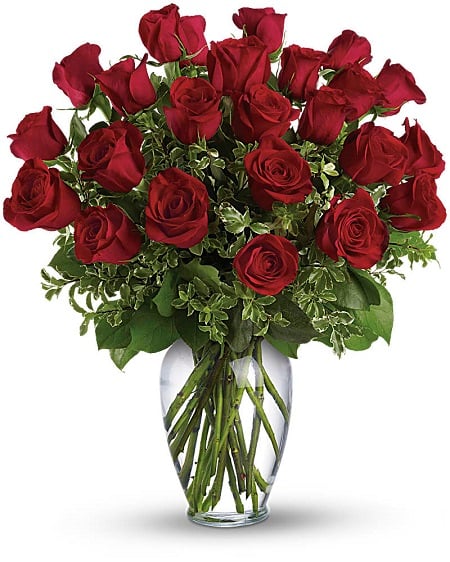
The classic full-devotion statement, unadorned by other flowers or filler, letting the dozen stems make the argument on their own. Built for a sender who wants the number itself to be the message, no layered meaning required, no ambiguity to decode. For the same statement any week of the year, our love and romance collection covers the rest of the calendar.
The same red roses land differently depending on where they show up. Workplace delivery on Valentine's Day does something a home delivery can't. Everyone at the desk sees it happen. That's not me telling anyone to spend more, just something worth knowing if the gesture itself is the point.
Keeping Red Flowers Fresh Longer
Everything above is about what red means. This part is about making it last long enough for the meaning to land.
Joan's Three Rules for Red
Look at the sepals before deciding a bud is "not open yet." Once they've folded back past ninety degrees from the base of the bloom, the rose has stored enough sugar to finish opening on its own. A bud with sepals still tight against the petals may never open at all, no matter how much water you give it.
Cut every stem at a forty-five degree angle, not straight across. An angled cut keeps the vascular system open to water. A flat cut can seal flush against the bottom of the vase and choke off uptake before the flower even gets started.
Give fresh-cut stems two to four hours to rehydrate before arranging them yourself. Flowers cut and arranged inside the same hour rarely perform as well as ones given time to drink first. Most home arrangers skip this step entirely, and it shows by day three.
Mixed bouquets add a wrinkle worth knowing before the roses start dropping petals. In a bouquet like Kisses, three flower types with three different lifespans, the red roses finish first, usually within five to seven days, while the daisy chrysanthemums and carnations keep going for another week or more. Pull the spent roses the moment they turn, and the rest of the arrangement keeps looking intentional rather than half-dead. Most people don't do this and assume the whole bouquet died early. It didn't. The lead singer finished. The backing band kept playing.
Red Flowers, Straight Answers
What does a red flower mean?
In the American market, red means romantic love first, warmth and remembrance second. Shade and species narrow it from there: a bright red rose is a declaration, a red carnation is longing, and deep crimson leans closer to grief than passion.
What do red flowers symbolize in a dream?
Popular dream interpretation, not clinical science, ties a red flower in full bloom to passion or vitality, and a wilting one to a fading relationship or a fear of losing something. Take it as folk psychology rather than fact.
What does it mean when someone gives you red flowers in a relationship?
It depends where you are in the relationship. Early on, red roses read as a bold declaration. Years in, the same rose can read as the comfortable, reliable default. Neither is wrong, but they're not the same gesture.
Is it okay to send red flowers for sympathy?
In American and Western tradition, a single dark crimson rose can be appropriate. A full red arrangement is a better fit for a home in the week after a loss than for the funeral service itself, and if the family's background is Chinese, Vietnamese, or Buddhist, it's worth asking first since red can read as celebratory rather than sympathetic in those traditions.
Further Reading
If red raised more questions than it answered, these go further into color and cultural symbolism on the rest of the site.
Whichever red flower you land on, ordering it is the simple part. Order before 1PM on a weekday, or 10AM Saturday, and it goes out same-day through Lily's Florist's network of 15,000+ partner florists across the country.
Shop Red FlowersSame-day delivery when you order before 1PM weekdays or 10AM Saturdays.
$16.95 flat-rate delivery.
Questions? Call 800-946-5457
About the Authors
This guide was written by Dennis, checked against real floristry practice by Joan, and carries one supply-chain note from co-founder Andrew. Read our full story.