Shop By



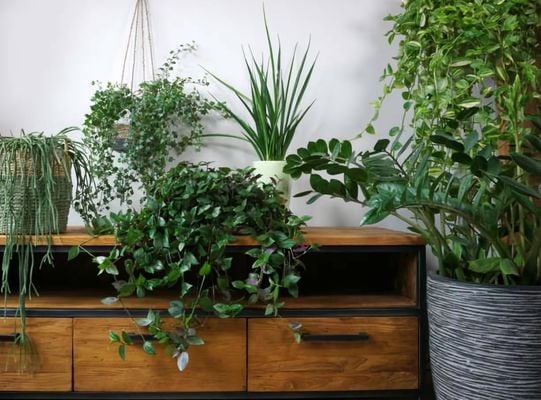
There is a decent chance you have killed a houseplant. Maybe a fiddle leaf fig that dropped its leaves one by one until it was a bare stick in a pot, or a pothos that went yellow and soft on you while you were doing everything the little plastic tag told you to do. If that is you, I want to say something before we go any further: it almost certainly was not because you did not care enough. Most of the time it is the opposite.
Nearly every houseplant guide online runs on the same three pieces of folklore. Mist your plants. Water once a week. Plants clean your air. Two of those three are actively wrong, and the third gets misread often enough that it kills more plants than drought ever has. The care itself is simple. The information most people are handed is what fails them.
So this guide does something a little different. It walks through what is actually going on inside the plant, in plain language, so the care decisions stop feeling like guesswork. Light before water. Why some plants forgive you and others hold a grudge. What plants genuinely do for a room, and what they do not. Then, once you know what you are looking at, it points you toward a short list of plants that are genuinely hard to kill, including a few we deliver same day if you would rather start with something already built to survive.
Joan, who takes gift calls for us and spent thirty years on a florist bench in North Carolina before that, shows up throughout. Not for the botany, which is not her lane and she would be the first to tell you so, but for the part she has lived a thousand times over the phone: which plant to send a grieving friend, what a hospital ward will and will not let through the door, and whether the thing you are about to buy is safe around a cat. That knowledge is hers, and it is the kind you cannot get from a care tag.
If you only have 30 seconds
- Light is the limiting factor, not water. A plant that slowly fades in a dim corner is starving, and no watering routine will save it.
- The "houseplants clean your air" claim is mostly a myth. You would need hundreds of plants per square meter to match a cracked window.
- Overwatering kills more houseplants than drought. Roots need to breathe, and soggy soil suffocates them.
- Water by weight, not by calendar. Lift the pot: light means thirsty, heavy means wait.
- Snake plants, ZZ plants, and pothos survive real neglect. Calatheas, ferns, and fiddle leaf figs do not. Buy to match your habits.
- Two houseplants are genuinely dangerous: sago palm and true lilies (fatal to cats). Most others are only mildly irritating.
- A living plant makes a longer-lasting gift than a bouquet, especially for sympathy, hospital discharge, and older recipients.
In this guide
Light Is the Real Bottleneck, Not Water
Here is the single most useful thing in this whole guide, so I will put it first. For most indoor plants, light is the limiting factor, not water. When a plant slowly declines over weeks, gets leggy, stops making new leaves, or turns pale, the usual cause is that it is not getting enough light to run itself, no matter how carefully you water it.
The problem is that the words we use for light are useless. A tag that says "bright, indirect light" or "does well in low light" is telling you almost nothing, because bright to a plant tag writer and bright to your north-facing apartment are two different planets. A spot that looks perfectly lit to your eyes can be a near-cave to a plant, because your eyes adjust and a leaf does not.
Horticulturalists solved this a long time ago with an actual unit. It is worth knowing, because it turns a vague feeling into a number you can check.
Plants run on a specific slice of sunlight called PAR (photosynthetically active radiation), the 400 to 700 nanometer band your eyes see as visible light. The instantaneous amount of that light landing on a leaf is PPFD, measured in micromoles per square meter per second. Add up all the PPFD a plant receives over a full day and you get DLI, the Daily Light Integral, measured in moles per square meter per day. DLI is the number that matters, because plants do not care about a bright moment. They care about the total light banked over the whole day. University greenhouse and extension research (Michigan State University Extension has published widely on this) uses DLI precisely because "bright" and "dim" fall apart the moment you try to compare two rooms.
You do not need to memorize the physics. You just need a rough sense of where common plants land, so you can match a plant to a window instead of hoping. These are approximate ranges pulled from greenhouse and extension guidance, and they are deliberately broad, because your mileage varies with season, latitude, and how clean your windows are.
| Plant | Rough daily light it wants (DLI) | What that looks like at home |
|---|---|---|
| Snake plant, ZZ, pothos, peace lily | Around 1 to 3 | North window, or several feet back from a brighter one. These are your low-light survivors. |
| Dracaena, aglaonema, philodendron, calathea | Around 3 to 6 | Near an east or west window, out of direct afternoon sun. |
| Boston fern, most trailing tropicals | Around 4 to 6 | Bright, steady, indirect light with some humidity nearby. |
| Fiddle leaf fig, croton, most succulents | Around 6 to 12 or more | Right up against a south or bright east window, or they sulk. |
That table alone will save more plants than any watering tip in this guide. If a plant on the high end of that range is sitting in a spot meant for the low end, no amount of careful watering will fix it. It is starving for light, and the slow decline you are watching is the result.
The Ten-Minute Light Test
So how do you know what your window is actually delivering? You measure it. This takes about ten minutes and costs nothing, because the meter is already in your pocket.
Get a light meter app
Search your phone's app store for a "light meter" or "lux meter" app. Most are free. One honest caveat before you trust the number: a phone sensor is built to balance photos, not to certify plant light, so treat the reading as a comparison tool, not a lab result. It is excellent for telling you that the east window reads twice as bright as the hallway. It is not excellent for a precise scientific figure. Used for comparison, it is plenty.
Measure at the spot the plant will actually live
Hold the phone flat where the plant's leaves will sit, sensor facing the same direction the leaves face, around midday on an ordinary day. Not the sunniest afternoon of the year, not a gray storm. A normal day. Take a reading at the window, then a reading where you were actually planning to put the plant. People are always surprised by how fast light falls off. Two feet back from the glass can be a third of the light at the sill.
Match the reading to the plant
As a rough field guide: a shady interior spot reads a few hundred lux, a bright indirect spot reads roughly 1,000 to 5,000 lux over the day, and right against a sunny window can run well past 10,000. Low-light plants (snake plant, ZZ, pothos) are content in the low range. High-light plants (fiddle leaf, croton, succulents) need the bright end and will decline anywhere dimmer. You do not need to convert to exact DLI. You need to know whether the spot is dim, medium, or bright, and put a plant there that agrees.
Lux measures brightness as human eyes perceive it, which is not identical to the light plants use, so any lux-to-DLI conversion is an approximation, which is fine for the purpose here. You are not certifying a greenhouse. You are answering one question, is this spot bright enough for this plant, and a phone reading answers it well enough to stop you from putting a sun-lover in a corner.
Why Some Plants Forgive You and Others Do Not
Some plants seem impossible to kill and others die if you look at them wrong. That is not personality. It is chemistry, and once you know the trick, you can pick forgiving plants on purpose.
Most houseplants use ordinary daytime photosynthesis (botanists call it C3). They open the tiny pores on their leaves during the day to take in carbon dioxide, and they lose water while doing it, which is why they wilt when they dry out. A smaller group, including snake plants, ZZ plants, and most succulents, uses a different strategy called CAM. They keep those pores shut through the heat of the day and open them at night instead, which means they lose far less water. That single adaptation is why a snake plant shrugs off three weeks of neglect while a fern is crisp by Thursday. The forgiving plants are not tougher by luck. They are built to hoard water.
If you sort plants by how much neglect they will absorb before real damage sets in, they fall into rough tiers. Buy from the bottom of this list if you know yourself and your track record.
If someone tells me they want color but they have killed everything they have ever owned, I point them at a kalanchoe. It is a flowering succulent, so it holds water the way a snake plant does, which means it takes a lot of forgetting before it gives up. Our Joy basket is two of them in a willow basket, and I recommend it constantly for exactly that reason. The one thing I always say on the call: do not water it on a schedule. Wait until the top inch of soil is dry, then water. Kindness in the form of a daily splash is how most of them actually die.
The Air-Purifying Myth: What the Science Actually Says
This is the claim you have heard a hundred times, printed on care tags and repeated across half the internet: houseplants clean the air in your home. It is one of the stickiest ideas in the whole houseplant world, and it is mostly not true. Not because plants do nothing, but because of how the original study worked.
Where the claim came from
In 1989, NASA ran a study (led by researcher B.C. Wolverton) testing whether plants could scrub volatile organic compounds out of the air on space stations. They could, and the results were real. The catch is the container. Those plants were sealed inside small, airtight test chambers roughly the size of a picnic cooler. That is a very long way from an open living room with doors, windows, drafts, and a furnace cycling air through it.
What happened when researchers checked the math
In 2020, two Drexel University researchers, Michael Waring and Bryan Cummings, re-analyzed a dozen of these plant studies and translated them into the metric building engineers actually use for air cleaning. Their finding was blunt. To match the air-cleaning that ordinary ventilation already does in a normal room, you would need somewhere between 10 and 1,000 plants per square meter of floor space. Not ten plants in the room. Ten plants per square meter, wall to wall, floor to ceiling. Opening a window for a few minutes does more for your indoor air than a jungle of houseplants ever could.
| The claim | What is really going on | Verdict |
|---|---|---|
| Cleans your air like a HEPA filter | The effect is real in a sealed box, negligible in a ventilated room. | Busted |
| Removes household VOCs meaningfully | You would need hundreds of plants per square meter to compete with a cracked window. | Busted |
| Raises humidity a little | Plants release water vapor through their leaves. In a small room, a cluster of them measurably nudges humidity up. | Works |
| Lowers stress and blood pressure | This one holds up in controlled studies, and it is the real reason to keep plants. More on that next. | Works |
None of this is a reason to skip houseplants. It is a reason to buy them for what they genuinely do. The air-cleaning was never really the point, and what they genuinely do turns out to be worth more anyway.
A houseplant is not an air filter, and the good news is it never needed to be. It earns its place on the windowsill for quieter reasons.Dennis, Lily's Florist
What Plants Actually Do For You
If plants are not cleaning your air, why bother? Because the benefits that do hold up are the ones that matter more to how a home feels. There are two, and the research behind each one is solid.
The humidity effect is genuine. Plants pull water up through their roots and release it through their leaves in a process called transpiration, which raises the moisture in the air immediately around them. In a small, dry room, a grouping of plants makes a noticeable difference, which is a real comfort in winter when heating dries everything out. The stress effect is genuine too. In a 2015 study published in the Journal of Physiological Anthropology, Lee and colleagues had participants repot a plant and, separately, do a screen-based task. Working with the plant lowered their blood pressure and measurably calmed their nervous system compared with the screen work. Layer on Attention Restoration Theory, the well-studied idea from psychologists Rachel and Stephen Kaplan that natural elements let a tired, overworked mind quietly recover, and you have the actual case for a houseplant.
I am not going to pretend a plant on the kitchen sill is going to change your life, because it will not, but there is something in it all the same. We have moved houses more times than I would like to count (business owners rarely sit still), and the first thing that goes on a windowsill in a new place, before the boxes are even unpacked, is something green. It makes a strange house feel lived in. A little less echoey.
And the science lines up with what I already knew in my hands, which is that repotting a plant on a bad afternoon, getting soil under your nails, deciding where the light is best, actually settles something. It is small. But small is not nothing. Some days small is the whole point.
Water, Air, and the Soil Underneath
Now the part everyone gets wrong. Overwatering kills more houseplants than drought, heat, and neglect put together, and the reason is not obvious, so it is worth spelling out.
Roots need to breathe. Healthy potting mix is full of tiny air pockets, and roots pull oxygen from them as much as they pull water. When you keep the soil soaked, those pockets stay flooded, the roots cannot get oxygen, and they begin to suffocate and rot. Root rot happens underground, and by the time the leaves yellow and go mushy, the damage was already done days earlier. The plant did not need more water. It was drowning in the water it already had.
This is why "water every Sunday" fails. A schedule ignores the only thing that matters, which is how fast that particular pot in that particular spot actually dries out. A big plant in a bright, warm window drinks fast. A small one in a cool, dim corner stays wet for a week. Same calendar, completely different needs. Here is the method that works instead, and it takes no tools at all.
Soil scientists measure something called air-filled porosity, the share of a soil's volume that holds air rather than water after it drains. Good indoor mixes are built to keep that number high, often with added bark, perlite, or coir, so roots keep getting oxygen even when the soil is damp. Cheap, dense soil packs down, loses its air pockets, and stays waterlogged, which is why a struggling plant sometimes just needs fresher mix and a pot that drains, not more attention. The same drainage logic holds whether you are potting foliage or flowering plants, and it is worth reading up on the best soil to use for flowering plants if you are repotting. Terracotta pots breathe through their walls and dry faster than glazed or plastic ones, which is why the same plant needs watering on a different rhythm depending on what it lives in.
Learn the pot's full weight
Water the plant thoroughly until it drains out the bottom, let it finish draining, then lift the pot and feel its weight. That is "full." Your hand is now a moisture meter, and it is a better one than most gadgets.
Learn the pot's dry weight
A few days later, check the top inch or two of soil with a finger. When it is dry down there, lift the pot again. That noticeably lighter weight is "thirsty." Now you know both ends of the range by feel.
Water by weight, not by calendar
From then on, lift before you water. Light means go, heavy means wait, regardless of what day it is. Water thoroughly when you do, until it drains, then let it dry back out. Most houseplants want a proper drink and then a chance to breathe, not a daily sip.
The Watering Rule, in Five Words
If you remember nothing else from this section, remember these.
Eight Houseplants Worth Your Windowsill
Everything above adds up to a shortlist. These eight cover the full range, from plants that survive genuine neglect to a couple that reward attention if you have some to give. Each note tells you the light it wants, how much forgetting it will absorb, and where it fits.
Snake Plant
Dracaena trifasciataThe most forgiving plant on this list. A CAM plant that hoards water, tolerates low light, and would rather you forgot it than fussed over it. Water when the soil is fully dry, which in winter can mean once a month. If you have killed everything else, start here.
JoanThe office-gift order I take more than any other, and the one plant I have never once had a complaint call about.
ZZ Plant
Zamioculcas zamiifoliaSnake plant's equal in toughness, with glossy dark leaves. It stores water in thick underground rhizomes, so it handles dim offices and long gaps between watering. The only reliable way to kill it is to keep it soaking wet.
From the phonesWhen someone is buying for a windowless office or a dim cubicle, this is where I steer them. It does not sulk about low light.
Pothos
Epipremnum aureumThe trailing vine you see in every cafe and dorm for good reason. It grows in almost any light, roots from cuttings in a glass of water, and tells you it is thirsty by softening slightly before it ever comes to harm. Nearly impossible to lose.
Joan steersI hand this to callers who tell me they have killed every gift I ever sent them. Nobody has managed to kill this one yet.
Peace Lily
SpathiphyllumTolerates low light, throws the occasional white bloom, and droops dramatically when thirsty, then recovers within hours of watering, which makes it almost self-explaining.
It has been the anchor of the sympathy dish garden for as long as I have been in the trade. It is the plant I trust to still be alive months after the flowers are gone. It sits at the center of our Serenity Now dish garden for exactly that reason.
Fiddle Leaf Fig
Ficus lyrataThe famous, photogenic, temperamental one. It wants a lot of bright indirect light and, above all, to be left in one spot. Move it, chill it, or let it dry out and it drops leaves in protest. Beautiful, but not a beginner plant. Its cousins the rubber plant and weeping fig behave the same way.
Joan's warningI talk people out of sending these as gifts more often than I sell them. It is the one that brings the worried follow-up call three weeks later.
Boston Fern
Nephrolepis exaltataLush and old-fashioned, and honest about its needs. It wants steady moisture and real humidity, which is why it thrives in a bright bathroom and crisps up in a dry living room. Give it what it asks for and it is gorgeous.
JoanA lovely gift for someone who already gardens. Not the one to send a new parent who wants something they can safely ignore for a week.
Calathea
Goeppertia speciesThe show-off, with striped and patterned leaves that fold up at night. The trade-off is fussiness. It is sensitive to dry air, cold drafts, and the chlorine in tap water, browning at the leaf edges when unhappy. Rewarding for an attentive owner, frustrating for a forgetful one.
From the call logsWhen a caller rings a month later asking why the leaf edges went brown, nine times in ten it is this plant. I flag it up front now.
Croton
Codiaeum variegatumThe most colorful plant here, with orange, yellow, and red variegation, and the most likely to test your patience. It drops leaves when moved or chilled and wants bright light to keep its color.
Gorgeous, and it sulks. Nearly every complaint call I ever took about a dish garden was the croton dropping leaves after the trip indoors. It settles once it stops being moved. It brings the color to our Garden Dish, and I always tell people to leave it be for a week before they panic.
Andrew A quick buying note, because where a plant comes from matters more than most people think. At a big-box store, lift the pot and check the drainage holes for circling or mushy brown roots, which means rot has already started, and turn a few leaves over to check for spider mites and their fine webbing. A plant that sat on a pallet in a dark loading dock for two weeks is already stressed before you get it home. We route plant orders through growers built for the trade, Costa Farms out of Florida and Altman Plants out of California among them, which is a large part of why our plants arrive in the condition the photo promises rather than the condition the shelf left them in.
Keeping Pets and Kids Safe
Before you bring any plant into a home with a cat, a dog, or a small child who tastes everything, it is worth knowing the difference between the plants that are merely unpleasant and the two that are genuinely dangerous. Most popular houseplants sit in the first group. A couple sit in the second, and those are the ones to actually worry about.
| Plant | What happens if chewed | How serious |
|---|---|---|
| Pothos, peace lily, philodendron, dieffenbachia, syngonium | These aroids carry insoluble calcium oxalate crystals that cause drooling, mouth and throat irritation, and vomiting. | Unpleasant, rarely dangerous. Usually resolves on its own, though a vet call is wise. |
| Snake plant, ZZ plant | Mild stomach upset and vomiting if a lot is eaten. | Low risk. Most pets take one bite and lose interest. |
| Sago palm | Contains cycasin, which attacks the liver. Every part is toxic and the seeds most of all. | Genuinely dangerous. Emergency vet, immediately. |
| True lilies (Lilium and Hemerocallis) | Cause acute kidney failure in cats. Even pollen or vase water can be enough. | Fatal to cats. Never in a cat household. |
The ASPCA maintains a searchable database of plants that are toxic and safe for cats, dogs, and horses, and it is worth a thirty-second check before you buy or send anything living into a home with animals.
Pet safety is one of the questions I hear most, and I have learned to ask it myself before the caller thinks to. "Is there a cat in the house?" If yes, I steer them away from true lilies entirely, whatever the occasion, because that is the one that does real harm. For the everyday plants, I tell people the honest version: most of them will make a curious dog or cat sick to its stomach, not much more, but if you have an animal that eats everything in sight, put the plant up high or pick something else. Nobody wants a get-well gift to turn into a vet bill.
Living Gifts: When a Plant Says More Than a Bouquet
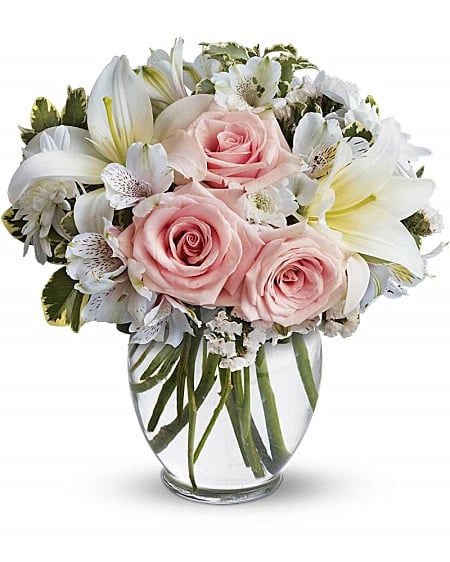
All of this circles back to a question we hear on the phone every day: should I send flowers or should I send a plant? The honest answer is that they say different things. Cut flowers say I was thinking of you today. A living plant says I am going to keep thinking of you for a while. For the right moment, that second message is the one worth sending, and this is Joan's territory, so I will hand it over.
Thirty years on the bench leaves your hands knowing things your head has to catch up to, and one of them is that a dish garden is the quiet workhorse of gifting. Cut flowers bloom and die. A dish garden just keeps sitting there doing its job. There are four moments where I reach for one over a bouquet, every time.
Sympathy, sent to the home, not the service. The saddest, kindest orders I take are the ones that arrive two or three weeks after a funeral, when the first flood of flowers has come and gone and the house feels emptied out. That is when a dish garden like the Serenity Now or the Dish Garden lands hardest, because it says the thinking did not stop when the service ended.
The welcome home after a hospital stay. This one comes with a caution I give on every call. In my experience, oncology wards, transplant units, and intensive care do not accept live soil plants, because the soil can carry fungal spores that are a real risk to patients with weakened immune systems, and often they will not take cut flowers either. So I ask which ward the person is in before I promise anything. Where a plant will not go, a welcome-home gift sent to the house once they are discharged is the better move. The Joy basket, with no pollen and no strong scent, is one I have sent to the same recovering family more times than I can count.
The desk gift that outlives the thank-you email. A promotion, a new office, a work anniversary. A bouquet is in the bin by the weekend. A Garden Dish is still on the credenza at Christmas. For a gift meant to stay visible, the plant wins on sheer stubbornness.
The gift for an older recipient. Adult children sending to a parent in retirement housing almost apologize to me for not sending "real flowers." I tell them the plant is the better gift, because it is company. It does not need arranging, it does not get thrown out in a week, and it gives them something small to tend. Those plants outlast a lot.
One worry lands on nearly every one of these calls: what if the person I am sending to is not a plant person, and it dies on them? That is exactly why these four are the ones I reach for. They forgive a lot of forgetting. And you are not sending it off into the dark. You get word once it reaches their door, a florist in or near their area handles the delivery, and if a grower runs short and one plant gets swapped for something close, we keep it in the same spirit and let you know. If anything turns up less than right, one call to me and we make it good.
Here are the four I reach for most, each one built to survive the trip and keep going for months. All arrive with same-day delivery and a flat $16.95 delivery fee.
 Serenity Now
$61.99
A quiet green-and-cream dish garden built around a peace lily. Joan's first pick for sympathy sent to the home.
Shop this →
Serenity Now
$61.99
A quiet green-and-cream dish garden built around a peace lily. Joan's first pick for sympathy sent to the home.
Shop this →
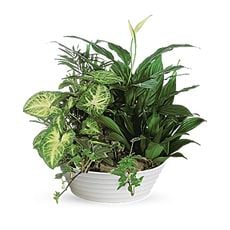 Dish Garden
$61.99
Peace lily, dracaena, and trailing ivy in a ceramic bowl. The safe, lasting choice when you do not know the recipient's taste.
Shop this →
Dish Garden
$61.99
Peace lily, dracaena, and trailing ivy in a ceramic bowl. The safe, lasting choice when you do not know the recipient's taste.
Shop this →
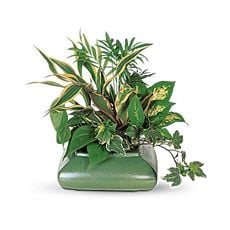 Garden Dish
$61.99
Palm, aglaonema, and a splash of croton color in forest-green stoneware. The desk gift that is still there at Christmas.
Shop this →
Garden Dish
$61.99
Palm, aglaonema, and a splash of croton color in forest-green stoneware. The desk gift that is still there at Christmas.
Shop this →
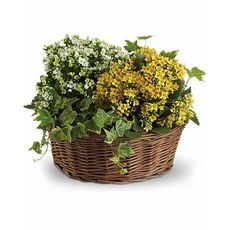 Joy
$61.99
Two flowering kalanchoes and trailing ivy. No pollen, no scent, which is why it goes to hospital welcome-homes so often.
Shop this →
Joy
$61.99
Two flowering kalanchoes and trailing ivy. No pollen, no scent, which is why it goes to hospital welcome-homes so often.
Shop this →
If the person you have in mind would rather have blooms than foliage, that is easy too. You can browse our orchid collection for something flowering, or start from the full range of plants we deliver same day. And for anything sympathy-related, the sympathy plants section gathers the pieces built for exactly these moments.
Further Reading
If the forgiving end of the list is where you want to live, these three go deeper on the plants that survive real neglect and how to style them.
Would rather skip the trial and error and start with something already built to survive your windowsill? Our plant collection leans on the forgiving end of this guide, and a real florist checks every order before it goes out.
Browse plants built to lastLily's Florist delivers across America through a network of 15,000+ partner florists.
Same-day delivery when you order before 1PM weekdays or 10AM Saturday. Flat $16.95 delivery.
Serving the US since 2017. The Lily's brand has run since 2009.
Questions? Call 800-946-5457 or email [email protected].
Sources
The science in this guide is drawn from peer-reviewed research, university horticultural extension, and government sources. The key ones:
- Wolverton, B.C. et al. (NASA, 1989). The original Clean Air Study, run inside sealed chambers, that later got misread as proof houseplants clean the air of a normal room.
- Cummings, B.E. and Waring, M.S. (2020), Journal of Exposure Science and Environmental Epidemiology. Re-analyzed a dozen chamber studies and found the real-room air-cleaning effect negligible.
- Lee, M.S. et al. (2015), Journal of Physiological Anthropology. Found that working with a plant lowered participants' blood pressure and sympathetic nervous activity.
- Kaplan, R. and Kaplan, S. Attention Restoration Theory, the research basis for why natural elements help a tired mind recover.
- Michigan State University Extension. Greenhouse and horticultural lighting guidance, including the use of Daily Light Integral (DLI).
- ASPCA. Toxic and Non-Toxic Plants database, the reference for the pet-safety section.
About the Authors
This guide was written by Dennis, with the horticultural science drawn from peer-reviewed and university-extension research, the gifting and safety knowledge from Joan, a buying note from Andrew, and a word on why any of it matters from Siobhan. Read our full story.

Dennis, who wrote this guide, with his family.