Shop By
It usually starts on a Tuesday. The wedding was a week ago, or the funeral, or the anniversary, and the bouquet has been sitting in its vase quietly losing itself. The water has gone cloudy. One of the roses has dropped a petal onto the table and you noticed it that morning and didn't sweep it away. You walk past the arrangement on the way out the door and think, almost without thinking it, I should do something with these. And then the day takes you somewhere else.
People who preserve flowers are almost never doing it for fun. They're protecting a piece of time. The bouquet from the day someone got married. The single bloom from the spray that sat on a coffin. The orchid that arrived after a baby was born. Flowers, by their construction, refuse to last, and there is something in most of us that wants to argue with that.
I'll tell you upfront that I've tried the home methods myself, twice, and the second time was after I should have learned from the first. Most people start too late. The bouquet sits in the vase for ten days, you remember somebody's neighbor who once dried roses with a microwave, and by the time you actually do something the rescue is already overdue. Joan, our florist, has taken that call from the other side of it more times than she can count.
So the two of us put together this guide. Five methods, from the easiest to the most demanding. Which flowers suit which technique. The biology of why a flower starts dying the second a stem is cut, and what you can do to slow that down. A note from Siobhan, who runs this business with me, on the harder question of which arrangements are worth the effort and which probably aren't.
None of this requires a chemistry degree. Some of it requires patience. The hardest part is usually starting before you think you need to.
In this guide
The science of letting go
Before any of the methods make sense, it helps to know what you're working against. A cut flower isn't slowly running down like a battery. It's running a program. Joan can explain this better than I can. She's NCCPF certified, which is the North Carolina certification that took her through nine courses and three hands-on workshops, all of it on what stems do and why.
Thirty years on the bench teaches you what a dying stem feels like before your eyes catch up. Four-thirty alarms, hands in cold water, conditioning bucket after bucket while the shop was still dark. After enough years your fingers learn the difference between a stem that has hours and a stem that has days, before you put it under the light to confirm.
The biological clock starts the second the stem is severed. People assume it's just dehydration, but a cut flower triggers a genetically programmed sequence of cellular events. Hormone signals, mostly ethylene in the species we work with most often, tell the cell walls it's time to stand down. The petals don't wilt because they ran out of water. They wilt because the plant is dismantling itself in the order it was designed to.
The frustrating thing is that the visible signs run behind the actual damage. By the time you see brown edges, the cellular breakdown has been running for hours. There's a body of research showing DNA fragmentation in petal tissue well before any wilt is visible. The flower looks fine. The flower is not fine.
Why bruised petals brown faster
The two enzymes that cause most browning have the unromantic names PPO (polyphenol oxidase) and POD (peroxidase). In a healthy flower, they're stored separately from the substrates they react with. The walls of the cell keep them apart. Mechanical damage, a thumbprint, a tight rubber band, an over-firm grip during arranging, collapses those internal walls and the enzymes meet their substrates. Browning follows.
This is the floristry version of the science: the gentler the handling, the longer the flower has before its own enzymes turn on it. It is also why a bloom that arrived bruised, or one that had its head crushed in transit, is a poor preservation candidate regardless of which technique you choose later.
Before I joined the phones in 2018, I conditioned stems for thirty years. I saw this play out on the bench every day. A bruised petal browns faster. A stem cut at a clean angle and put straight into cold, clean water buys you hours. Not because the water is magical, but because you've slowed the hormone cascade before it really starts. That's not best practice. That's interrupting a process that's already running.
What florists use to slow it down
Commercial florists and preservation specialists work with chemical pre-treatments at the conditioning stage. These aren't household techniques. They're the reason a properly handled stem at the wholesale level reaches a customer in better condition than a stem cut from a garden and stuck in tap water.
| What florists use | What it does | Why it works |
|---|---|---|
| Citric acid solution | Slows browning | Drops the pH below the enzyme's active range |
| Aluminum sulfate | Locks in blue and purple pigment | Binds chemically to the pigment molecules and stabilizes them |
| Cobalt or copper sulfate | Preserves the vascular system | Blocks ethylene synthesis, keeps the stem clear of microbial growth |
Joan, on the table above: citric acid was on hand at every shop I worked. Aluminum sulfate I saw less often. The cobalt sulfate is specialty work, mostly conservation labs.
None of that is something you'd do at home with a bouquet from a wedding. The point of including it is the underlying lesson: how a flower is treated before the work begins counts at least as much as which technique you eventually pick. Skip ahead to the timing section if you want the practical version.
The petals don't wilt because they ran out of water. They wilt because the plant is dismantling itself in the order it was designed to.Joan, after thirty years on the bench
Five ways to preserve a flower
There are roughly five home techniques that anyone outside a museum conservation lab can realistically use. They sit on a spectrum from easiest and lowest fidelity to hardest and highest fidelity. Most readers want one of the first two. A smaller group will graduate to resin work. Freeze-drying exists too, but only as a professional service, and we'll cover it briefly at the end.
What none of these methods can do is rescue a flower that has already started breaking down. Starting condition wins over technique. We'll come back to that. I'll admit I learned this myself by ruining things. Silica is not patient with rushed enthusiasm, and a microwaved rose doesn't get a second chance.
Air drying
Bundle the flowers loosely. Hang upside down in a warm, dry, dark spot. Wait two to three weeks. Best results: lavender, statice, strawflower, baby's breath, celosia, dried grasses, small-headed roses with tight petals.
Worst results: peonies, dahlias, lilies, anything soft-petaled and full of moisture. They collapse, mold, or both. The single most common mistake is bundling too tight: the stems need air around them or the inner ones rot before they dry.
Air drying is the oldest technique for a reason. It asks nothing of the flower that nature doesn't eventually do itself. The mistake I see most often is people bundling too many stems together because they like how it looks hanging. Airflow is everything. And if you're somewhere humid, like the Carolinas in August or anywhere on the Gulf Coast, a dehumidifier in the room isn't optional. It's the difference between dried lavender and a brown wet mess.
Silica gel desiccant
Bury the flower completely in fine-mesh silica gel inside an airtight container. Three to seven days, depending on the density of the flower. Best for roses, peonies, carnations, camellias, dahlias, and any multi-petaled flower that would collapse under air drying. This is the wedding bouquet route.
Why it works is worth understanding. Silica does two jobs at the same time. It pulls moisture out of the flower's tissue and holds the petal geometry steady while it does. The gel exerts lower vapor pressure than the flower's tissue does, so the moisture migrates outward without the petals collapsing inward, which is what air drying often does to a multi-petaled bloom. The target final moisture is roughly 8 to 11.5 percent. Below 8 percent, the petals get too brittle to handle. Above 11.5 percent, the flower can still rot.
Use fine-mesh silica, not the coarse stuff most hardware stores sell. The fine grains migrate between the petals and reach the flower's interior. Coarse silica skips the inside of the bloom and you end up with dry edges and a wet center, which then molds. If you can pour it like sugar, it's right. If it pours like rice, it's too coarse for this job.
Microwave plus silica (fast drying)
Same silica, much faster. Bury the flower, microwave in short bursts of one to two minutes with rest periods between. Total cooking time runs five to ten minutes instead of weeks. This is the approach to use when time is short and you can't wait.
The risk is non-trivial. Internal vapor pressure can build inside the petal tissue fast enough to physically rupture the cell walls. The technical phrase from horticultural research is "catastrophic cellular rupture," which translates to: you cook your rose, it turns to mush inside, the surface looks fine, you find out later when it falls apart in your hand. There's no recovery from that.
In my experience, this approach belongs to people who already know flowers well. Mistakes here are permanent. You can't undo a microwaved rose. If a wedding bouquet is the project, I'd say wait the seven days for the regular silica route. The microwave is for people who already feel comfortable handling the bloom and know what a good petal feels like in the hand.
Resin encapsulation
Once a flower is fully dry, you encase it in clear casting resin. Paperweights, jewelry pieces, shadow boxes, wedding rings nestled in dried petals: this is the approach behind almost every "permanent" floral keepsake you've ever held.
Two things will ruin a resin project. The first is residual moisture. The flower has to be bone dry before it goes anywhere near liquid resin. Any moisture left inside the petals creates micro-bubbles in the resin and, worse, kicks off internal decay inside the sealed block. You will not be able to fix it. Wait the extra week if you're not sure.
The second thing is heat. Resin cures by an exothermic chemical reaction, meaning it generates heat as it sets. A deep pour, more than half an inch at once, can push the internal temperature past 200 degrees Fahrenheit. That's enough to brown the petals, warp them, and lock them in that browned state forever. The fix is multiple thin pours, with full curing between each layer. It takes longer. There is no shortcut.
The most heartbreaking calls I take are from people who rushed the resin step and locked rotting flowers into a block they can't open. You can hear it before they tell you. The long pause, the small breath in. They've already poured, they're calling because they don't know what to do, and the answer is that there is nothing to do. I let them talk through it before I say so. The mold spreads under the resin layer for months and then the whole keepsake darkens from the inside out. You cannot undo it. The flower has to be bone dry. If you're in a humid kitchen, the petals can pull moisture back out of the air after they came out of silica. Store them in a sealed container with a fresh desiccant pack until the day you pour.
One more thing about resin. All of it yellows over time. The premium UV-stabilized formulas slow it. UV-protective display cases slow it further. None of them stop it. A clear resin paperweight made today will be visibly amber in ten or fifteen years. Worth knowing before you commit.
Pressing
Place the flowers between absorbent paper, parchment or specialist blotting paper. Weight heavily. Wait two to four weeks. Best for naturally flat or semi-flat flowers: pansies, violas, larkspur, daisies, Queen Anne's lace, ferns, and individual petals from larger flowers.
Pressed flowers go into framed art, into card stock, into resin (press first, then encase), into the inside front cover of a book where you'll find them again in twenty years. Herbarium specimens from the 1600s still survive in museum collections, dried and pressed. The technique is genuinely ancient.
Pressing trades dimension for color. I love what a good press preserves, and I'm honest about what it loses. It keeps the color and the form, but it flattens what was three-dimensional. A pansy was always nearly flat, so the trade is small. A rose was emphatically not flat, so pressing one means giving up most of what made it look like a rose. Pick the flower that suits the technique, not the other way around. That principle applies to most of these choices, but it's most obvious here.
One method that doesn't fit on this list, because it isn't a home technique: freeze-drying. It produces the highest fidelity result possible, holding shape, color, and even texture almost exactly as the flower looked the day it was cut. The catch is the equipment. Industrial freeze-dryers run for weeks at temperatures and vacuums no kitchen can provide. There are professional preservation services in most US cities that do this for wedding bouquets and important sympathy arrangements. You can find one by searching "professional flower preservation" or "freeze-dried bridal bouquet" with your city name. We don't offer the service ourselves. Saying so is part of the job.
Timing: the 48-hour window
This is the question almost no one asks until it's too late: when do you actually start? The honest answer is that preservation works dramatically better when you begin while the flowers are still in peak condition, not after they've already begun to drop and droop.
Preservation works best when started within the first 24 to 48 hours after a flower hits peak bloom. That's a narrow window and most people miss it because they're still living with the bouquet and not thinking about it as a preservation project yet. By the time the flower is past its best and you've decided you want to save it, the cellular breakdown has already done damage you can't reverse. The DNA fragmentation, the membrane failures: those are not something silica can put back together.
What you're looking for is a tell. On a rose, the sepals start folding back. The sepals are the green outer leaves that cup the bud. When they reflex to about ninety degrees, the flower has stored peak sugar and will open properly. A bud that's still fully closed looks fresh in the photo but it just sits there. Three days later it drops without ever opening. I checked this on every batch that came through conditioning. A bud at the right reflex was money. A bud too tight was a returned phone call from the shop two days later.
The other thing nobody tells you is the conditioning window before any work begins. Two to four hours minimum, in clean cool water, before the stem goes anywhere. A rose at full turgidity holds its cell structure through desiccation. A rose that went limp in the vase before you stuck it in silica was already half collapsed before the silica started working. The drying just locks in what was already there.
This is why the front end of the project decides the back end. A bloom that arrived already half-open and tired is a difficult preservation candidate regardless of technique. A bloom that came in at tight bud, properly conditioned and hydrated, gives you a ten-day window to choose your moment. That window is everything. If you're already planning to preserve an arrangement, decide before it arrives. Have your silica or your hanging line ready the day it walks through the door.
Start sooner than you think
The 48-hour window is real. If you know in advance that an arrangement will matter, get your materials ready before the flowers arrive. Order the fine-mesh silica. Clear a dry, dark spot. Decide the method. Flowers that have already started to droop, brown, or open fully past peak are harder to preserve regardless of technique. Earlier is better. Earlier is almost always cheaper too, because rushed second attempts cost more than a careful first attempt.
The flowers worth keeping (and the ones that aren't)
I want to argue with the premise of this whole post for a minute, which feels like a strange thing to do six sections in, but here we are. Most guides on this assume that if a flower meant something, you should preserve it. I don't actually think that's true. I think some flowers are meant to be lived with for a week and then composted, and the act of letting them go is part of why they were beautiful in the first place.
The bouquet on our kitchen island right now (white tulips, my fault, I know they collapse) is going to be in the bin by Sunday. I've never once wished I'd preserved a tulip. Tulips do this dropping-and-curling thing as they go that I find more interesting than fresh tulips, and then they're done, and that feels right.
The arrangements I've actually wanted to keep, looking back, weren't always the obvious ones. The wedding flowers, yes (and I didn't preserve those, and I think about that occasionally, but not in a way that ruins anything). The bunch Andrew bought me the day Asha was born, which was just a wrapped bunch from a service station because the hospital didn't have a florist nearby and he was in that fog new fathers get into. I would have preserved that one. I didn't. I was too tired. The first roses Ivy was given by a small boy at school, when she was eight and didn't know what to do with them. I wish I'd pressed one of those.
What I'm actually trying to say, I think, is that the worth-preserving question isn't really about the flower. It's about whether the moment behind it is the kind of thing you'll want a small physical reminder of in twenty years, or whether you'll want the memory clean and your hands empty. Both of those are valid. There's no rule that says every meaningful arrangement needs an artifact attached to it.
If you're sure, though. If you're holding the bouquet right now and you already know the answer is yes. Joan's section above tells you what to do, and our arrangements page is where to start if you're trying to choose something that will preserve well at the front end of all this. Pick tight buds, multi-petaled blooms, things with structure. Tulips, just to repeat myself, are not the answer.
The worth-preserving question isn't really about the flower. It's about whether the moment behind it is the kind of thing you'll want a small physical reminder of in twenty years.Siobhan Thomson, Co-Founder
Two arrangements with preservation in mind
If you're picking flowers for a moment you already think you'll want to keep something from, the choice at the front end shapes everything that follows. Both arrangements below contain species Joan flagged earlier in this guide as preservation-friendly. They aren't the only options on the site, but they're two of the cleanest editorial fits.
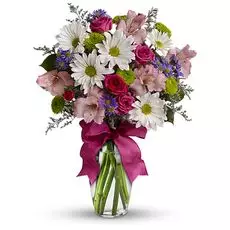
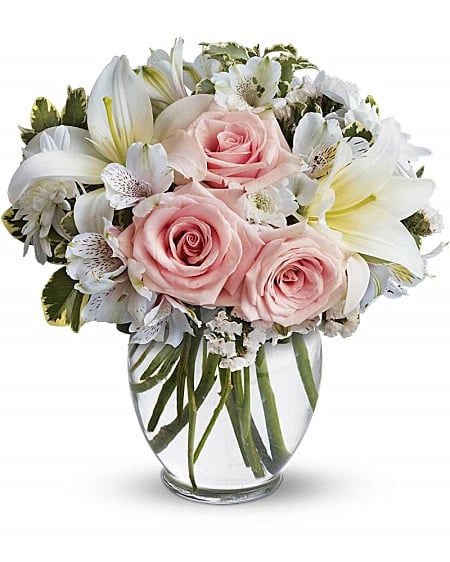
Purple statice runs through this one. Joan flagged statice in her species guide above as one of the flowers that essentially dries itself, and the purple variety holds color for over a decade. The hot pink roses come in tight bud, which is the right stage to start preservation from. $54.99.
View arrangement →
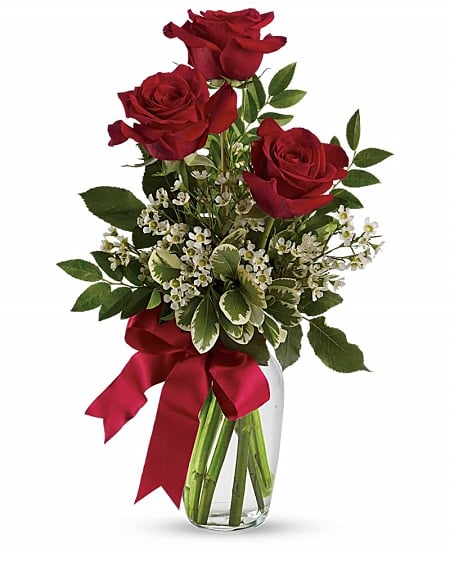
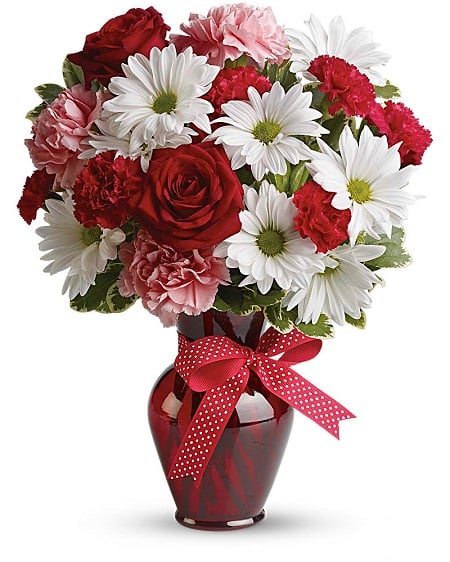
Three red roses at the half-open stage Joan describes as the right window to start preservation, when the sepals have reflexed but the bloom hasn't blown. Hot pink carnations carry the rest of the color. Both species sit firmly on Joan's preservation-friendly list. The red glass vase is a Teleflora proprietary piece. $59.99.
View arrangement →The long game: making a preserved flower last
So you've preserved the flower. You did it correctly. The bouquet from the wedding, or the arrangement from the service, is now sitting in front of you, dry and structurally sound. The next question, which most guides skip, is how to keep it that way. Preserved flowers are not bulletproof. Two things will undo months of careful work, faster than seems fair.
UV light
Direct sunlight is the first one. Even without resin around them, dried flowers fade in weeks if they sit in a window. Pigment molecules absorb light energy and break down. There's no technique that prevents this entirely. Premium resin formulas use UV-absorbing stabilizers that work on a reversible proton-transfer mechanism: they grab the UV energy and release it as heat, slowing the damage. Slowing, not stopping. The practical version of this advice is unglamorous: keep preserved flowers out of direct sun. Hallway, interior wall, low-light shelf, framed shadow box on a north-facing wall. Not the windowsill. Not the kitchen counter under a skylight.
I've watched preserved bridal bouquets fade from peach to dust in eighteen months because the family hung them in a south-facing dining room. Once the pigment goes, it's gone. I tell brides who ask about preservation that the right wall is more important than the right technique. Wrong wall and the best preservation in the world will not survive the second anniversary.
Humidity
The second thing is humidity. Preserved flowers are hygroscopic, which means they pull moisture out of the air. If the residual moisture climbs back above roughly 11.5 percent, the dormant cellular decay reactivates within weeks. Mold returns within months. The work undoes itself.
Bathroom humidity undoes the work. I take calls from people who preserved their wedding bouquet beautifully, framed it, and then hung it in the bathroom because it looked nice over the tub. Three months later it has black spots on the petals and they don't understand why. The humidity reactivates everything that was dormant. Salt air on the coast does the same thing because salt is hygroscopic too, it pulls water onto the surface of whatever it touches. A sealed shadow box, with a small silica desiccant pack tucked behind the matting, is the right answer. That's not a suggestion or a nice-to-have. The desiccant pack is the difference between a five-year keepsake and a five-month one.
Sealed shadow boxes with UV-protective glazing are widely available. Most decent custom framers in the US will build one to spec. Not all framers know about the silica desiccant requirement, though, which is something worth flagging directly when you bring the project in.
Andrew A note on framers. We've had customers describe getting a beautiful shadow box made by a local framing shop, only to find the dried bouquet started fading or going moldy within the first year because no one mentioned the desiccant or specified UV-blocking glass. When you take the project to a framer, ask for both: silica packs sealed inside the back of the box, and UV-protective glazing on the front. Some framers will know exactly what you're asking for. Others won't. The difference is months versus years.
Which flowers work best
The honest answer is that not every flower was designed to be kept. Some, like lavender and statice, seem to dry themselves. Others, like most orchids, resist almost every technique short of professional freeze-drying. Knowing which you're working with before you start saves a lot of heartbreak. What follows is a working species guide, organized by what works rather than by what would make a tidy table.
Joan handles preservation calls regularly. The read below is hers.
After thirty years on the bench and somewhere north of forty thousand arrangements, the pattern is consistent. A flower's preservation potential is mostly determined by two things: how much water it carries, and how dense its structure is. High-water, dense-structure flowers like peonies and lilies are the hardest. Low-water, paper-textured flowers like statice and strawflower are the easiest. Everything else falls somewhere in between, and the technique needs to match. What follows is what I tell customers when they call about preserving an arrangement and I need to give them a quick read on whether it's worth attempting at home.
Lavender
Easy. Air drying.Holds color well, retains scent for years. The most reliable beginner project there is. Hang in loose bundles, somewhere dark and dry, two to three weeks. The bundles you see in farmhouse photographs aren't stylized: that's how it's done.
Statice and strawflower
Easy. Air drying.Statice and strawflowers have papery petals already, almost like nature designed them for drying. Color retention is excellent. Statice in particular keeps its purple-blue brilliance for a decade or more.
Baby's breath
Easy. Air drying.Dries almost unchanged. The transition from fresh to dried is so subtle that many people don't notice their baby's breath has dried. Excellent filler for dried-flower arrangements and shadow boxes.
Hydrangea
Easy. Air drying.Hydrangea dries quickly and naturally if you let the flower start to feel papery on the plant first. Color fades to antique tones, often beautifully. The trick is to start drying when it's almost ready to dry on its own, not at peak fresh. One workaround that's specific to hydrangeas: if a head wilts before you start the drying process, submerge the entire flower in cool water for thirty minutes. Hydrangeas drink through their bracts as well as their stem. It's the only flower in this guide that does. They come back.
Rose (tight bud)
Medium. Silica gel.Best preserved at tight bud or half-open stage. Open-faced roses collapse during desiccation regardless of technique. If you want to preserve a wedding rose, pick the one that looks slightly less fully open. It will hold form better.
Peony
Medium-hard. Silica only.Air drying always fails. There is too much moisture trapped in the center of a peony for any non-silica method to handle. Bury completely in fine-mesh silica. Be patient. Five to seven days. The reward is one of the most beautiful preserved flowers there is.
Carnation
Medium. Silica gel.Dense, multi-petaled, and structurally tough enough to hold shape through almost any silica routine. The petal density that makes carnations cheap at the supermarket is the same property that holds form through desiccation. Practice on white or pink standards before you spend silica on a wedding rose. The mistakes look the same and the carnation costs a tenth as much.
Camellia
Medium. Silica gel.Exceptional results when the flower is buried in silica within 24 hours of cutting. Camellias drop their entire bloom intact rather than petal by petal, which is a structural advantage for preservation. The flower's tissue is built to come off the plant in one piece, so it holds geometry through desiccation more cleanly than flowers that shed gradually. The catch is timing. You have to catch them at peak. Wait too long and the whole flower hits the ground first.
Dahlia
Medium-hard. Silica gel.The large heads need at least seven days of full silica burial. Smaller pompon varieties are easier. Decorative and dinnerplate dahlias are a real test of patience but the result, if you get it right, is remarkable.
Pansy and viola
Easy. Pressing.Naturally flat. Press perfectly. The classic species for botanical art and pressed-flower stationery. Hold their faces almost intact through the pressing process, which is rarer than it sounds.
Lily
Difficult.High moisture content, heavy petals, and prominent stamens that shed pollen and stain. Possible with very fine-mesh silica and patience, but most home attempts fail. Stargazers and orientals are the worst offenders. Asiatic lilies handle slightly better. One pre-step that buys time: pinch the anthers off before they shed pollen. Two reasons. The pollen stains everything once it's loose, and the lily thinks it hasn't been pollinated, so it keeps blooming for three or four extra days. That can be the difference between catching peak and missing the window entirely.
Orchid
Very difficult.Phalaenopsis collapses in almost every home method. Dendrobiums sometimes survive silica with care. The genuine answer for orchids is professional freeze-drying. If the orchid was the centerpiece of a wedding or memorial and you can't afford to lose it, this is one of the few cases where the professional service is the right call.
Method comparison at a glance
Skimming, not reading? Here's the shortest possible version. Difficulty rises as you go down the list, and so does fidelity to the original flower.
Before you pour resin
The exothermic heat risk during curing is the single most common reason resin projects fail. Do not pour more than half an inch at a time. Deep pours generate enough internal heat to brown and warp the petals you spent weeks preserving. The flower must also be bone dry before encasing. A flower that feels dry to the touch may still hold residual intracellular moisture. Wait an extra week if you're unsure. A small visible imperfection is better than an irreversibly scorched petal trapped under resin you can't open.
Further reading
If this guide was useful, the two posts below sit next to it on the same shelf. The first goes further into the history and craft of drying and pressing. The second is for readers who are starting earlier in the process: choosing flowers worth keeping in the first place.
If you're thinking about an arrangement that's worth preserving, the front end of the project counts as much as the back end. Tight buds, multi-petaled blooms, and stems that arrived properly conditioned give you a head start that no preservation method can manufacture later.
Browse arrangements worth keepingLily's Florist USA delivers across America through a network of 15,000+ partner florists.
In business in the US since 2017. Same-day delivery when you order before 1PM weekdays or 10AM Saturdays.
Questions? Call 800-946-5457 or email [email protected]
About the authors
This guide was written by Andrew, with the floristry sections developed alongside Joan and a personal contribution from Siobhan. Read our full story.

Andrew, Siobhan, Ivy and Asha.