Shop By
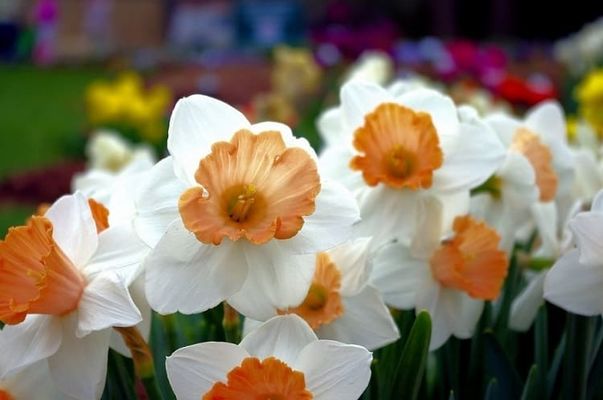
I'll say the quiet part first: daffodils have an image problem. They're the flower everyone can identify and almost nobody stops to think about, because they show up so reliably every March that they start to read as wallpaper. A neighbor's front bed. A grocery store bucket by the door. The flower your grandmother always had in a jar on the windowsill. Easy to love, easier to overlook.
That's a mistake, and not just a sentimental one. Somewhere between the Greek botanist who first wrote the plant down around 300 BCE and the FDA approval that landed on a daffodil-derived drug in 2024, this flower picked up a genuinely strange resume. It's poisonous enough that veterinary references treat the bulb as a household hazard on par with rat bait. It's also, in a different concentration, the raw material for a medication prescribed to people losing their memory. Both of those facts are true about the same plant, sometimes the same bulb.
We asked Joan, our expert reviewer who spent three decades on a florist's bench in Piedmont North Carolina before she started fielding our phones, to help us get past the "cheerful spring flower" version of this story. What follows pulls from the botanical record, from a set of Alzheimer's drug trials, from a Rutgers psychology lab that used hidden cameras in an elevator, and from the dermatology journals that document what daffodil sap actually does to a florist's hands.
None of it makes the daffodil less cheerful. It just explains why that cheerfulness is doing more work than it gets credit for.
If you only have 30 seconds
- The daffodil's "hope and renewal" symbolism isn't a Victorian invention. It's a direct flip of an older Greek myth in which the flower marks Persephone's abduction into the underworld, and later, her return.
- The same alkaloid family that makes daffodils toxic to pets and irritating to florists' skin is the source of galantamine, an FDA-approved Alzheimer's medication that got a new companion drug, Zunveyl, in 2024.
- In a controlled study, 100% of women who received flowers showed a genuine, muscle-verified smile. Only 77% smiled at a candle and 90% at a fruit basket. That is a nearly unheard-of consensus rate in emotion research.
- Daffodils feel cheerful mostly because they're bright and heavily saturated, not because yellow has some special power over the brain. Vision scientists found lightness and saturation explain 94% of the "happiness" people report from color.
- The most common real-world daffodil poisoning isn't a dog nosing around a garden bed. It's a bulb getting mistaken for an onion in someone's kitchen.
- Daffodils are the single most common cause of skin irritation among American florists, and it isn't chemical. It's mechanical: microscopic needle-shaped crystals in the sap that puncture skin when a stem snaps.
In This Guide
A Name Nobody Fully Agrees On
The daffodil belongs to the genus Narcissus, part of the amaryllis family, native to the Mediterranean basin and North Africa. Cultivation records go back to at least 300 BCE, when the Greek botanist Theophrastus first catalogued it. The genus name comes from the Greek word for "numbness" or "stupor," narke, and that's not just a nod to the vanity myth. The plant's alkaloids have real sedative and neurotoxic properties, which we'll come back to.
The common name is where things get contested. One theory traces "daffodil" to a corruption of "asphodel," a different Mediterranean flower tied to the Greek underworld, with the initial "D" absorbed from the Dutch article "de." Cornell's Botanic Gardens favors a rival account: that "daffodil" comes from the Dutch "affo dyle," meaning "that which comes early," a nod to the plant's habit of being the first thing up in a cold garden.
There's a regional wrinkle that trips up out-of-state buyers shopping for someone in the American South. "Jonquil" gets used interchangeably with "daffodil" down there, but strictly speaking it refers only to Narcissus jonquilla and its close relatives, identifiable by thin, reed-like foliage. The word comes from the Spanish diminutive of junco, meaning "reed."
I still get callers in the Carolinas and Georgia who ask for jonquils and get a little put out when I clarify we're talking about the same plant family. It's not wrong to call them that. Jonquils are just one specific branch of the daffodil tree, the fragrant, narrow-leaved branch. If someone tells you they want jonquils for their grandmother's porch, they usually mean the classic yellow ones with the strong smell, not the big trumpet types you see in a grocery store bucket.
Where the Word Actually Came From: Two Rival Theories
A Corrupted "Asphodel"
"Daffodil" traces to a mangled version of "asphodel," a different Mediterranean flower tied to the Greek underworld. The initial "D" got absorbed from the Dutch article "de," as in "de affodil."
Cornell's "Affo Dyle"
Cornell Botanic Gardens favors a rival origin: the Dutch "affo dyle," meaning "that which comes early," a nod to the plant's habit of being first up in a cold garden.
Neither theory has won. Both are still cited as authoritative today.
Narcissus Was a Grief Story First
Everyone knows the surface version: a beautiful young man named Narcissus becomes so transfixed by his own reflection in a pool that he wastes away and turns into the flower. That story gets repeated at face value so often that the older, darker layer underneath it tends to disappear.
The ancient Greeks and Romans linked the flower directly to death and the underworld. Narcissus flowers were believed to grow in the Elysian Fields, and Romans planted them on graves and used them in funeral rites specifically for that association, not as decoration. A separate, less-cited strand of the myth ties the daffodil to Persephone: in one version, the flowers sprang from her tears as Hades pulled her into the underworld, and they later became the signal to her mother Demeter that Persephone was returning to the surface each spring.
That reframes everything. The daffodil's "hope and renewal" meaning isn't an arbitrary Victorian sentiment layered on top of a pretty flower. It's a direct inversion of a grief myth, an abduction story turned into a reunion story, replayed every year in the same weeks the actual flower comes up out of the cold ground.
It's also, probably, why the most famous poem ever written about this flower isn't about loss at all. William Wordsworth wasn't thinking about Persephone when he wrote "I Wandered Lonely as a Cloud" in 1804, but he landed on the same emotional turn anyway, a field of daffodils as the thing that returns to comfort him long after the moment itself has passed.
For oft, when on my couch I lie
In vacant or in pensive mood,
They flash upon that inward eye
Which is the bliss of solitude;
And then my heart with pleasure fills,
And dances with the daffodils.
There's a grimmer historical footnote here too. Soldiers in earlier eras reportedly carried daffodil bulbs into battle, specifically because the plant's numbing alkaloids could let a mortally wounded man end his suffering on his own terms. It's a hard detail to sit with, and it's also the same biochemical family now being repurposed for something closer to the opposite: preserving memory rather than ending pain.
The daffodil's "hope and renewal" symbolism isn't an arbitrary invention. It's a grief myth turned inside out, replayed every spring.Joan, Florist Guidance
A Toxic Flower That Treats the Brain
Here's the fact almost no florist content mentions: the same alkaloid that makes daffodils poisonous to pets and irritating to skin, a compound related to lycorine, sits in the same biochemical family as galantamine. Galantamine is extracted from daffodil bulbs and was approved by the FDA in 2001 as an acetylcholinesterase inhibitor for Alzheimer's disease. In 2024, Zunveyl, a new galantamine-based oral medication, became the first new Alzheimer's drug of its kind approved by the FDA in two decades, and demand for naturally sourced (rather than synthetic) galantamine is expected to climb as a result.
One Flower, One Molecule, One Long Medical Timeline
Same neurotoxic alkaloid family, three very different centuries. The compound that once ended suffering on a battlefield is now being farmed, deliberately, to slow memory loss.
Cochrane review data shows galantamine produces statistically significant cognitive improvements at daily doses of 16 to 32 mg over three to six months, with measurable gains on the ADAS-Cog scale, the standard yardstick for Alzheimer's drug trials.
There's a strange agricultural detail attached to this. A Welsh sheep farmer named Kevin Stephens discovered that daffodils grown at 1,200 feet in harsh mountain conditions produce meaningfully higher galantamine concentrations than the same plant grown in easier lowland soil. It's a textbook case of stress-induced defensive chemistry: the plant produces more of its own neurotoxin when it's struggling. Researchers studying the extraction process have separately found that daffodil-derived compounds can reduce methane emissions in grazing livestock, an unrelated but genuine co-benefit.
I run the operational side of this business, not the pharmaceutical side, but the sourcing logic here is worth flagging. A crop that gets more valuable the harder it is to grow, on mountain soil a lowland farm can't replicate, is a supply chain most flower buyers never think about. It's the same principle behind a lot of what we do getting flowers from a grower to a doorstep. The hard-to-produce version is usually the one worth understanding.
What Actually Happens When Someone Opens the Door
The most rigorous research on how flowers land emotionally comes from Rutgers psychologist Dr. Jeannette Haviland-Jones, who ran a three-part study published in Evolutionary Psychology. The first study sent 147 women one of three thank-you gifts, a candle, a fruit basket, or a flower bouquet, with observers posing as delivery drivers secretly coding facial expressions on arrival.
What Actually Made People Smile for Real
147 women, three thank-you gifts, hidden observers coding facial muscles on arrival.
The flower bar isn't measuring "smiled at all," it's measuring a genuine, muscle-verified Duchenne smile in every single recipient. Zero exceptions, in a field where 100% consensus almost never happens.
A Duchenne smile is the involuntary kind, the one that engages the muscles around the eyes and can't be faked for a polite reaction. Haviland-Jones herself noted that 100% consensus responses are almost unheard of in emotion research outside fear stimuli, like snakes. That makes flowers one of the only reliably universal positive-emotion triggers ever measured in a lab.
The second study is the one Joan likes to tell customers about, because it's the most counterintuitive. Researchers handed flowers, pens, or nothing to strangers riding in an elevator. The people holding flowers broke the well-documented social norm of standing at the back of an elevator avoiding eye contact. Instead, they moved toward the center, smiled at strangers, and started conversations. The pen recipients didn't.
Joan hears versions of this on the phones constantly. People assume flowers are a private mood boost for whoever receives them. The elevator study says something more specific: flowers lower a person's guard around everyone standing nearby, their own mood is only part of it. Send flowers to someone at a workplace or in a waiting room and you're changing how they behave toward the people around them for the next few minutes, not only how they feel. I've had callers ask whether flowers would cheer up an entire hospital room, roommate included. This research says yes, and it's not a guess.
The third study, run in a retirement community, found something with direct relevance to memory. Residents who received two sequential flower deliveries showed the best documented recall on memory tests involving unrelated study materials, compared to single-delivery or no-delivery groups. Researchers couldn't determine whether flowers directly improved memory encoding or whether the effect ran through mood and motivation, but they explicitly noted the finding "opens up the possibility" of a direct cognitive link.
Set next to the galantamine research above, that creates an unusual double narrative. Daffodils may support memory two separate ways at once: biochemically, through galantamine-based medication, and behaviorally, through the mood-linked memory improvements tied to the act of receiving flowers. Two independent scientific threads, converging on the same flower family.
Why Yellow Specifically Works, and Why That's the Wrong Question
Most daffodils are a saturated yellow, so it's worth asking what that color is actually doing. A systematic review spanning 128 years of research, 42,266 participants, and 64 countries found yellow and orange are consistently linked to high-arousal positive emotions like happiness and fun, and that lighter, more saturated colors generally get more positive emotional ratings across cultures.
A more rigorous vision-science study complicates the simple "yellow equals happy" story. When researchers controlled for lightness and chroma independently of hue, they found 94% of the variance in happiness ratings came from lightness and saturation, not yellowness itself. In plain terms, daffodils feel cheerful largely because they're bright and highly saturated, not because yellow carries some intrinsic emotional charge.
There's also a geographic layer that rarely makes it into flower marketing. A cross-cultural study of color-emotion associations across 55 countries found that the strength of the yellow-joy link correlates with distance from the equator and rainfall. People in cloudier, higher-latitude climates, think the Pacific Northwest or New England, show stronger positive associations with yellow than people in consistently sunny regions. In that study, US respondents showed a 60 to 70% yellow-joy association, notably lower than Finland's 87.7% but well above Egypt's 5.7%.
The Cloudier the Climate, the Harder Yellow Hits
Share of people who link yellow with joy, by country, across a 55-country study
The practical read: a daffodil bouquet is likely to land harder, emotionally, in Seattle or Boston in February than it will in Miami in July. That's not marketing spin, it's what a 55-country dataset says about climate and color psychology.
The Physical Risk Nobody Puts on the Label
Daffodils are documented as the single most common cause of irritant contact dermatitis among professional florists, and the mechanism is mechanical, not purely chemical. Daffodil sap contains microscopic, needle-shaped calcium oxalate crystals called raphides. When a stem snaps during harvesting, those crystals physically puncture the skin and cause fissuring, scaling, and redness on the fingertips and forearms, a condition florists informally call daffodil pickers' rash.
Every florist I trained alongside in North Carolina learned this the hard way at least once. You process a bucket of daffodils bare-handed because they look harmless, and by that evening your fingers are cracked and stinging. It's not an allergic thing for most people, it's the crystals doing exactly what they evolved to do, which is discourage anything from eating the plant. Gloves during bulk processing aren't optional if you're moving a lot of stems.
Research also shows that more elongated, barbed crystal structures cause proportionally worse irritation, and that Narcissus pseudonarcissus, the common daffodil, causes markedly more skin irritation than Narcissus tazetta. Not every daffodil species is equally hazardous to handle. There's also documented evidence of a distinct allergic protein called "narcin," isolated specifically from N. tazetta bulbs, capable of triggering a genuine allergic reaction rather than just mechanical irritation.
The household risk profile is a little different, and the part that catches people off guard has nothing to do with pets in a garden. Every part of the daffodil plant is toxic to dogs, cats, and horses, but the bulb carries by far the highest concentration of lycorine and related alkaloids. The most common real-world poisoning pathway isn't an animal nosing around outdoor flower beds. It's a bulb getting mistaken for an onion in a kitchen or pantry, a mix-up serious enough that veterinary toxicology references flag it as a genuine human poisoning risk, not just a pet issue.
For anyone gifting daffodils to a pet-owning household, the practical version of all this is simple: keep the vase somewhere a curious animal can't tip it, and never let cut bulbs, if you're gifting the potted or bulb form rather than cut stems, sit anywhere near the kitchen.
Four Daffodils That Aren't the One You're Picturing
The American Daffodil Society recognizes 13 official classifications within the genus Narcissus. Most people picture one shape: the classic yellow trumpet. That's a fraction of what the plant actually does. Here are four varieties most people never see in a grocery store bucket, useful if you're the kind of gift-giver who likes to arrive with information nobody else bothered to look up.
Jonquil
Narcissus jonquillaThin, tube-shaped, rush-like foliage instead of the usual flat leaves, and a strong fragrance carried across one to five flowers per stem. Petals grow only in yellow shades, but the cups vary widely: pale pink, yellow, white-rimmed cream, or orange to orange-red. This is the daffodil most commonly meant when someone in the American South asks for jonquils by name.
Double Daffodils
Narcissus, doubled formsThe showy end of the family. Petals ruffle with doubled segments, cup, or both, in shades of peach, pink, white, and bi-color combinations. Narcissus 'Delnashaugh' pairs creamy white outer petals with ruffled apricot-pink centers. Narcissus 'Tahiti' carries golden yellow petals with a striking vermilion interior.
Tazettas
Narcissus tazettaHeavy bloomers, up to 20 flowers on a single stem, with a scent strong enough that you'll usually catch it before you see the flowers. They stay under 18 inches tall and thrive in beds, borders, containers, or naturalized under deciduous trees. The popular paperwhite is a tazetta narcissus.
Poeticus
Narcissus poeticus, "Pheasant's Eye"Pure white petals around a short, disc-shaped cup with a pale yellow center, a faint green tinge, and a red rim. Highly fragrant, and cultivated in southern France and the Netherlands for essential oil used in perfume. Narcissus 'Actaea' makes an especially good cut flower from this group.
Nantucket and Skagit Valley Are Telling Two Different Stories
The United States has two geographically distinct daffodil festival traditions with genuinely different cultural roots. The Nantucket Daffodil Festival has run since 1975 and marks its 50th anniversary in 2026. It centers on an antique car parade, a "Daffy Dog Parade," and a Garden Club flower show sanctioned by the American Daffodil Society, reflecting an old-money New England social tradition more than an agricultural one.
The La Conner Daffodil Festival in Washington's Skagit Valley is a different animal entirely, explicitly agricultural and commercial. It features over 500 acres of working daffodil fields that serve as the visual and economic lead-in to the much larger Skagit Valley Tulip Festival the following month. Daffodils function there as a literal opening act crop in the region's bulb industry calendar.
East Coast daffodil culture reads as heritage and leisure. Pacific Northwest daffodil culture reads as agri-tourism and production. Same flower, two entirely different American stories.
Pick a Coast: Same Flower, Two Completely Different Festivals
Running since: 1975, marking its 50th anniversary in 2026.
The scene: An antique car parade, a "Daffy Dog Parade," and a Garden Club flower show sanctioned by the American Daffodil Society.
What it's really about: Old-money New England social tradition. Leisure and heritage, not agriculture.
Scale: Over 500 acres of working daffodil fields.
The scene: A commercial bulb farm on public display, timed as the visual lead-in to the much larger Skagit Valley Tulip Festival the following month.
What it's really about: Agri-tourism and production. Daffodils here are a literal opening act crop in the regional bulb industry calendar.
Nationally, the American Cancer Society has used the daffodil as its symbol of hope for cancer patients and survivors for decades, a legitimate cause-marketing angle rooted in the same rebirth-after-dormancy symbolism running through nearly every cultural tradition tied to this plant. It's part of why yellow has earned a real place inside sympathy flowers for a life well lived, where hope symbolism reads differently than the traditional all-white service register. "Nearly every cultural tradition" is a big claim, so it's worth asking Joan to back it up, since yellow's place in mourning isn't a Western quirk she picked up secondhand.
It isn't, not even close. At a Buddhist funeral, white is primary, but yellow belongs there too, white chrysanthemums, orchids, and lotus, sometimes woven with yellow chrysanthemums. Red is the one color that's off the table entirely, since red at a Buddhist funeral reads as celebrating the death. Chinese funeral customs lean the same way, white and yellow chrysanthemums together, and Qingming, the early-April tomb-sweeping day, brings a wave of yellow-and-white chrysanthemum orders from families visiting ancestral graves. The catch I warn callers about: chrysanthemums mean death in Chinese culture specifically, so if someone rings wanting to send chrysanthemums as a birthday gift to a Chinese colleague, I redirect them to roses every time. Send chrysanthemums to a Chinese household for a birthday and the message you're sending is the opposite of the one you meant. Hindu customs bring yellow in a different way, garlands in orange and yellow, warm tones throughout, though the garland itself is usually built by family rather than a florist. Different countries, different rules, same color showing up again and again where hope needs to sit next to grief.
What the Common Claim Leaves Out
| Dimension | Common Claim | What's Underneath |
|---|---|---|
| Symbolism | "Hope and renewal" | A direct reversal of the Persephone/Demeter grief myth, tied to first bloom after winter dormancy |
| Color | "Yellow makes people happy" | 94% of the effect is driven by lightness and saturation, not the hue itself |
| Psychology | "Flowers make people happy" | A 100% Duchenne smile rate in a controlled Rutgers study, one of the only unanimous positive-emotion results in the field |
| Pharmacology | "Toxic flower" | Galantamine, from the same alkaloid family, is FDA-approved for Alzheimer's disease |
| Occupational health | "Delicate flower" | Leading cause of florist contact dermatitis, via microscopic crystals in the sap |
| Regional culture | "Spring flower" | Two distinct festival identities: heritage-coded Nantucket vs. agricultural-coded Skagit Valley |
Why We Don't Ship Loose Daffodils Nationwide, and What We Send Instead
A fair question at this point: if daffodils are this interesting, why isn't there a daffodil bouquet on our site? The honest answer is a network answer, not a floristry one. The bloom window is short, two or three weeks at most in any given region, which makes daffodils a poor fit for a same-day delivery network that has to move flowers reliably across the whole country every week of the year, not just the weeks a daffodil crop happens to be at its best.
What we lean on instead are the pieces in our own catalog that carry the same emotional register: bright, unfussy, and steady enough to survive a cross-country trip.
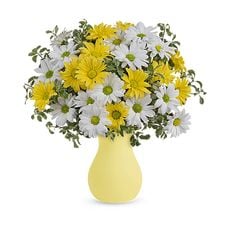
Lemon Sorbet
From $59.99A yellow and white daisy dome in a saturated butter-yellow ceramic vase. It runs the same emotional lane daffodils do: friendly, not romantic. Fine for a general hospital room; for oncology, ICU, or transplant wards, call the nurses' station first no matter what you're sending. Vase life runs twelve to fourteen days.
Shop Lemon Sorbet →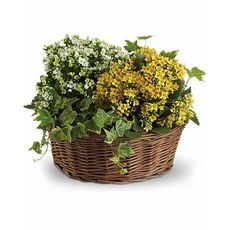
Joy
$61.99A yellow and white kalanchoe plant basket with trailing ivy. No pollen and no standing vase water, so it clears more general rooms without a second thought. It blooms for four to eight weeks, longer than any cut arrangement in the same price band.
Shop Joy →When someone calls asking specifically for daffodils and we're outside the March window, or the delivery zip code is nowhere near a fresh daffodil crop, Joan steers them toward Lemon Sorbet or Joy for the same reason she'd have steered a customer that direction back on her own shop floor in North Carolina. Fresh-cut daffodil sap needs several hours conditioning alone in water before it can safely sit with other stems, it's actively toxic to whatever it's mixed with too soon, which is one more reason the timing rarely lines up for a nationwide order. In Joan's experience, the people who call back after ordering the substitute almost never mention the swap, they mention that the flowers were still good two weeks later, which is the part that actually sticks. You keep the yellow, keep the cheer, and get something built to survive the trip. And on the hospital question specifically, her rule doesn't change by product type: a soil-based plant isn't automatically safer than a cut stem. Oncology, ICU, and transplant units restrict all organic material in some hospitals and only fresh-cut flowers in others. Ask the ward before you order, not after.
The Case for Taking a Simple Flower Seriously
The Rutgers elevator study is the single most useful data point in all of this, and the least used. It shows flowers measurably reduce social guardedness between strangers, not just private mood in the person who received them. That reframes daffodil gifting away from a vague "make someone feel good" pitch and toward something more precise: flowers appear to lower a recipient's default interpersonal defenses, prompting eye contact, conversation, and closeness that wouldn't otherwise happen.
Layer in the memory-recall findings from the retirement community study, and there's a legitimate, source-backed case that daffodils, and flowers generally, work on three levels at once: as a mood intervention, as a social lubricant, and, at the biochemical extreme via galantamine, as a literal cognitive-support compound. Three narrative threads almost never assembled together, converging on a flower most people walk past without a second look.
There's a theory that explains why we ever started growing flowers in the first place, and it's worth sitting with. Evolutionary psychologists call it the "Big Bloom" hypothesis: flowers have no nutritional value and no reliable medicinal use, yet people have cultivated them for more than 5,000 years anyway, purely because they reliably produce positive emotion. That makes humans behave like unconscious caretakers toward a plant, the same relationship most people have with a pet. A daffodil doesn't feed you. It doesn't need you the way a dog does. It gets tended to anyway, every March, because something in that response is older than agriculture itself.
Daffodil Questions We Get Asked the Most
Are daffodils poisonous to dogs and cats?
Yes. Every part of the plant contains lycorine and related alkaloids, but the bulb carries by far the highest concentration. Symptoms in pets, vomiting, hypersalivation, and diarrhea, typically appear within 15 minutes to 24 hours of ingestion. Severe bulb ingestion can cause low blood pressure, tremors, and cardiac arrhythmia. A cat brushing against a few petals is a very different risk than a dog getting into a bag of stored bulbs.
Is a jonquil the same thing as a daffodil?
Jonquils are daffodils, but not every daffodil is a jonquil. "Jonquil" refers specifically to Narcissus jonquilla and its close relatives, identifiable by thin, reed-like foliage and strong fragrance. In the American South, "jonquil" is often used as a catch-all term for any daffodil, which is a regional habit rather than a botanical rule.
Why do my hands itch after cutting daffodils?
Daffodil sap contains microscopic, needle-shaped calcium oxalate crystals called raphides. When a stem snaps, those crystals physically puncture the skin and cause fissuring and redness, a reaction florists call daffodil pickers' rash. It's mechanical irritation, not typically an allergy, though a distinct allergic protein has also been isolated from one daffodil species. Gloves are the fix for anyone processing more than a stem or two.
Can you mix daffodils with other flowers in a vase?
Not right away. Fresh-cut daffodil sap is toxic to other cut stems and will shorten their vase life if mixed too soon. Florists condition daffodils alone in water for several hours first, which lets the sap stop flowing from the cut end, before combining them into a mixed arrangement.
What does a daffodil symbolize?
Hope and renewal, most commonly, tied to its status as one of the first flowers to bloom after winter. That meaning traces back further than most people realize: in Greek mythology, daffodils are linked to Persephone's return from the underworld each spring. The American Cancer Society also uses the daffodil as its symbol of hope for cancer patients and survivors.
Why is the daffodil the March birth flower?
Daffodils are one of the earliest flowers to bloom as winter ends, which is why they became associated with March across most of the Northern Hemisphere. The timing lines up with the same renewal symbolism behind the flower's broader meaning, first bloom after dormancy, rather than any separate birth-flower tradition.
Further Reading
If the science and symbolism angle here was useful, these go deeper on the pieces we could only touch on above.
Sending flowers to someone this spring? Our yellow flower collection carries the same cheerful, hospital-safe register the daffodil is known for, delivered same-day when you order before 1PM weekdays or 10AM Saturdays.
Shop Yellow FlowersLily's Florist USA delivers nationwide through a network of 15,000+ partner florists.
Same-day delivery when you order before 1PM weekdays or 10AM Saturdays.
Questions? Call (800) 946-5457
About This Article
Written by Dennis, part of Lily's Florist USA's small distributed team. Florist guidance reviewed by Joan, NCCPF Certified Florist (30 years on the bench). Read our full story.
Sources
Cornell Botanic Gardens, "Narcissus: A Global Symbol of Spring, Renewal, and Resilience"
PubMed, "Galantamine for Alzheimer's Disease"
PubMed, "Galantamine for Dementia Due to Alzheimer's Disease"
BBC News, "Could Daffodils Help With Treating Alzheimer's?"
Country Living, "How One Welsh Farmer's Daffodil Crop Could Help Thousands"
SAGE Journals / Evolutionary Psychology, Haviland-Jones et al., "An Environmental Approach to Positive Emotion: Flowers"
ScienceDaily, "The Evolutionary Triumph of Flower Power"
University of Florida Health, "Flower Power: Brain Awareness Lecturer Discusses Flowers' Positive Effect on Emotions"
Journal of Vision, "Yellow Is No Happier Than Blue When Lightness and Chroma Are Controlled"
Psychonomic Society, "Color Me Impressed: Psychology Research Links Colors and Emotions"
Science.org, "What Makes People Happy When Skies Are Gray? The Color Yellow"
MDedge, "Botanical Briefs: Daffodils (Narcissus Species)"
ASPCA, "Toxic and Non-Toxic Plants: Daffodil"
American College of Veterinary Pharmacists, "Daffodils"
Visit Skagit Valley, "The Daffodil Festival at Tulip Valley Farms"
Nantucket Chamber of Commerce, "Daffodil Festival"
FloralDaily, "A Sea of Sunshine Set to Bloom in Skagit Valley This March"
American Daffodil Society, "Daffodil Divisions Using the RHS System of Classification"
William Wordsworth, "I Wandered Lonely as a Cloud" (1804)