Shop By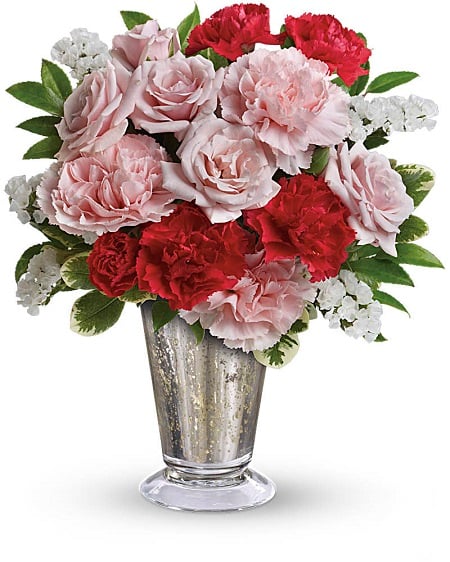
You picked a specific number this time. Seventy. Not sixty-five, not seventy-five, a milestone people say out loud at the party, and you are choosing a bouquet from a photo on a screen for someone who has been having birthdays since before most American living rooms had a color television.
Our order system tags every birthday delivery by the age in the card message, when a sender includes one. Thirtieth and fortieth orders mostly move the same way: quick, decisive, a name and sometimes a smiley face if it's placed through the online form. Seventieth-birthday orders take longer to place. Card messages run three and four lines instead of one. Callers ask what color she liked twenty years ago, not just what's in stock this week.
You can't always be in the room for this one, and the flowers are standing in for some of what you'd say if you were. That's a real job for a bouquet, and it's worth doing with more than a guess.
Joan, our NCCPF-certified florist, picked four arrangements for this specific birthday, and she built the picks around research most florists never open: a Rutgers lab's two-decade study of what flowers actually do to people, and a University College London study on how a seventy-year-old's eyes process color differently than a thirty-year-old's. I'll walk through both, and where the science and the catalog photo disagree with each other, I'm not going to pretend they don't.
Why Seventy Is Different
Three separate research traditions, built decades apart and never designed to talk to each other, land on roughly the same conclusion about what happens to a person's inner life around this age. Erik Erikson's life-cycle model puts late life at a specific psychological hinge point he called ego integrity versus despair: a stretch where a person does a genuine review of the life they've lived and works to make peace with it as it actually happened, not as they wish it had gone. Lars Tornstam, a Swedish sociologist, spent years interviewing older adults and found something the earlier "decline and withdrawal" model of aging had missed entirely: many people in their seventies report a shift toward what he named gerotranscendence, a move away from needing big events and toward finding real meaning in small, quiet ones. Stanford psychologist Laura Carstensen's socioemotional selectivity theory explains the mechanism behind that shift. As people sense that time ahead is more limited than time behind, their priorities move from chasing new information toward protecting emotional satisfaction right now, a pattern researchers call the positivity effect.
None of that was in my training. I picked flowers for eight years before I read a single word of it. Turns out the psychology holds up anyway, which is more than I can say for most of what gets forwarded to me as "research."
| Framework | What it found | What it means for a birthday delivery |
|---|---|---|
| Erikson | Late life centers on reviewing and making peace with a lived past. | Card messages that reference something specific and real land better than generic milestone language. |
| Tornstam | Older adults often shift toward finding meaning in small, quiet things rather than big ones. | One arrangement with a genuine focal bloom can outperform a busy, crowded bunch. |
| Carstensen | Priorities shift toward present-moment emotional reward over novelty. | Flowers are exactly the kind of immediate, low-effort, high-reward gesture the theory predicts a 70-year-old is primed to respond to. |
Joan, NCCPF Certified Florist
I've built a lot of milestone bouquets that were more flowers than the room needed. Somebody wants to make a statement, so the order gets bigger and bigger, and what actually lands better with a lot of seventy-year-olds is one honest, well-grown focal bloom they can sit and look at, not a wall of color competing for attention. That Tornstam idea about finding meaning in something small tracks with what I hear on the phones. People don't say it in those words. They say "she's not really a big fuss person" or "she'd rather have something she can actually enjoy looking at." Same idea.
The photograph on the product page and the research on aging eyes do not always agree with each other. We'd rather tell you that than let you find out on delivery day.Andrew, Co-Founder
The Colors Her Eyes Actually See
Two ordinary parts of getting older change how color looks, and neither one is about taste. The lens inside the eye yellows slightly with decades of light exposure, and it filters out blue and violet wavelengths the way a very faint pair of amber sunglasses would. Separately, the pupil's maximum diameter in dim light shrinks with age, a condition called senile miosis, so less light reaches the retina in the first place. The two effects stack. By a person's sixties, meaningfully less light is reaching the retina than it was at twenty, which is one of the reasons pale, cool-toned bouquets that look elegant under a florist's studio lighting can read as flat or washed out on an actual side table at home.
I run a flower company, not a vision lab. I did not plan on spending a week reading pupillometry papers to pick a color palette. That is exactly what happened, and it changed four product picks on this page.
Researchers at University College London went further and asked whether the eye alone explains the shift, or whether the brain's color processing changes too. Using a high-speed eye-tracking camera recording pupil diameter 1,000 times a second, they measured how strongly the pupils of healthy older and younger adults reacted to changes in color saturation. The older adults' pupils constricted noticeably less in response to more saturated colors, especially in the green and magenta range, while their response to plain lightness stayed about the same as the younger group's. That's a cortical finding, not just an eye-lens finding: the aging brain itself is processing color intensity differently, not just receiving less light. The study was published in Scientific Reports and is the first to use pupil response this way to track color perception across the lifespan.
A separate line of ophthalmology research, following 865 adults aged 58 to 102, found that color-vision abnormalities, mostly the blue-yellow type rather than red-green, showed up in about 45% of people in their mid-70s, rising past 50% after 85. Red and deep yellow are the two hues that reliably punch through both the lens filtering and the reduced saturation response, which is a genuinely useful fact if you're picking a bouquet, not just a piece of trivia.
| What changes | What it does | What to choose instead |
|---|---|---|
| Pupil (senile miosis) | Less light reaches the retina in normal indoor lighting. | Bright, consistent room lighting near the arrangement. |
| Lens yellowing | Blue and violet tones get filtered out before they're even registered. | Avoid pale blue and pastel lavender as the dominant color. |
| Cortical saturation response | Vivid colors register as less intense, especially green and magenta. | Choose bold, saturated warm tones as the anchor color. |
How Clearly an Aging Eye Reads Each Color
Illustrative scale, not a precise measurement. Based on the lens-yellowing and pupillometry research above.
Why: the aging lens filters blue and violet wavelengths before they're even registered, and UCL pupillometry found the aging brain responds less to saturated green and magenta specifically. Red and deep yellow pass through both filters largely intact.
This is the part where I'll admit something. I've been building pale, sophisticated bouquets for retirement occasions for years because clients ask for elegant and elegant, to most people, means cream and peach and soft mint. Nothing wrong with that palette. It's genuinely beautiful. It's just possibly the wrong beautiful for the actual eyes looking at it. If vividness matters more to you than restraint, tell whoever you're ordering from that directly, because the default "tasteful" option and the option her eyes will actually see clearly are not always the same arrangement.
What Turning Seventy Has Meant For a Very Long Time
Reaching seventy has carried specific cultural weight for centuries in places far from the United States, and the color that keeps showing up is the same one the vision science points to.
Koki
JapanThe tradition traces to a line from the Tang dynasty poet Du Fu: life to seventy is rare since ancient times. The milestone's theme color is purple, historically reserved for the highest ranks of the imperial court. In the Japanese language of flowers, purple chrysanthemum and purple orchid are the traditional Koki blooms, chosen specifically for dignity and endurance.
Gu Xi
ChinaSame Du Fu poem, same rarity framing. By seventy, structured longevity gifting is expected, and the butterfly appears throughout the tradition as a direct visual pun: the classical word for someone aged seventy to eighty, die, is a near-homophone for the word for butterfly, hudie.
The coincidence worth noticing
Purple wasn't chosen for Koki because anyone in eighth-century Japan understood cortical saturation response. It was chosen because it read as rare, dignified, and visible. Centuries later, UCL's pupillometry work found purple sits in the range of hues that still register clearly to an aging eye. Sometimes tradition and physiology land on the same answer from opposite directions.
The Honest Allergy Section
Lilies aren't automatically off the table for an allergy-sensitive recipient. Most of the risk in a mixed bouquet comes from wind-pollinated flowers that throw light, airborne pollen, chrysanthemums and asters chief among them. Insect-pollinated flowers evolved the opposite strategy: heavy, sticky pollen built to cling to a bee, not drift through a room. Roses, orchids, and carnations all fall into that safer category by design, not by luck.
| Flower | Allergy profile | Care note |
|---|---|---|
| Orchid | Very low risk. Pollen is sealed inside a waxy structure and rarely becomes airborne. Also the traditional purple Koki bloom above, so it does double duty if you want that color story and a safe pick at once. | Keep away from ripening fruit, which speeds up its aging. |
| Rose | Low risk. Heavy, sticky, insect-adapted pollen. | Re-cut stems at an angle and change the water every few days. |
| Carnation | Low risk. Pollen sits inside a densely layered, ruffled bloom. | One of the longest-lasting cut flowers in the trade, often two weeks. |
| Lily | Moderate if left untreated. Heavy pollen and strong scent. | Snip the anthers before delivery. See below. |
Allergy Risk, At a Glance
Bar length reflects relative pollen risk, not a lab measurement.
Joan's anther trick below is a genuine florist technique, not a home remedy, and it's exactly the kind of thing that's easy to explain over the phone and hard to guarantee happened correctly through a web order form. If the recipient has a specific allergy history, call us at 800-946-5457 and we'll talk through it with you before anything gets built, not after it's already on the truck.
Joan on Lily Anthers
Everyone who's ever bought lilies knows to snip the anthers so the orange pollen doesn't stain a tablecloth or a sleeve. What most people don't know is that it also keeps the flower alive longer. A lily "thinks" it hasn't been pollinated yet if the anthers are removed early, so it keeps blooming instead of starting to close down. You can add three or four extra days of display life just by getting that pollen off before it sheds, which matters more than usual for a recipient who isn't going to be doing much stem maintenance herself.
Joan built four arrangements around everything above: the vision science, the Koki color tradition, and the allergy question. Here's what she picked and why.
See Joan's 70th Birthday PicksJoan's Four Arrangements for a 70th Birthday
Four options, $51.99 to $81.99 depending on size, each chosen for a different reason. Where a pick has a real trade-off, Joan says so instead of letting the photo do the talking. The size tiers buy more stems and a fuller look, not better flowers, so Standard is never the compromise option.
Which Arrangement Fits Her Best?
Pick what matters most, and see Joan's match.
Dare To Wish
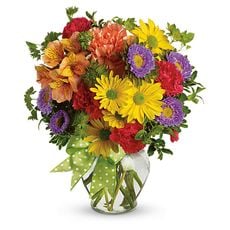
Orange and purple sit next to complementary on the color wheel, the exact pairing that reads clearest to an aging eye. Joan's pick if she only gets to make one.
Designers Choice Retirement Bouquet
Peach, cream, and mint with a magenta accent for backbone. Quieter and more pastel than the vision science favors, genuinely lovely if restraint matters more than vividness here.
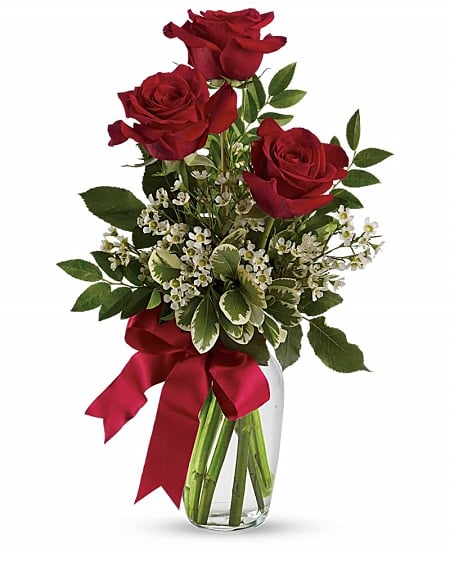
Kisses
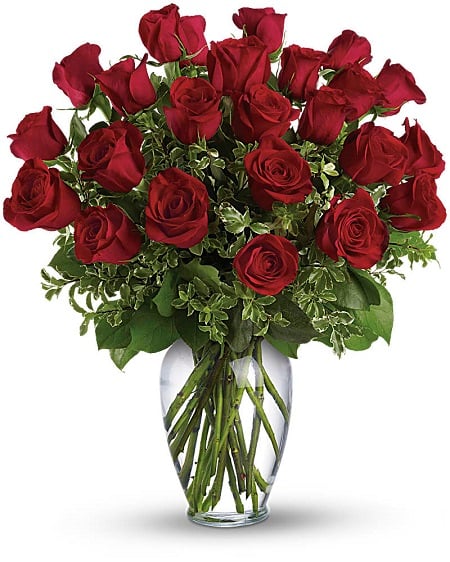
Red carries the farthest of any color for aging eyes. The straightforward pick when she'd rather have something instantly recognizable than a color-theory statement.
Joyous
Catalogued under "I'm Sorry," not birthdays, worth knowing upfront. The deepest true purple in the catalog, closest to the centuries-old Koki tradition covered above.
Dare To Wish
$59.99 · Standard / Deluxe +$10 / Premium +$20
Joan's Pick
Orange and purple sit next to complementary on the color wheel, which is exactly the pairing that reads clearest to an aging eye. This is the one I'd pick blind if I only got to pick one.
Shop Dare To Wish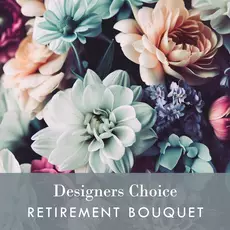
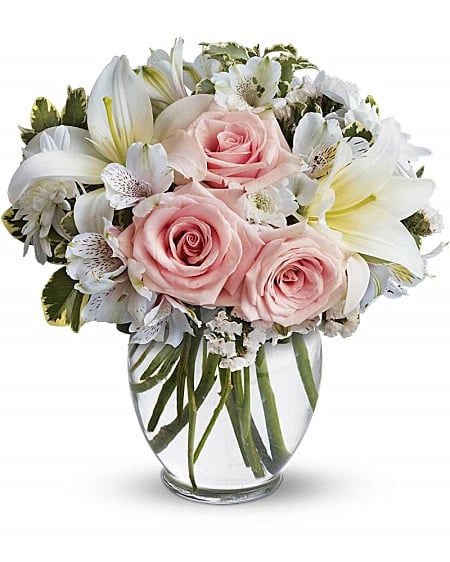
Designers Choice Retirement Bouquet
$51.99
This is where callers land when they want sophisticated over bold: peach, cream, and mint with a magenta accent for backbone. Worth knowing upfront, it's a quieter, more pastel build than the vision science above would steer you toward. If restraint is the actual brief here, not vividness, this is genuinely lovely, honestly built, and priced lowest of the four.
Shop Retirement Bouquet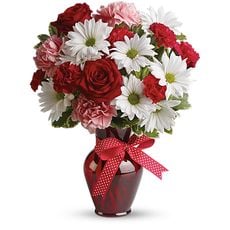
Kisses
$59.99 · Standard / Deluxe +$12 / Premium +$22
Red carries the farthest of any color for aging eyes. If she's the type who wants something classic and immediately recognizable rather than a color-theory statement, this is the straightforward version of that. No explaining required when she opens the door.
Shop Kisses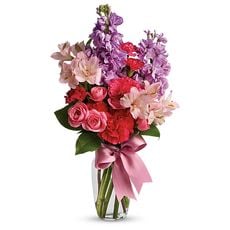
Joyous
$59.99 · Standard / Deluxe +$10 / Premium +$20
This one's actually catalogued under "I'm Sorry," not birthdays, and we'd rather tell you that than have you find out later. The reason it's still on this list: the purple stock in it is the deepest true purple in the whole catalog, closer to the Koki tradition above than anything built for a birthday occasion. If that specific color is what you're after and Dare To Wish isn't the right size, this is a legitimate, if unconventional, way to get there.
Shop JoyousJoan on Why the Front Desk Matters
A retirement community delivery is never a one-hand-off job the way a house is. The flowers land at reception first, and reception is not the recipient. Whatever gets built has to survive a second leg of the trip it wasn't necessarily designed for.
If this is going to a retirement community or assisted living facility rather than a private home, the delivery physics change slightly. Most of these buildings route flowers through a front desk before staff carry them to the actual room, which means the arrangement needs to survive being handled twice and sometimes sitting a while before it reaches her. Box arrangements and sturdy vase builds like the ones above travel that path more reliably than a loose hand-tied bouquet with no water source of its own.
After You Order
You've picked something. Here's what actually happens next, and what we do when it doesn't go the way it should.
A Note from Dennis
I know what happens after you hit order for something like this. You start wondering whether it actually landed the way you meant it to. That's a different worry than "did the flowers arrive," and honestly (I'll just say it) it's the harder one to shake for a birthday this significant.
Here's a pattern we see a version of every few weeks, usually around milestone birthdays specifically: an order goes to a retirement community, the courier hands it off right on time at the front desk, and then it sits there for a stretch before a staff member walks it down the hall to the actual room. To the sender, it looks late even though it technically wasn't. To the resident, the day already felt half over by the time the flowers showed up. The first time we caught this pattern, we called the facility ourselves to confirm the flowers had actually reached her room, then we fixed the process so we wouldn't have to keep doing that manually: we changed how we brief partner florists on any address that reads as a retirement or assisted-living facility, confirming room-level delivery with the front desk at drop-off instead of leaving it to get carried along whenever someone has a free minute.
You'll get a confirmation email the moment the order is placed, and if you're ordering close to the wire, the real cutoff is 1PM weekdays or 10AM Saturdays, not whatever time you happen to be looking at the clock. If a day or two goes by after delivery and you haven't heard anything back from her directly, that's normal, not a bad sign. She may not think to call and tell you the flowers arrived. We hear that on the phones constantly, people assume you'll just know. If you want to know for certain, email us a photo request or just call, and we'll check.
A Few More Things Worth Knowing
What do you write in a 70th birthday card?
Short and specific beats long and generic. "Happy 70th! Wish I could be there" works fine on its own, but if you can reference one real, specific memory rather than the round number itself, it lands better; the psychology in the first section above is part of why. A card that says "still thinking about that trip to the coast in '98" does more work than "70 years young!"
Is it okay to send flowers to a retirement community or assisted living facility?
Yes, and it's one of the most common deliveries we handle. The one thing worth doing differently: choose a sturdy vase or box arrangement rather than a loose wrapped bouquet, since it's likely traveling through a front desk before it reaches the room. See the delivery note above for the full reasoning.
What color flowers show up best for older eyes?
Red and deep yellow, based on the vision-science section above. Purple is a strong second choice, and it also happens to carry real cultural meaning at this exact milestone. Pale pastels are the one palette worth reconsidering, not because they're wrong, but because they may not read as clearly as they look in a photo.
Are lilies safe to send if she has allergies?
Often, yes, with one adjustment. Ask whoever builds the arrangement to remove the anthers before delivery; it cuts the pollen risk and adds a few extra days of vase life at the same time. Call us directly if there's a specific allergy history you want to walk through first.
Further Reading
Sending for a different milestone, or want to explore color first? Start here.
Purple and red both came up more than once above. Browse purple flowers or red flowers directly if either is the color you've settled on. If flowers alone don't feel like enough for this particular birthday, our gift baskets pair well alongside any of Joan's four picks. Sending for a birthday that isn't a milestone year, or not sure this is even the right occasion? Start from our full birthday flowers collection instead. And if "retirement" is the more accurate occasion than "birthday," our dedicated retirement flowers collection is worth a look too.
Still deciding? Dare To Wish is the pick Joan would make with no other information at all. When in doubt, that's the one.
Shop 70th Birthday Flowers
Delivered through a network of 15,000+ partner florists across the country, running since 2017 in the US.
Order before 1PM weekdays or 10AM Saturdays for same-day delivery.
Questions before you order? Call 800-946-5457 or email [email protected].