Shop By
Almost everyone carries a rough sense that flowers showing up at someone's desk is a good move. You have watched it happen, or had it happen to you, or filed it away as a thing you would like to do for someone one day. What most people do not have is the part underneath the hunch. Not the etiquette. The reason it works, and the quieter reason it so often falls flat by Thursday.
Search this topic and you get the same article nine times over. When to send. What to write on the card. Is it even appropriate. All useful, none of it new, and all of it skipping the two questions that actually decide whether the gesture lands: what is happening in a person's head when a bouquet arrives at work, and what has to be true about the flowers themselves for that effect to still be there two days later.
There are two people worth listening to on this, and they come at it from opposite ends. One is a researcher at Rutgers who put real numbers on how flowers change a person's mood and how long the change holds. The other is Joan, who spent thirty years on a florist's bench in North Carolina and now takes the phone calls, and who will tell you plainly that the science only pays off if the arrangement survives the room you sent it into. Think of it as the promise and the fine print. The lab says a Monday delivery can lift her whole week. Joan says only if the flowers make it to Friday.
I know how that sounds, running a warm gesture through a lab report. Stay with me. The reason this is worth doing carefully is the same reason it is worth doing at all. A generic bouquet, dead by midweek, quietly says less than nothing. The right one, still standing when she packs up on Friday, keeps saying the thing you meant all week long.
In this guide
What a Delivery Actually Does to Someone
Three chemicals do most of the lifting, and it helps to know which is which because they behave differently. Dopamine is the anticipation-and-reward one. Flowers seem to trip an old reward pathway wired to the sight of abundance, which is a polite way of saying the brain reads a bouquet as good news before the thinking part catches up. Serotonin is the mood one, tied to certain colors and scents. Oxytocin is the one that matters most here.
Oxytocin is the bonding chemical, the same one involved in trust and closeness. A gift from someone who matters activates a longer, steadier response than a quick pleasure hit. That is the difference between a treat and a bouquet from a person she cares about. A treat is a spike. This settles in. It is also the cleanest explanation for the thing people notice but rarely question, which is why the good mood after flowers lasts into the next day instead of fading by lunch.
Dr. Jeannette Haviland-Jones and her team at Rutgers ran the study everything else builds on. They gave flowers to 147 women and measured the face in the first five seconds, before anyone could arrange an expression to be polite. Every woman produced a genuine smile, the involuntary kind that reaches the eyes. Follow-up work found the same held for men, who made more eye contact and stood closer to the researchers afterward. In the days after a delivery, people reported less depression, less anxiety, and more satisfaction with life. A separate study at the University of North Florida tracked people living with flowers in the room and measured lower stress across twelve days, an effect that did not show up with a candle or with nothing at all.
Take the office part on its own for a second, because it is the bridge to everything Joan has to say. An eight-month study at Texas A&M found more creative problem-solving in workplaces with flowers around than in bare offices or ones decorated with abstract sculpture. Researchers at the University of Exeter measured productivity gains from adding plants to sparse offices. Both findings quietly assume the same thing: that the flowers are still alive and still look like something on day four. That assumption is exactly where most workplace deliveries fall apart, and it is the reason a florist gets the second half of this article.
That worry has a voice, and I hear it every week. Somebody calls to send flowers to a partner at work, and before we hang up they ask, half-apologizing for asking, whether the things will even last the week on her desk. They are right to ask. That one question is the whole ballgame for an office delivery, and it is why the prettiest bouquet on the page is not always the right one to send. More on that shortly.
The Part Nobody Mentions: It Gets Seen
Everything above happens whether the flowers arrive at her home or her desk. Here is the one thing a desk delivery does that a home delivery cannot. It has an audience. The bouquet lands, and the office clocks it. For an afternoon, she is visibly someone who has a person thinking about her in the middle of a Tuesday.
That is a separate machine from the brain chemistry, and it is worth pulling apart rather than folding into the oxytocin story. Researchers at the University of Missouri looked at why people display an attractive or valued partner to their peers. Part of the reason is a status signal that runs both directions, toward the partner and toward the crowd watching. Bring it back to the office and the flowers on the desk are doing quiet social work all afternoon, the kind she did not ask for and would not admit she enjoys.
There is a second engine bolted onto that one, and it runs for days after the flowers arrive. She tells the story. To the coworker who leaned over and asked, to a friend over lunch, to whoever she has dinner with that night. Robert Cialdini's work on reciprocity is part of why. A gift leaves a small, pleasant sense of being owed something, and people settle that feeling by retelling how it happened and thinking warmly about the person who did it. Every retelling is another quiet hit of the same good feeling, which is how a two-minute delivery on Monday is still paying out on Thursday.
Now the uncomfortable part, the one senders feel and almost never see named out loud. Her reaction is only half of what is going through your head. The other half is what her coworkers will make of it, and of you. Whether the arrangement will look like you tried or like you clicked the first thing on the page. That worry is real, it is normal, and it is a big reason the specific flowers matter more here than they would if the bouquet were going to her kitchen table where nobody else votes.
I send more romantic orders to workplaces than to homes, and it is on purpose. Somebody calls, a little sheepish, wanting to do something nice for a partner, and I ask where she will be that day. If the answer is work, that is usually where I point them. Not because it is fancier. Because a bouquet at the house gets seen by her and the dog. A bouquet at the office gets seen by everyone who walks past her desk, and she gets to be the story in the break room for the afternoon. People have felt that for a long time. The researchers just put a name on it.
Here is the part that pays you back after you have clicked order. A desk delivery is the most photographed kind there is. She takes a picture at her desk, half the office in the background, and it is on your phone before lunch. If you have ever sent flowers and then sat there wondering whether they even landed, the office is the one place you rarely have to wonder.
The study says a Monday delivery can lift her whole week. The trouble is the office air conditioning does not care what the study says.Joan, NCCPF Certified Florist
Why Most Office Flowers Are Dead by Thursday
This is the section that makes this guide different from every other one, so it gets the most room. The research promises a week of raised mood from a single delivery. Fine. That promise has a condition attached that almost nobody sending flowers thinks about, and it is the reason so many desk arrangements look sad by midweek. An office is one of the harshest rooms in America to keep cut flowers alive, and the culprit is the thing that makes the office comfortable for the humans.
American offices run the air conditioning hard and they run it all day. That dries the air out. Indoor humidity in an air-conditioned office drops to around 25 or 30 percent, which is desert territory, and a cut flower reads dry air as a signal to give up. A bouquet that would go two weeks on a kitchen counter at home can be finished by Friday on a reception desk, and nobody refills the water over a weekend. I took this call for years. Somebody spends real money, the flowers look tired on Wednesday, and they think they got a bad batch. They did not. The room did it.
So the trick is not to fight the science. It is to send flowers built to make the science actually happen. If the studies say a Monday delivery can carry her mood the whole week, then the arrangement has to still be standing the whole week. That part is my job, and it comes down to which stems you pick.
The office flower gap
The science promises a week. The office AC delivers three days.
- The research’s promise. A Monday delivery can keep her mood lifted all week.
- A typical single-type bouquet. Spent by midweek in dry office air.
- A staggered bouquet. Roses up top, chrysanthemums and carnations underneath, holding the line to Friday.
Office air conditioning runs indoor humidity down to about 25 to 30 percent, which is what closes the gap early. The fix is a bouquet built in layers: a few roses for the moment, and durable stems underneath to carry the week.
Sources: Rutgers University (Haviland-Jones et al.); University of North Florida; Lily’s Florist bench guidance (Joan, NCCPF Certified Florist).
Here is the honest sorting, and the honest part is that the flowers that survive an office are not always the ones that photograph best. Roses are the ones people reach for, and in dry office air a soft commercial red is on borrowed time from the day it lands. Chrysanthemums and carnations are less glamorous and they will outlast the roses by a week and a half. That tension is the whole game. You want it to look like something on Monday and still be alive on Friday, and the answer is usually a mix, not a bunch of one thing.
Save this before you order
The office survival scoreboard
How long each stem holds up on a desk in office air conditioning.
Build the bouquet on the teal stems and let a few roses ride on top for the romantic hit. That is the whole trick to a desk arrangement that still looks like something on Friday.
Vase life under office air conditioning, per Lily’s Florist bench guidance (Joan, NCCPF Certified Florist). Home conditions run longer.
The move that actually beats the office is a staggered bouquet. A few roses to carry the message on day one, and a base of chrysanthemums and carnations underneath to carry the arrangement once the roses are done. The roses finish first, usually around day four or five and honestly closer to three in that dry office air, and then the mums and carnations hold the whole thing together for the rest of the week. She never gets the moment where the flowers look dead, because the tired stems can come out and the strong ones keep going. Most people have no idea a bouquet is even built that way until someone explains it. If you want the shortcut, there is a bouquet further down built to do exactly this.
Color, and What It Says at a Desk
Color does real work, and at a desk it does louder work than usual because there is an audience reading it. This is a shorthand, not a rulebook, and the point is to match the message to how public the moment is. A partner can carry red on her desk with no explanation. A colleague or a friend usually should not have to. Joan still fields the version of this that went sideways, the red roses sent to a coworker that had her spending the afternoon telling people there was nothing going on. That call is the reason the platonic picks on this page point at yellow and white.
| Color | What it reads as | Good for an office when |
|---|---|---|
| Red | Romance, plainly. The least ambiguous signal in the box. | She is a partner and you both would be fine with the office knowing it. |
| Pink | Warmth and affection without the full romantic claim. | You want it to read as fond rather than declarative. Works for more relationships than red does. |
| Yellow and bright mixed | Friendship, cheer, congratulations. Reads as platonic. | The recipient is a colleague, a friend, or a mentee, and romance would be the wrong note. |
| White and green | Clean, calm, considered. Quietly upscale. | You want something that looks deliberate and will not start a rumor. |
If you take one thing from the table, take this: red is the only color on it that makes a public statement on her behalf without asking first. That is exactly why it is right for some deliveries and a small landmine for others. When in doubt, pink says most of what red says and asks less of the room.
Which leaves the card, the one part of this that nobody at her office gets to interpret for her. It is also the part people freeze on, so it is worth handing over to someone who reads them for a living.
People overwrite the card every single time, and somewhere other people might read it over her shoulder is the last place you want a paragraph. Short and plain beats clever and long. For a partner, skip the speech. "Thinking about you today" or "Saw these and thought of you" carries more than a full sentence trying too hard. For a colleague or a friend, keep the warmth and drop the romance: "Congratulations, you earned this," or "Rooting for you this week." And if there is genuinely no occasion, say exactly that. "No reason. Just wanted to." In thirty years the cards people kept were never the elaborate ones.
Timing, and the Thing That Ruins the Surprise
The surprise runs on timing, and this is the part people get wrong because it feels like a detail. Mid-morning is the window you want. Late enough that she has arrived and settled, early enough that the flowers are on her desk before lunch pulls her away and before the afternoon slump. The research on the surprise element lines up with that instinct. The delivery does the most work when it lands in the middle of an ordinary morning, not at the tail end of a day she is already trying to leave.
Which sets up the one failure that undoes all of it, and I would rather you hear it before you order than after. If she is not at her desk when the flowers arrive, the whole mechanism collapses. No witness effect, no mid-morning lift, just an arrangement sitting at a reception desk waiting for someone who left at noon for a client meeting. Before you order, make sure she is actually going to be in the office that day. It is the least romantic sentence in this article and the most important one.
There is a fragrance trap here too, and a shared office is the one place it really bites. Skip anything strongly scented for a desk she shares. A bouquet heavy with Oriental lilies or hyacinth reads gorgeous and romantic in a living room, and by two in the afternoon it is the thing the person at the next desk is quietly resenting. There is a floristry wrinkle inside this that is worth knowing. Pollen-bearing lilies stain, and taking the anthers out both stops the staining and makes the bloom last longer, because the flower thinks it has not been pollinated yet and keeps going. Trouble is, when you order online you have no way to know whether anyone pulled the anthers. So either ask for anther-removed lilies or stay with the naturally low-pollen stems, roses, carnations, chrysanthemums, alstroemeria, for a shared space.
The logistics under all of this are simple, which is the point. Order before 1PM on a weekday, or 10AM on a Saturday, and it goes to a florist in or near her office who builds it that morning from what they bought fresh. Flat $16.95 anywhere in the country. Our order data shows workplace deliveries running earlier in the day than home ones, because everyone wants them on the desk before she is buried in it, and a badge-access lobby can add a step to the run. The one thing we cannot fix is an empty desk. If her schedule is loose, call it in and we will hold a window rather than gamble on it.
Reading the Room
Not every desk is the same desk, and the layout of her workplace should change what you send more than most people realize. A gesture that lands beautifully in a private office can turn into a small ordeal on an open floor. Here is how the room changes the call.
Open floor plan
The most public optionMaximum witness effect, and maximum exposure. Keep the scent low so you do not annoy a whole row of coworkers, and keep the size sensible. A dinner-plate arrangement on a shared bench reads as a lot. This is where the durable, low-fragrance mix earns its keep.
Private office
Her rules applyThe one place you can send the more fragrant, more dramatic arrangement without a neighbor voting on it. If you were ever going to reach for garden roses or a scented bloom, this is the room for it. She controls the door and the air.
Reception or front desk
A handoff, not a homeFlowers to a front desk are only as fast as whoever walks them back to her, and in a big lobby they wait in line with every other delivery that morning. Put her full name on the order so the receptionist knows whose desk it belongs to, and keep the build stable enough to travel without shedding across the floor.
Working from home
No audience, more freedomThe witness effect is gone, so you are back to the private version of the gesture. That is not a downgrade. It just means you are sending for her, not for the room, and you can send the pretty, fragrant thing you would have skipped for a shared office.
The other judgment call is whether work is even the right address. If the two of you are private about the relationship, or her workplace is formal in a way that would make a public delivery awkward for her, send it home. The gesture is supposed to make her day easier, not hand her a thing to explain in a meeting. When you are not sure, that uncertainty is usually its own answer.
What to Actually Send
This guide argues that a thoughtless generic bouquet quietly undercuts the whole gesture, so it would be a little rich to end on a single hard push. Here are four, doing four different jobs, with Joan on which is right for whom. If you already know the shape of what you want, the full romance range is the place to browse.
A word on spend, because it runs backward from instinct. In a shared office, bigger works against you. An oversized arrangement on a communal bench turns into a performance everyone clocks, her included, and a tiny one reads like an afterthought. The comfortable middle, roughly the fifty-to-sixty-dollar band, is the right call for a desk, and all four picks below sit there on purpose.
Will it survive your office?
Pick a flower, see how it holds up
Tap a stem to see how long it lasts on a desk in office air conditioning.
Joan: The workhorse of a desk arrangement. Shrugs off dry air and a skipped water change without complaint.
Build the whole thing around these and you are most of the way to Friday.
Joan: Waxy petals that hold their moisture. The most durable stem in most office bouquets.
A base of these carries the arrangement once the roses are done.
Joan: Keeps opening new florets as the older ones fade, so it still looks full on day ten.
The quiet overachiever tucked in under the roses.
Joan: Gorgeous for a couple of days, then the dry office air pulls the moisture out of the outer petals.
Send a few for the moment, not the whole bouquet. Better in a private office than an open floor.
Joan: The pollen stains a shared desk, and untreated blooms fade faster than people expect.
Ask for the anthers removed, or skip them altogether for a shared office.
Vase life under office air conditioning, per Lily’s Florist bench guidance (Joan, NCCPF Certified Florist).

Kisses
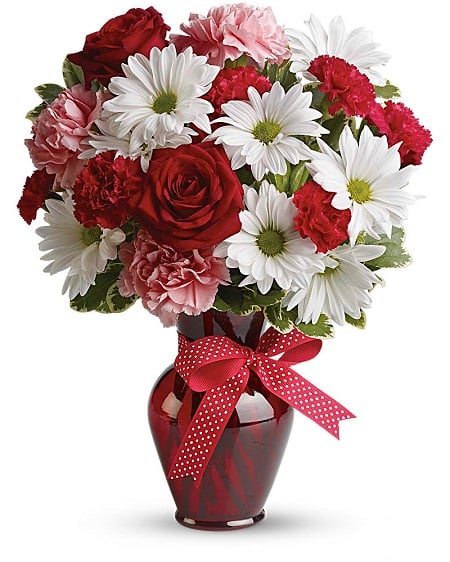
$59.99This is the one built for the Thursday problem. The three red roses carry the romantic message on day one, and underneath them the white daisy chrysanthemums and hot pink carnations run twelve to fourteen days. When the roses finish, and in office air they finish fast, the arrangement does not die. It keeps going on the mums and carnations through the rest of the week. Priced to read as someone tried without tipping into a grand statement.
See Kisses
Thinking Of You
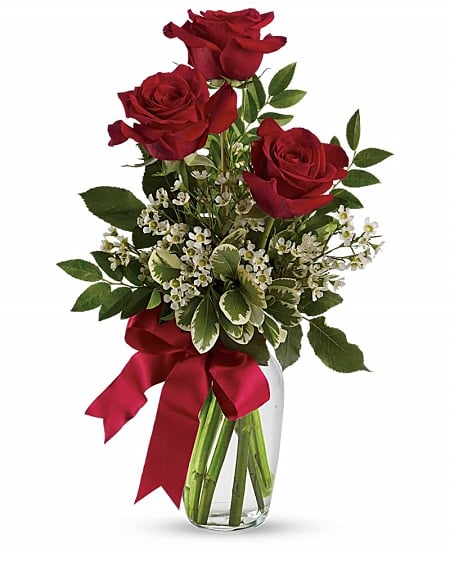
$59.99Plenty of people reading this are not sending a romantic gesture. A colleague's promotion, a friend having a hard week, a mentee's first real win, or someone you have been meaning to check on for longer than you would like to admit. Three red roses in a small vase, sized to sit on a desk, warm without making a romantic claim. It gives you the public moment without the public romance. Red says you matter here, not I love you.
See Thinking Of You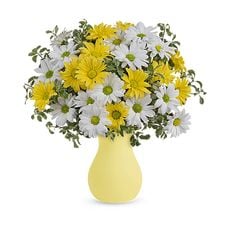
Lemon Sorbet
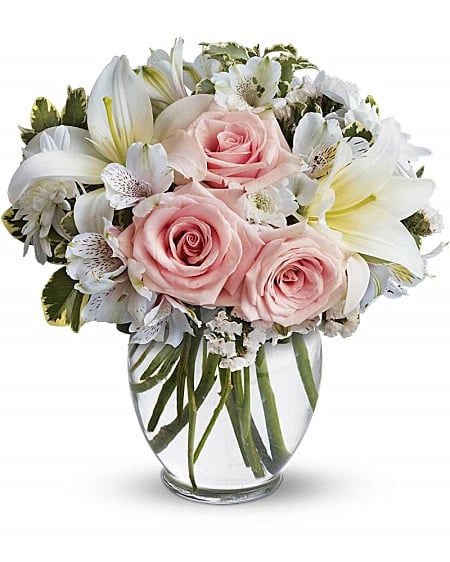
$59.99When the desk belongs to a colleague or a mentee and romance would be the wrong note, this is the one. It is built from the exact stems at the top of the scoreboard, white and yellow daisy chrysanthemums, which makes it the longest-lasting thing on this page and the least likely to bother a shared office. No strong scent, no romantic signal, and it still looks cheerful on Friday. Joan steered a lot of get-well and hospital orders here too, because the nurses cleared daisies on almost every ward she sent to.
See Lemon Sorbet
Designers Choice Romance
$51.99The most striking of the four and the one most likely to catch her eye. Read the fragrance section before you send it to a shared office, though. The garden roses and peonies are sensitive to heat and dry air, and the hyacinth is strongly scented, which is a lot to ask of an open floor by mid-afternoon. Perfect for a private office or a work-from-home desk. Worth a second thought for an open plan.
See Designers Choice RomanceTwo footnotes for the edges. For a no-reason-at-all delivery, the kind that lands hardest precisely because there is no occasion attached, browse just because flowers. And if the desk in question belongs to a friend rather than a partner, flowers for a friend keep the register right without any romantic signal creeping in.
Sending Flowers to Her Work, Answered
Is it weird to send flowers to someone at work?
No, and the office setting is usually the point rather than a problem. A desk delivery gets witnessed, which adds a social lift a home delivery cannot. The one time to send home instead is when the relationship is private, or her workplace is formal enough that a public delivery would put her on the spot. If that describes her, send it to the house.
What flowers last longest in an office?
Chrysanthemums, carnations, and alstroemeria. Office air conditioning drops indoor humidity to around 25 to 30 percent, which is rough on soft blooms, and those three shrug it off for a week or more. Garden roses and untreated lilies are the ones most likely to look tired by midweek. The smart move is a mix: a few roses for the moment, durable stems underneath to carry the week.
Should I send flowers to her work or her home?
Send to work when you want the gesture seen and she will be at her desk that day. Send home when the relationship is private, her office is formal, or her schedule is uncertain. The witness effect is the reason to choose work. Her comfort is the reason to choose home. When you cannot decide, that hesitation is usually pointing you toward home.
What time should flowers arrive at an office?
Mid-morning is the window, late enough that she has settled in, early enough to beat lunch and the afternoon slump. Order before 1PM on a weekday or 10AM on a Saturday for same-day delivery, and confirm she will actually be in the office that day. An arrangement waiting at an empty desk is the one way the whole thing falls flat.
Further Reading
If romance flowers are the thread you want to pull next, these two go a layer deeper, one on building a better romantic bouquet and one on what it takes to get those flowers into the country at all.
When you know what her desk needs, the romance range is built around exactly this kind of send. If red roses are the whole point, start with the roses and work out from there.
Find the right arrangement for her deskLily's Florist delivers across America through a network of 15,000+ partner florists, making every arrangement fresh in or near the town it is going to.
Same-day delivery when you order before 1PM on weekdays or 10AM on Saturdays. Flat $16.95 delivery.
Questions? Call 800-946-5457 and a real person will help you get the timing right.
Sources
- Haviland-Jones, J., Rosario, H. H., Wilson, P., & McGuire, T. R. (2005). "An Environmental Approach to Positive Emotion: Flowers." Evolutionary Psychology, Rutgers University. Facial response measured in the first five seconds of receiving flowers; a genuine smile in every participant.
- Haviland-Jones, J., et al. Rutgers University. Follow-up findings on male and older-adult responses to flowers: increased eye contact, closer proximity, and improved mood in the days after a delivery.
- University of North Florida. Study on measurable stress reduction from living with fresh flowers in the home environment across roughly twelve days, an effect not reproduced with a candle or with no gift.
- Ulrich, R., & Haviland-Jones, J. Texas A&M University. Eight-month workplace study linking the presence of flowers to more creative problem-solving.
- Knight, C., & Haslam, S. A. (2014). University of Exeter, Journal of Experimental Psychology: Applied. Productivity gains from adding plants to sparse office environments.
- Winegard, B., Winegard, B., & Geary, D. C. (2013). University of Missouri. Research on the display ("flaunting") of valued partners and the two-way social status signal it sends.
- Cialdini, R. B. Influence: The Psychology of Persuasion. The reciprocity principle: why a gift is retold and remembered.
- Lily's Florist USA product analysis and Joan's bench and phone guidance (NCCPF Certified Florist, 30 years' experience). Vase-life ranges and office-condition observations.
About the Authors
This guide pairs the psychology of why a workplace delivery lands with a working florist's account of what actually survives the office. Written by Dennis, with floristry guidance reviewed by Joan and an operational note from Andrew. Read our full story.

Dennis and family.